
As AI becomes an integral part of every workflow in the business, having a solid foundation of how it works and how to integrate it into your L&D practices is imperative for thriving in an increasingly digital-first world of learning. This guide will help you understand how to harness the full potential of AI to drive the success of your L&D programs.
The first thing you need to know is that AI isn’t a trend. It has existed since the 1950s; until recently, many AI-driven tools were too advanced for anyone without a data science degree to use. But recent innovations, such as ChatGPT and DALL-E, have brought this technology into the mainstream – though they represent only a fraction of what AI can help organizations with.
Now L&D leaders have unprecedented opportunities to use AI to add efficiency to their work, greatly improve and customize the learning experience of every employee, and execute complex tasks such as setting up skills to job relationships.
How does AI benefit L&D leaders?
AI helps L&D leaders work more efficiently, make data-driven decisions, and generate new content in the form of text, images, video, audio, and computer code.
In practice, this looks like:


How AI Works?
At the heart of AI is an algorithm, which is a sequence of mathematical formulas that instructs the AI model on what to do and the kind of outcome it needs to produce. Even models designed to do the same thing could use different algorithms, depending on the decisions made by their creators. Simply put, without an algorithm, AI can’t make intelligent decisions or perform complex tasks.
There are often very lively debates in data science communities about which algorithm is the best for which kind of purpose and which kind of outcome, but one of the most important things to note about an algorithm is the information it has been taught.

Why a Well-Trained AI Matters?
You may have heard that AI’s results all boil down to how it was trained. This means that the algorithm is being taught to think and learn from experience based on the data it’s fed. It’s not unlike what human learners need to go through to master a skill. And just like with humans, if the training they get is wrong, limited, or contains errors, the results will leave a lot to be desired.
For example, imagine you want to teach a computer to recognize pictures of dogs. You start by showing it thousands of pictures, some with dogs and some without. The computer uses these examples to learn what features, like shapes and patterns, typically appear in dog photos.
Everytime it gets the answer right or wrong, the computer adjusts its understanding until it can produce accurate results most of the time or more.
Some types of AI algorithms can be taught to learn on their own and take in new data to change and refine their process. Others need the intervention of a programmer in order to streamline.
The Challenge of Getting Training Right
In order to work, AI needs to be trained on a huge variety of training data and scenarios. The more data, and the more representative, the better.
Without this variety, the AI will struggle to produce correct results. You might’ve heard stories in the media about an AI failing to recognize the faces of people of color. When algorithms are trained on a very narrow set of data, it not only leads to inaccurate outputs but also biased ones that can cause real harm.
And even when your AI is trained properly, know that it’s never going to be 100% correct. The benchmark for accuracy is 70%, which is still pretty good, but reminds you to always check the AI’s output before committing it as fact.

The 9 Common Types of AI
Even though the average person has only recently started using AI, it’s been part of many business and consumer systems for a long time. Here are the more common forms of AI that you may have encountered without even realizing it:
1. Object Recognition
These algorithms identify and classify objects within images or videos. It’s commonly used in autonomous vehicles, security surveillance, and augmented reality.
A limitation here is that recognition of the environment may override the system’s visual recognition of an object. For example, the AI may be trained to recognize a sheep in a field, but if you show it a picture with a bunch of small sheep in a tree, it’ll categorize those sheep as birds. This is because it has no experience with the idea of sheep and trees, but it does know that birds are associated with trees, and as the most obvious scenario, it wins out.
2. Voice to Text
This algorithm converts spoken language into written text using pattern matching. It’s one you may have used for phone dictation or meeting transcription, and if so, you may have noticed that it doesn’t always take down what it “hears” perfectly. This is because, while the AI may recognize the sound as a word, it can’t actually understand or apply any meaning to this, resulting in transcriptions with wrong words or spelling.
3. Machine Learning
This is a subset of AI in which a model gains abilities after it is trained on, or shown, many example data points. Machine learning algorithms detect patterns and learn how to make predictions and recommendations by processing data and experiences, rather than by receiving explicit programming instructions. These algorithms can also adapt and become more effective in response to new data and experiences.
4. Predictive Analytics
Predictive algorithms consume large amounts of historical data to make predictions about future events. Its outputs can then be used for career pathing, sales forecasting, stock price prediction, customer churn analysis, and more.

5. Prescriptive Analytics
This algorithm suggests—and even executes on—optimal actions to achieve desired outcomes based on data input and predictive models. Prescriptive analytics can consume and interpret information incredibly quickly.
While it isn’t a common feature in an LMS’s reporting and analytics, it’s technology that your business data and analytics team is definitely leveraging. They can apply prescriptive analytics to a learning lens to help you discover more about how to improve your programs and content.
6. Generative AI
Generative models, such as Generative Adversarial Networks (GANs), create new data instances by learning patterns from existing data. While text-generating chatbots, such as ChatGPT, have been receiving outsize attention, generative AI can create a broad range of content, including images, video, audio, and computer code. And it can perform several functions in organizations, including classifying, editing, summarizing, answering questions, and drafting new content.
7. Natural Language Processing (NLP)
This is the umbrella term for an algorithm’s ability to understand, interpret, and generate human language. It can also be used to codify language, such as with sentiment analysis of engagement surveys. The algorithm generates sentiment scores from the text, giving you numbers that can be more easily tracked and measured against.
8. Natural Language Queries (NLQ)
With this algorithm, users can use natural language to interact with a database, rather than running a predefined report, writing a query in code, or creating a report using an interface. However, there are usually still some rules, structure, and mappings that need to be in place in order for the query to work.
For example, you typically have to use the right column labels and avoid spelling mistakes for it to recognize what to do next.
9. Natural Language Input (NLI)
NLI understands instructions in human language and parses the meaning from what’s being asked. This means it can accept a spelling mistake, or accept that the word ‘class’ means the same as the word ‘offering’ or ‘session’. This algorithm truly understands what the user is asking for and then translates that into a query that a report engine, for example, can execute.
Use Cases for AI in Learning Management
There are a number of ways to enhance learning and development functions with AI, particularly by using an AI-enabled learning management system. Here are features to look for:
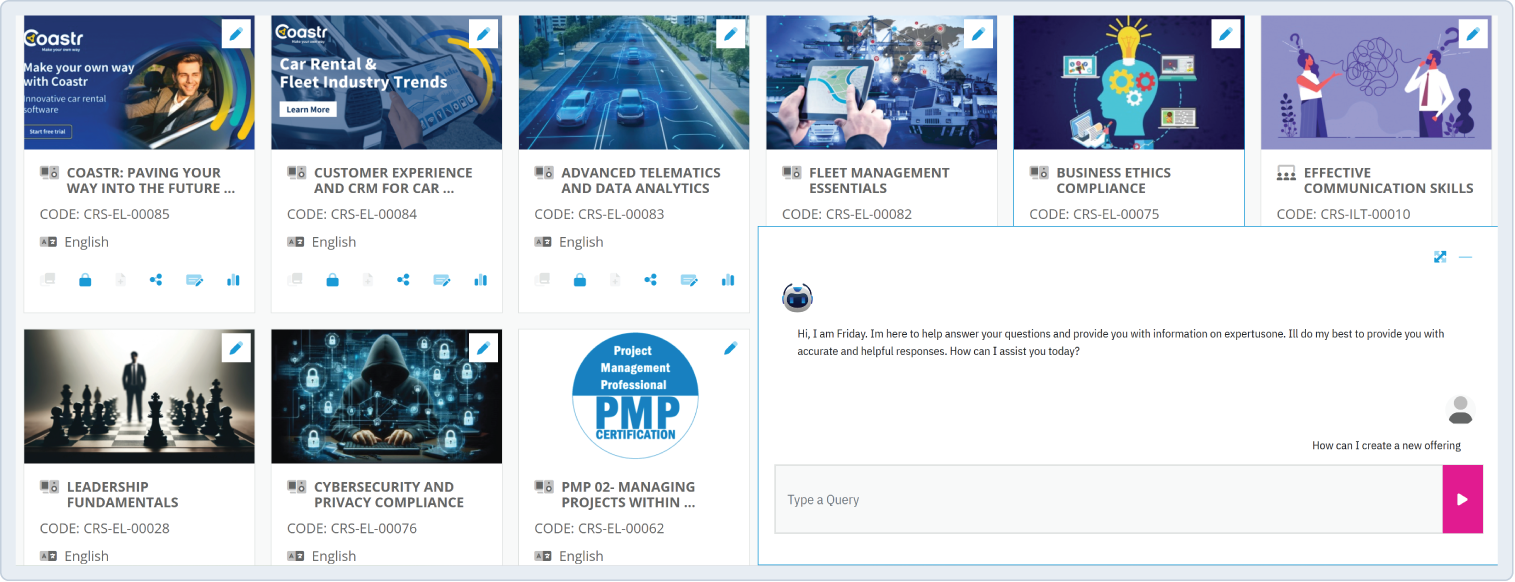
Chatbots
Chatbots use AI to simulate conversations with human end users. There are two types:
Simple: To answer queries, this chatbot automatically maps keywords in prompts to tags on canned answers provided by the programmer. It can be easily stumped by anything without a pre-programmed answer, but this means it will also never make up an answer.
NLP and generative AI-powered: These chatbots can handle all kinds of prompts, and they will generate an answer based on the data that it has been trained on. Because it uses NLP, these chatbots can feel a lot more like you’re talking to a real person. With this technology, there are risks that it wasn’t trained with enough representative data or that it may hallucinate—the term for when AI generates inaccurate information and presents it as fact—a response. Always do a quality control check on your chatbot before releasing it into the wild.
Use Case: Chatbots give learners a self-serve way to answer common queries and free up the L&D team to do more strategic work.
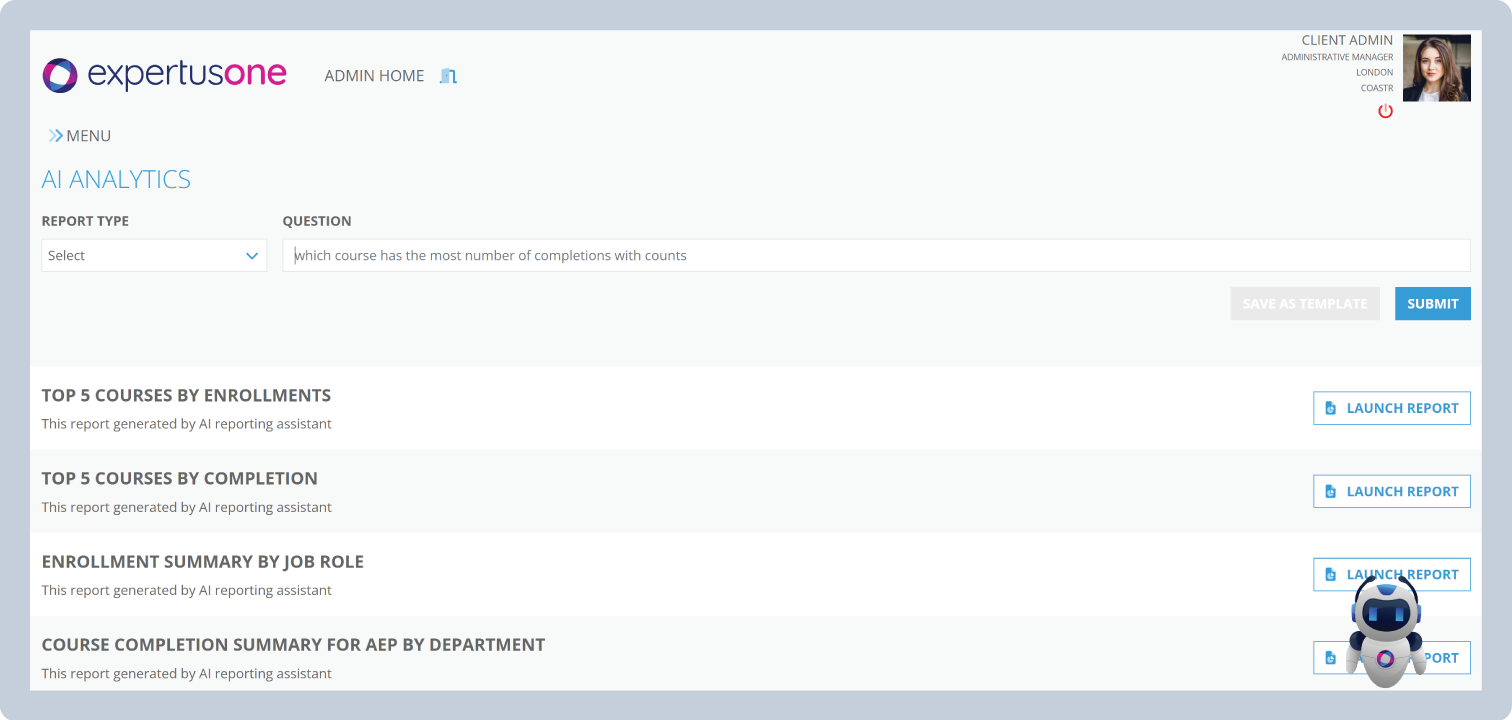
Reporting
NLQ or NLI can be leveraged to create new reports using natural language prompts—no coding required. Just like with chatbots, there are two different ways this can work.
One is with a NLQ request, where the system doesn’t completely understand the query, but is more doing keyword matching to find the right report to pull forward. While this type of algorithm requires the right words or columns to be used, it’s still an easier way to create a report than manually pulling information together.
The other form uses NLI to understand a query, whether or not the right words or columns are used. It does this by mapping synonyms together to parse meaning from what’s been asked and then generates a report according to that understanding.
Use Case: AI gives L&D teams a more efficient way to generate accurate and trustworthy reports.
Analytics
By using machine learning for pattern recognition, L&D leaders can identify learning’s impact on business outcomes. It can be used to analyze data and get answers like, does learning participation play a role in employee retention, or how does learning play a role in high-potential employee engagement. Your data team could also help with predictive analytics that can tell you what the impact of onboarding and other training will be on company goals.
Use Case: Being able to measure learning’s impact and see that alongside other elements can give you a sense of how you’re doing, how to course correct, and how to get more leadership buy-in for future investments.
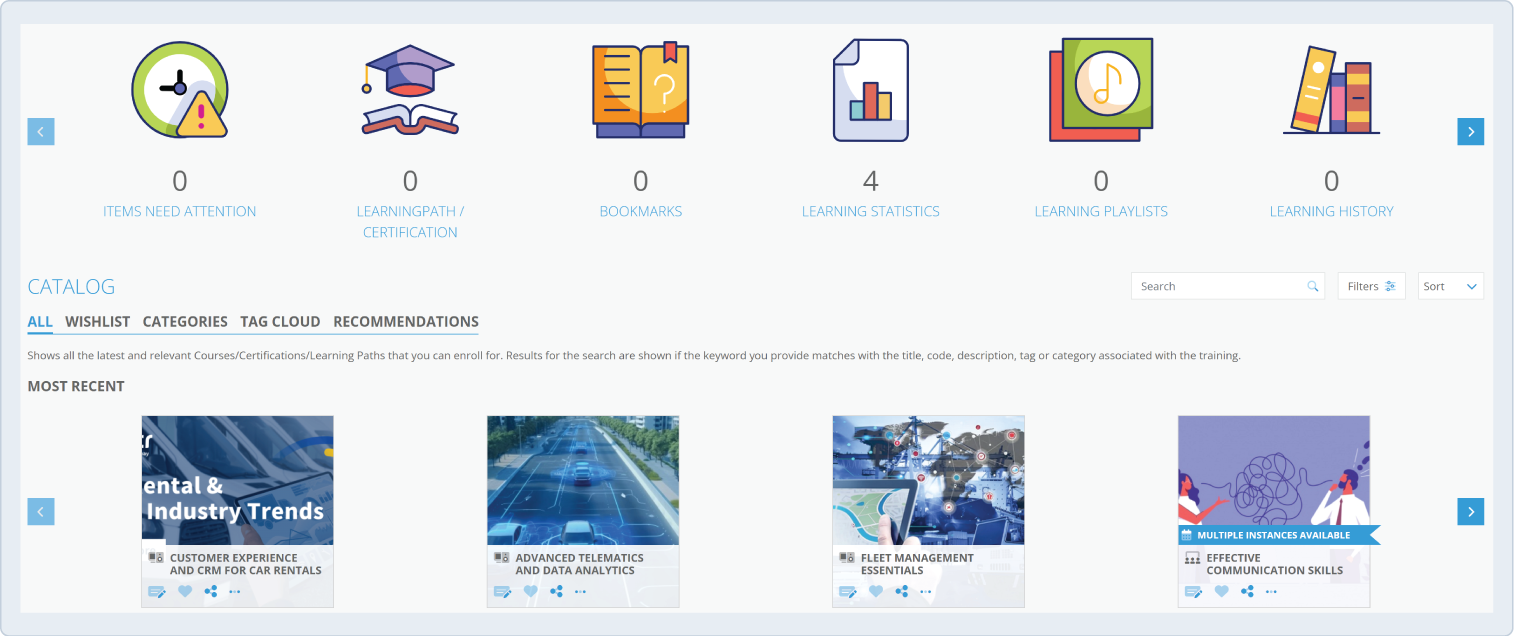
Recommendations
Recommendations are a great place for AI, which makes learning more discoverable, personalized, and engaging for learners. The algorithm creates a profile for each learner based on a holistic combination of markers—jobs, locations, skills, peers—to tailor content exactly to their needs.
Use Case: Makes L&D content more relevant for learners and facilitates discovery.
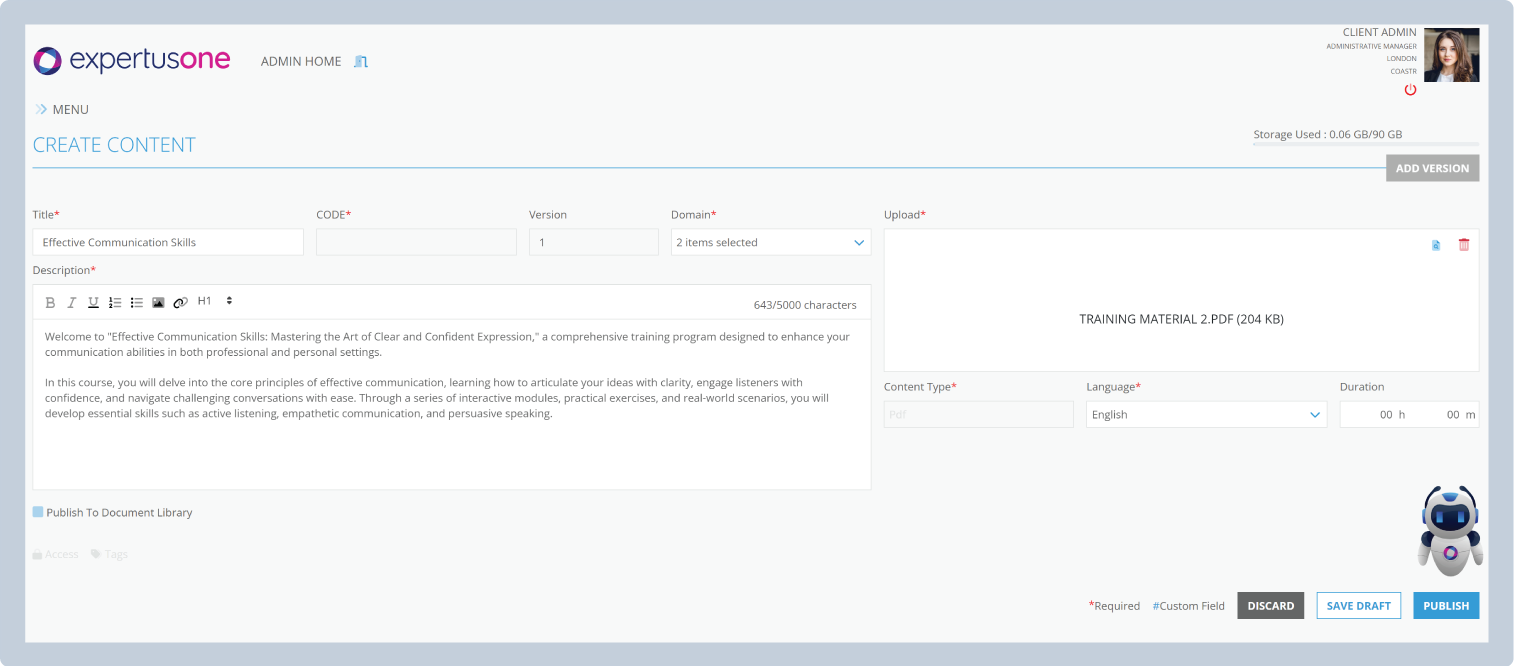
Content Creation
Generative AI can either create new content or repurpose your existing materials into new formats. For example, you can get generative AI to turn a technical document into a job aid, process guides into slide decks, or webinars into text, video, and audio formats.
The ability to create a variety of formats quickly can scale your offerings dramatically and allow you to support the multiple ways people consume information. However, generative AI isn’t an expert in your processes or adult education principles, and, depending on the tools you use, it may have limited access to outside information to inform content creation.
As always with anything AI-generated, it’s critical to review what it creates to make sure nothing is made up, copyrighted, or biased.
Use Case: Scale up content creation and deliver the same content in multiple formats to reach learners with their preferred delivery method.
How to Invest Wisely in AI
Now that we’ve gone through what’s essential to know about AI as an L&D leader, you may be ready to take the next step and buy some AI-powered tools. Before you do, let’s look at the costs associated with this technology and the questions you need to ask both your team and potential vendors.
The Cost of AI
Whether you’re creating your own algorithms or investing in an AI-enabled LMS, knowing what costs are tied to AI will help you understand what you’re buying in addition to technology features. When taken together, the costs below provide a better sense of why AI is priced a certain way:
1. Data Costs
AI needs a substantial amount of data to get and stay accurate, but data isn’t always as easy to come by as you might think. Data needs to be “cleansed” of inaccuracies, like duplicate information, and prepared to be ingested by different systems. To achieve this, you’ll need a data team in-house who can work with you and your various learning vendors. And if the AI will be trained only on your organizational data—which cuts down on hallucinations and data irrelevant to your business—you’ll need the means to keep that data safe and the technical skillset to continuously train your AI.
2. Technical Infrastructure Costs
Because AI consumes and processes so much data, there’s a big need for data centers and powerful graphics processing units to facilitate all that.
3. Energy Consumption
All this technical infrastructure requires a ton of energy in order to enable the AI to process information and generate a response. When scaled up to millions of daily queries, the cumulative energy consumption becomes significant.
4. Ethical Considerations
In order to avoid creating a biased AI, companies need to invest in the right training data from the beginning. It’s also important to bring in the resources to fact-check the algorithm’s output, ensuring it’s not only bias-free but also free of any copyright infringement.
Questions to Ask Your Team
While AI brings many benefits to L&D teams, taking a moment to talk through why you need this technology will help narrow down the kind of AI—and vendor—you require. These are the questions to ask:
-
Where would AI help our users?
-
Could AI be used to make it easier for users to navigate our current LMS system?
-
Would AI personalized recommendations be helpful?
-
Where would AI help our admins?
-
Do we need help creating reports?
-
Do we want help generating content?
-
What policies does our organization have around AI and data privacy?
-
Is the value of AI offset by the cost?
Once you’ve started this conversation with your team, bring the discussion to IT and talk to them about any security concerns they have around AI and your Wishlist. For example, some organizations only allow teams to use proprietary AI tools because they don’t want any data to leave the company walls.
Questions to Ask Your LMS Vendor
Learning management systems are table stakes in every organization, but how each vendor leverages AI can be the key differentiator. Whether you’re in the market for a new LMS or want to evaluate your current vendor’s AI capabilities, here’s what to ask them and why:
“Where are you using AI and what kind?”
Because there are at least nine different kinds of AI, it’s important to know which models they’re using and how they will help you accomplish the goals you and your team have discussed.
“Which AI partners are you working with?”
It’s likely that most LMS vendors have partnered with another organization to source their AI algorithm, which is totally fine. Not many vendors have developed these in-house, and it works in your favor to have a company with expertise in AI ensuring the technology does what it should.
“Does our data stay within your infrastructure?”
If your vendor is working with partners, you’ll want to really quiz them on who has access to your organization’s data. For example, if you’re using a generative AI feature to build a new course based on a process document, does that process document get uploaded and pushed offsite to be turned into new content or does it stay within your LMS vendor’s technical infrastructure?
“What is your long-term AI strategy?”
AI is constantly evolving, and you need to work with an organization that has thoughtfully built its solution to be able to absorb and adopt AI as it changes.
Conclusion
But more than that, you are the ones who make learning matter. Technology helps streamline certain workflows, but it cannot motivate managers to get their teams trained or create the source material that becomes compelling learning programs. You understand when it’s important to engage with learners. You understand the best places to inject gamification, what topics are relevant to the culture of your organization, and have the years of experience to know how to highlight that.
AI is the way to help you do more of this creative and strategic work, and now, hopefully, you feel a little more ready to add it to your practice.