
BLOG
AI in Learning and Development: What’s Actually Working for Enterprise L&D Teams
Author: Ferik Ferizaj
BLOG
AI in Learning and Development: What’s Actually Working for Enterprise L&D Teams
Author: Ferik Ferizaj
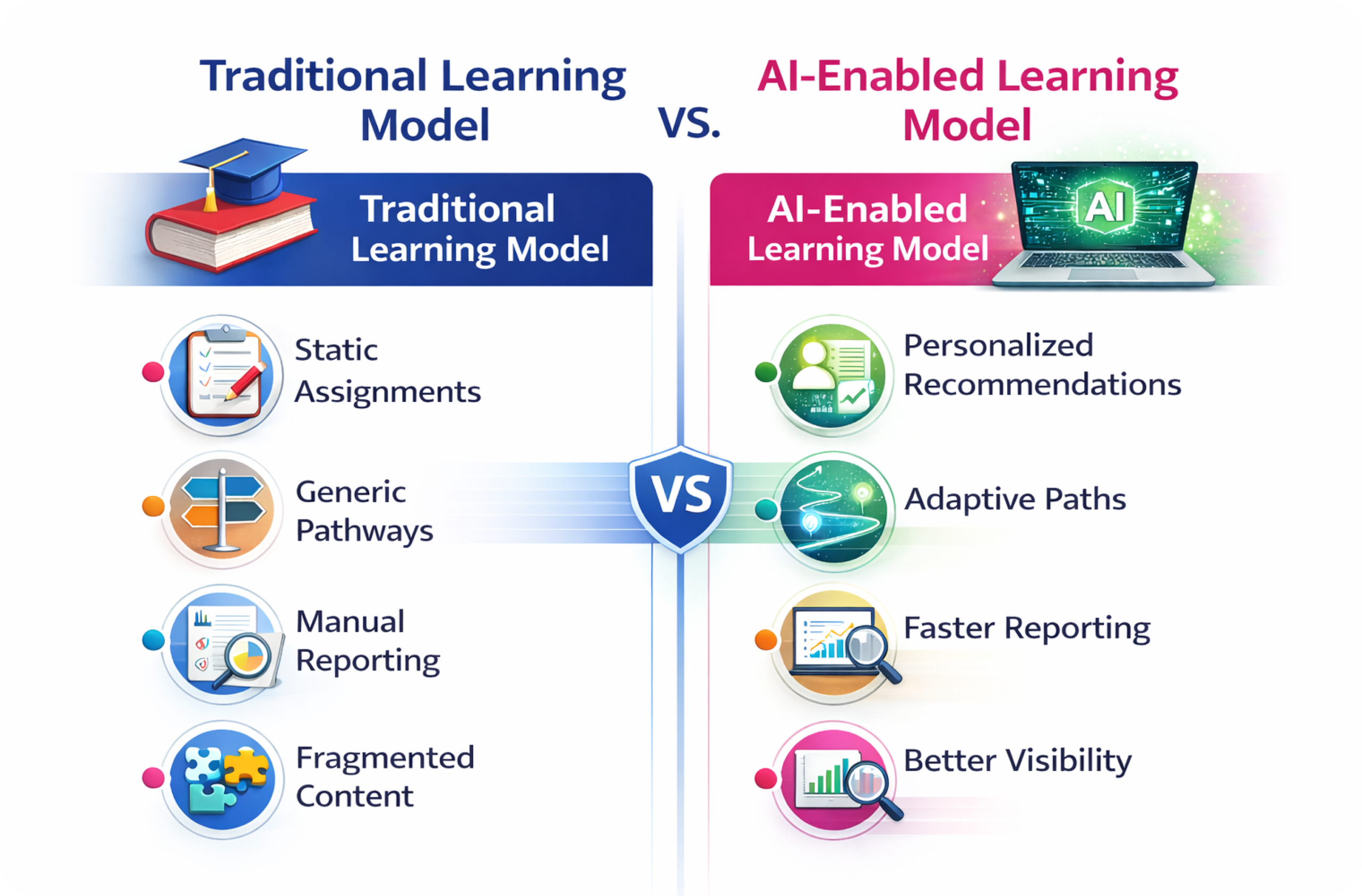
Artificial intelligence is helping enterprise organizations make training more effective and easier to manage. It can improve training delivery, personalize learning, reduce administrative work, and give teams better visibility into learning performance. This guide explains how AI supports content discovery, adaptive learning, content creation, reporting, and skills-based development. It also shows why these capabilities matter in large, complex learning environments.
Key Terms:
- AI in Learning and Development
- AI-Powered Learning
- Personalized Learning
- Adaptive Learning
- Generative AI in Training
- Skills-Based Learning
- Learning Analytics
- Enterprise Learning Platform
Why Does AI Matter in Enterprise Learning?
Learning and development teams are being asked to do more than manage catalogs and track completions. In many organizations, they are expected to help people adapt to changing job requirements, support faster onboarding, strengthen customer and partner education, enable internal mobility, and contribute more directly to workforce capability building.
That expectation is growing at the same time that skills are changing more quickly. The World Economic Forum’s research found that employers expect 44% of workers’ core skills to change within five years and that six in ten workers will require training before 2027. Yet only half of workers are seen as having access to adequate training opportunities. For large organizations, that creates a familiar tension. The need for workforce development is increasing, but traditional learning models often remain too rigid to keep pace.
This helps explain why AI has become more relevant in enterprise learning. It offers a way to make learning systems more responsive without turning every update into another manual process. In practical terms, that can mean helping learners find more relevant content, supporting more tailored learning paths, reducing repetitive work for administrators, and improving visibility into patterns that would otherwise be difficult to see.
LinkedIn’s Workplace Learning Report reflects the broader shift in expectations. It describes L&D as being at the center of organizational agility in the AI era, which is a useful way to think about the role enterprise learning now plays. Learning teams are no longer judged only on completions and content availability. They are increasingly expected to help the organization adapt faster, build critical capabilities, and support change more directly.
For enterprise organizations, the appeal of AI is not simply that it is new. It is that it can help simplify complexity. In a large learning environment, even modest improvements in discovery, personalization, reporting, and administrative efficiency can make a noticeable difference to both the learner experience and the operating model behind it. That is also why AI tends to be most useful when it is part of a broader platform strategy rather than a disconnected point solution. When learning management, learner discovery, skills development, reporting, and extended enterprise delivery work together, AI has a much stronger foundation to build on.
What Does AI in Learning and Development Include?
One reason the AI conversation often feels vague is that the term is used to describe several different technologies at once. In practice, AI in learning and development is not one feature. It is a group of capabilities that solves different kinds of problems.
Some AI tools focus on recommendations and pattern recognition. These are the systems that help a platform suggest relevant content, identify likely next steps, or surface patterns in learner behavior. Others focus on predictive analytics, using historical data to forecast future outcomes or highlight emerging trends. Natural language processing supports language-based interactions, such as chat interfaces or tools that interpret written prompts. Generative AI adds another layer by helping create, summarize, classify, edit, and transform content into new formats.
That distinction matters because different forms of AI create value in different ways. A chatbot that answers common learner questions addresses one need. A recommendation engine that makes a large content library easier to navigate addresses another issue. A natural-language reporting tool that helps administrators generate reports without building them manually serves a different purpose again. Generative AI, meanwhile, is especially relevant where learning teams need to draft, repurpose, or localize content more efficiently.
For most enterprise learning teams, the strongest use cases are the ones that improve everyday work. They tend to center on a few practical areas:
- Making learning easier to discover
- Improving the relevance of what learners see
- Simplifying reporting and analytics
- Reducing repetitive support or administrative work
- Speeding up content creation and transformation
- Helping leaders see patterns in learning and skills data
IDC’s guidance on AI and enterprise skills supports that practical framing. It argues that organizations should use AI and generative AI to improve and speed training, and it points specifically to more personalized upskilling and reskilling tied to roles, skills, and learning styles. That is useful because it keeps the conversation grounded in workforce development rather than novelty.
Seen that way, AI becomes easier to evaluate. The question is not whether a learning platform “has AI.” The more useful question is where AI improves the actual work of learning teams and the experience of learners. In most cases, the strongest answers are familiar ones: better discovery, better personalization, more efficient reporting, faster content work, stronger skills alignment, and clearer analytics.
The Benefits of AI-powered Learning
Much of the interest in AI comes down to a simple question: what actually gets better?
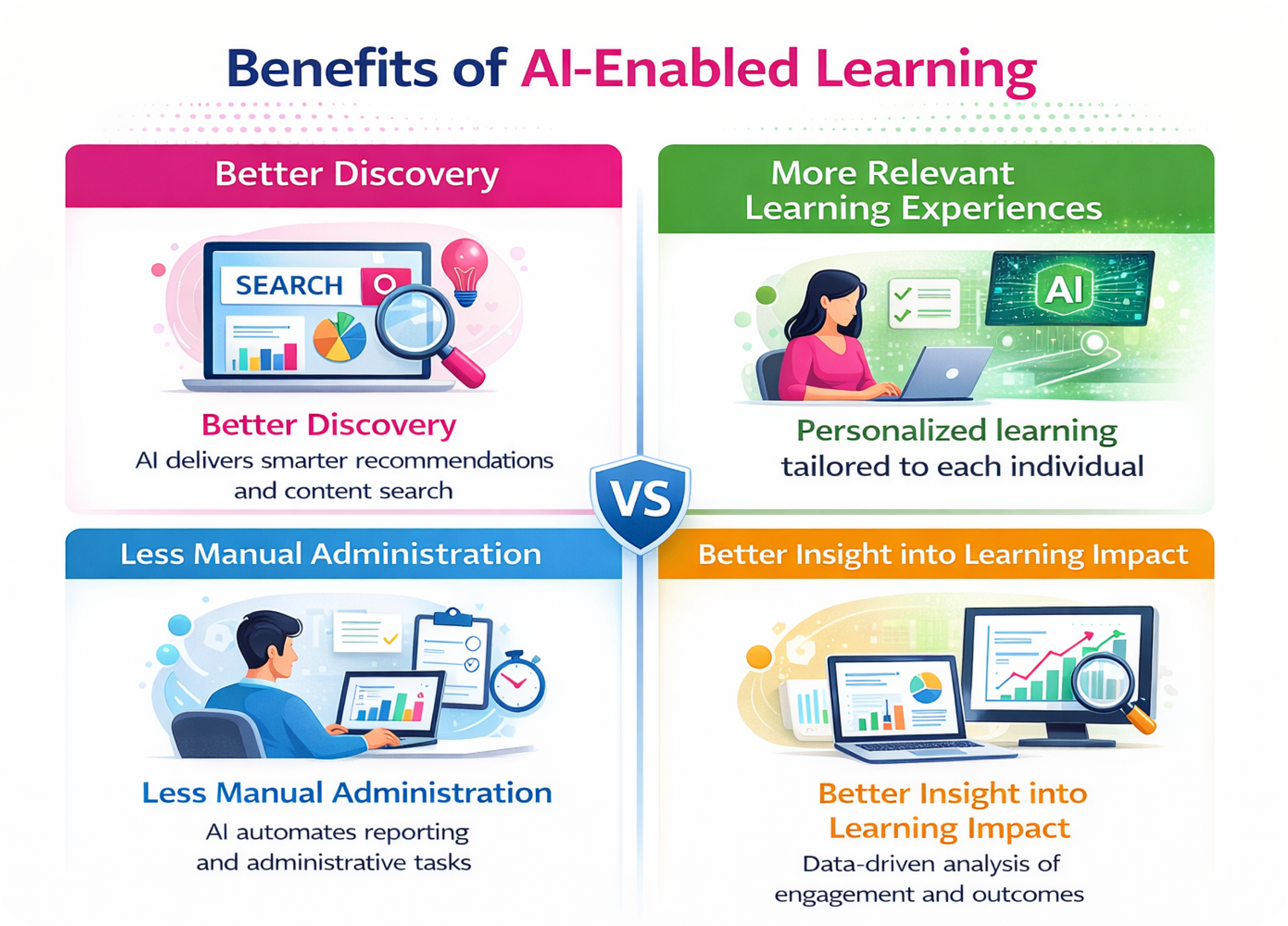
In enterprise learning, the answer usually falls into four broad areas. AI can improve how people find learning, how relevant learning feels, how efficiently the learning function operates, and how clearly leaders can understand impact.
Better Discovery in Large Learning Environments
Large organizations rarely struggle because they have too little learning content. More often, they struggle because they have too much content spread across too many systems. Employees may have access to internal courses, external libraries, videos, webinars, job aids, product content, certifications, and policy materials, yet still find it difficult to identify what is most relevant. Even motivated learners can spend too much time searching or default to whatever is easiest to find rather than what would actually be most useful.
AI helps reduce that friction by surfacing content based on a richer picture of the learner. Role, location, prior completions, peer behavior, declared interests, and current skills can all help shape more relevant recommendations. In a large learning environment, that can make the difference between a catalog that feels overwhelming and one that feels usable.
This is one reason AI-driven learner discovery has become such a practical use case. It does not require an organization to rebuild its learning strategy from scratch. It improves the experience by helping learners get to the right content more efficiently, which in turn supports stronger engagement and adoption. In practice, discovery works best when it is connected to learning paths, skills, reporting, and the broader learning ecosystem, rather than treated as a separate layer on top.
Platforms such as ExpertusONE support this kind of discovery through personalized learner dashboards and a more intuitive learning experience, which helps large content environments feel easier to navigate.
More Relevant Learning Experiences
One of the clearest benefits of AI in learning is that it makes personalization more practical.
AI helps move beyond that model by supporting recommendations and pathways shaped by more specific signals, including:
- Job role
- Prior completions
- Current skill needs
- Career goals
- Assessment results
- Learner behavior over time
This matters because relevance affects both engagement and efficiency. When learners spend less time navigating generic pathways and more time with content that connects to their work, the experience becomes more useful, and the training investment becomes more productive.
IDC’s recent guidance on AI and enterprise skills makes that case directly. It recommends personalized learning paths tailored to job roles, career goals, and skill levels, and argues that AI-enabled training tools can personalize courses to employees’ roles, skills, and learning styles in ways that support faster and better skilling outcomes.
For enterprise organizations, that kind of personalization is most useful when it operates inside a structured system rather than as a loose recommendation layer. Personalized learning paths, skills-aware recommendations, and audience-specific delivery all help make AI more useful because they give it better context. This is also where a platform like ExpertusONE starts to make sense in the story. The value is not just that AI can recommend something. The value is that those recommendations sit inside a broader learning environment designed for complexity.
Less Manual Administration
Another major benefit of AI-powered learning is operational efficiency. Enterprise learning teams spend a great deal of time on work that is necessary but repetitive. That may include answering common learner questions, managing assignments, generating standard reports, monitoring participation, or helping people find the right resource. AI can streamline parts of that work and make the overall learning operation easier to manage.
Chat-based support can give learners a self-service way to resolve common issues. Natural-language search and reporting can make reporting easier and more accessible. Recommendation logic can reduce some of the manual effort involved in steering people toward the right learning. Pattern detection can make it easier to see where learners are dropping off or where a particular audience may need more support.
None of that removes the need for strong administration. What it can do is reduce the amount of time the learning team spends on routine activity, creating more room for program design, stakeholder alignment, and workforce planning. In a large organization, even small gains in efficiency can have a meaningful cumulative effect. That is one reason enterprise buyers often care as much about AI’s operational value as they do about the learner experience itself.
Better Insight into Learning Impact
AI can also help organizations understand learning more clearly. As learning becomes more closely tied to workforce development, leaders need better answers to practical questions. Which programs are driving engagement? Where are learners dropping off? Which audiences may need additional support? Are particular pathways associated with stronger retention, readiness, or skill development?
Machine learning and predictive analytics can help identify patterns in learning and business data that would be difficult to spot through manual reporting alone. That does not mean every organization needs complex predictive models across its entire learning environment. It does mean AI can make reporting more useful and analysis more actionable.
McKinsey’s work on upskilling and reskilling for the generative AI era reinforces the need for more systematic, scaled approaches to workforce development. Once organizations start thinking about learning as part of a broader capability strategy, visibility becomes more important. Better data helps teams make better decisions, spot weak points earlier, and show how learning is contributing to business priorities.
This matters most at the enterprise level, where learning leaders are often expected to show not just activity, but impact. Better visibility supports better decisions, faster course correction, and stronger alignment between learning strategy and business priorities. That is also why analytics and reporting features tend to matter so much in enterprise learning platforms. They are not just administrative tools. They shape how learning is understood across the organization.
AI for L&D Leaders
For learning leaders, AI is not just another feature category to evaluate. It is part of a broader shift in how learning teams operate and how they support the business. The value is not simply that AI can automate tasks. It is that it can help L&D make learning more responsive, reduce operational friction, and make better-informed decisions about where to invest time and budget.
What matters most is where AI improves the work learning teams are already trying to do: supporting learners more effectively, simplifying reporting, improving discovery, creating and adapting content more efficiently, and linking learning activity more closely to workforce needs.
Supporting learners without adding support burden
One of the clearest uses of AI in learning is learner support. Chatbots and virtual assistants can help answer common questions, guide learners to relevant resources, and reduce the volume of routine requests that would otherwise land with administrators or program managers.
That can be especially useful in large organizations where learners need quick answers about enrollments, deadlines, course access, or what to take next. In that context, conversational support is not just a convenience feature. It can make the platform easier to use while reducing repetitive support work for the learning team.
The quality of that experience still matters. Simple chat tools may only recognize keywords and route learners to pre-written responses, while more advanced tools can interpret natural language and respond more flexibly. That added flexibility can be valuable, but it also increases the need for review and governance, particularly when the system is being used to guide learners through important decisions.
Making reporting more accessible
Reporting is another area where AI can make a meaningful difference for L&D teams. Many organizations still rely on reporting processes that are time-consuming, rigid, or too dependent on technical support. Natural language queries and related tools can make reporting easier by allowing administrators to ask for information in plain language rather than building every report manually. That can lower the reporting burden and make it easier for learning teams to answer new questions quickly.
For L&D leaders, this matters because reporting is not just a compliance exercise. It is how they monitor adoption, track completion, identify lagging audiences, and show progress to stakeholders. When reporting becomes easier to access and easier to interpret, the team can spend less time assembling data and more time acting on it.
This is also where enterprise platforms can add practical value. ExpertusONE’s reporting and analytics capabilities, including the Insights dashboard, fit naturally into this part of the story because they help learning teams move from raw activity data to more useful operational visibility.
Using analytics to support better decisions
Beyond reporting, AI can strengthen the strategic role of L&D by helping leaders see patterns that are harder to spot through manual analysis alone.
That may include identifying which learning paths are driving engagement, where drop-off points are appearing, which audiences are not progressing as expected, or where skill gaps are becoming more visible. In more mature environments, it can also help leaders explore how learning relates to broader outcomes such as retention, readiness, or internal mobility.
This kind of visibility matters because L&D leaders are increasingly expected to do more than report activity. They need to explain how learning supports workforce capability and business priorities. Better analytics does not solve that challenge on its own, but it gives leaders a stronger foundation for making decisions, prioritizing investment, and showing the value of learning more clearly.
Improving discovery and relevance
Recommendation tools can use signals such as role, location, prior learning activity, skills, and peer behavior to surface more relevant content. That makes discovery easier for learners, but it also helps learning teams get more value from the content they already have. In large learning environments, better discovery can improve engagement without requiring the team to build entirely new programs from scratch.
For L&D leaders, that makes recommendations more than a learner experience enhancement. They become part of a broader strategy for improving relevance, increasing adoption, and reducing the friction that comes with large content ecosystems.
Scaling content creation and adaptation
Generative AI has also changed what learning teams can realistically produce, especially when resources are limited and demand is growing.
A single source asset can now be adapted into multiple formats more quickly. Long documents can be summarized into job aids. Process guidance can be turned into slides or short reinforcement content. Existing materials can be repurposed for different audiences or delivery contexts. For learning teams supporting multiple regions, languages, or roles, this can make content operations much more scalable.
At the same time, the caution here is important. Generative AI can accelerate production, but it does not replace instructional judgment, subject-matter expertise, or governance. It can miss context, introduce inaccuracies, or produce content that sounds polished without being especially useful. In regulated or high-stakes environments, review remains essential.
Investing in AI with the right expectations
For L&D leaders, the right question is rarely whether AI sounds promising. It is whether the investment will improve the work of the learning function in ways that are practical, measurable, and sustainable.
That means looking beyond the feature list. Real AI costs may include data preparation, technical infrastructure, governance, maintenance, and change management. It also means being selective about where AI is introduced first. In many cases, the best starting points are the areas where friction is already visible, such as learner support, discovery, reporting, or content operations.
The strongest AI strategy is usually the one that improves learning operations without creating unnecessary complexity. In that sense, AI is most useful when it supports the existing goals of the learning team: making learning easier to use, easier to manage, and more clearly tied to workforce development.
Why do AI and Personalization Work Better Together?
AI and personalization belong together because personalization is one of the clearest ways learners experience AI.
In enterprise learning, people increasingly expect the platform to help them find what matters instead of leaving them to work through a generic catalog. Organizations, meanwhile, need learning that reflects role, skill needs, business context, and career direction rather than simply presenting the same content to everyone. AI makes that kind of personalization more practical at scale by helping tailor learning paths, recommendations, and development experiences to the individual.
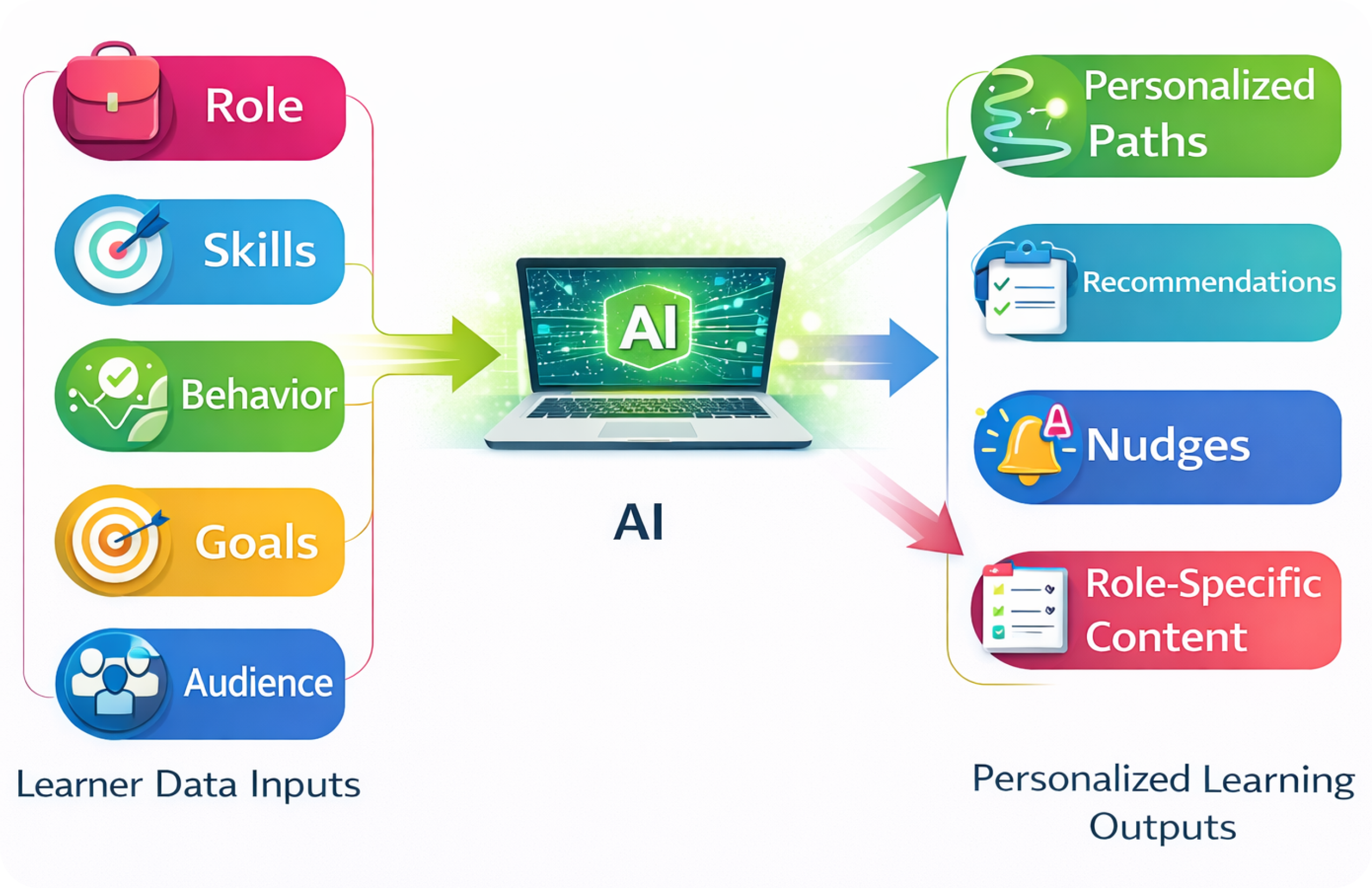
That matters for several reasons. Learning becomes more relevant when it clearly connects to the work someone does or the role they want to grow into. It becomes more efficient when employees can focus on the development that is most useful now rather than spending time on broad pathways that only partly apply to them. And it becomes easier to connect learning with workforce development when training is aligned to real roles and skill needs.
In practice, this kind of personalization depends on more than a recommendation engine alone. It works best when it is supported by structured learning paths, skills data, audience segmentation, and reporting that helps teams understand what is working. That is where a platform such as ExpertusONE becomes especially useful. Features such as personalized learning paths, AI-driven content recommendations, skills tracking, extended enterprise audience management, and learning analytics dashboards all help make personalized learning more practical at scale.
The Business Case for AI-driven Personalization
Personalization is often described as a learner experience benefit, but its value is broader than that. In enterprise learning, personalization can also improve how organizations build skills, support retention, and respond to changing business needs.
Learning experience platforms have helped push this shift by using AI to make training, skilling, and development more responsive to the individual. That can include tailoring content to role and skill level, delivering learning in the most appropriate format, and using timely nudges or reminders to keep progress moving. The result is not simply a more polished learner experience. It is a more targeted approach to development that helps employees focus on what matters most for their work and growth.
The business implications of that approach can be significant. Organizations using learning experience platforms have been associated with stronger results across several workforce and performance measures.
According to an IDC report, organizations using learning experience management vendors were more likely to report stronger workforce and business outcomes, including:
- 99% higher likelihood of improving revenue through better skills alignment, development, and deployment
- 76% higher likelihood of extending average employee tenure through visible investment in skills growth
- 67% higher likelihood of lowering voluntary and involuntary employee attrition
- 54% higher likelihood of improving employee and workforce performance
- 50% greater likelihood of aligning and redeploying headcount around changing business needs without derailing employee career paths
These kinds of outcomes reinforce an important point. AI-driven personalization is not only about making learning feel more relevant to the individual learner, although it does that as well. It can also help organizations align development more closely with workforce needs, improve retention, and respond more effectively when priorities shift.
What are Useful Personalization Strategies in Enterprise Learning?
While personalization is easy to support in theory, it becomes more challenging to implement well in a large organization. In practice, the most effective enterprise personalization strategies usually combine several simple inputs rather than trying to generate a completely unique path for every learner from the beginning.
Start with Roles
Role-based pathways are often the most effective way to make learning immediately relevant. A field technician does not need the same development path as a first-line manager, and a new sales rep does not need the same starting point as a product specialist. Designing around roles gives learners a credible sense that the platform understands their context, while also giving learning leaders a straightforward way to organize content around business needs.
Add Skills
Skills-based logic adds another layer of flexibility to personalization. When learning is tied to skills, the platform can recommend development based on gaps, aspirations, assessments, or changing business priorities. This becomes even more valuable as organizations move toward skills-based workforce strategies. McKinsey’s guidance on upskilling and reskilling for the generative AI era reinforces the need for scaled approaches to capability building, which is exactly where skills-informed personalization becomes useful.
Use Behavior Signals
Behavioral data also plays an important role in making personalization more useful over time. Search history, completions, ratings, repeated visits, and peer patterns can all help refine recommendations as the learner interacts with the platform. This is what makes AI-driven discovery more useful than a static catalog. The system can learn from what learners actually do, not only from what they are assigned.
Account for Audience Complexity
Enterprise learning rarely serves employees alone, which is why personalization has to account for audience complexity from the start. Partners, customers, franchisees, dealers, and contractors may all need different journeys, permissions, content sets, and reporting rules. Personalization should reflect that reality rather than assuming one audience model. In practice, enterprise learning has to personalize across populations, not only within a single employee audience.
Respect Timing and Context
Timing and business context are just as important as the learner profile. What a new hire needs in the first month is different from what an experienced employee needs while preparing for a leadership move. What a team needs before a product launch is different from what it needs after. Effective personalization strategies take account of stage, timing, and immediate business context, not just static learner attributes.
Taken together, these strategies make personalization feel more practical. They show that enterprise personalization is not about chasing novelty. It is about making learning more relevant and more usable in a way that scales.
Adaptive Learning: A More Dynamic Approach
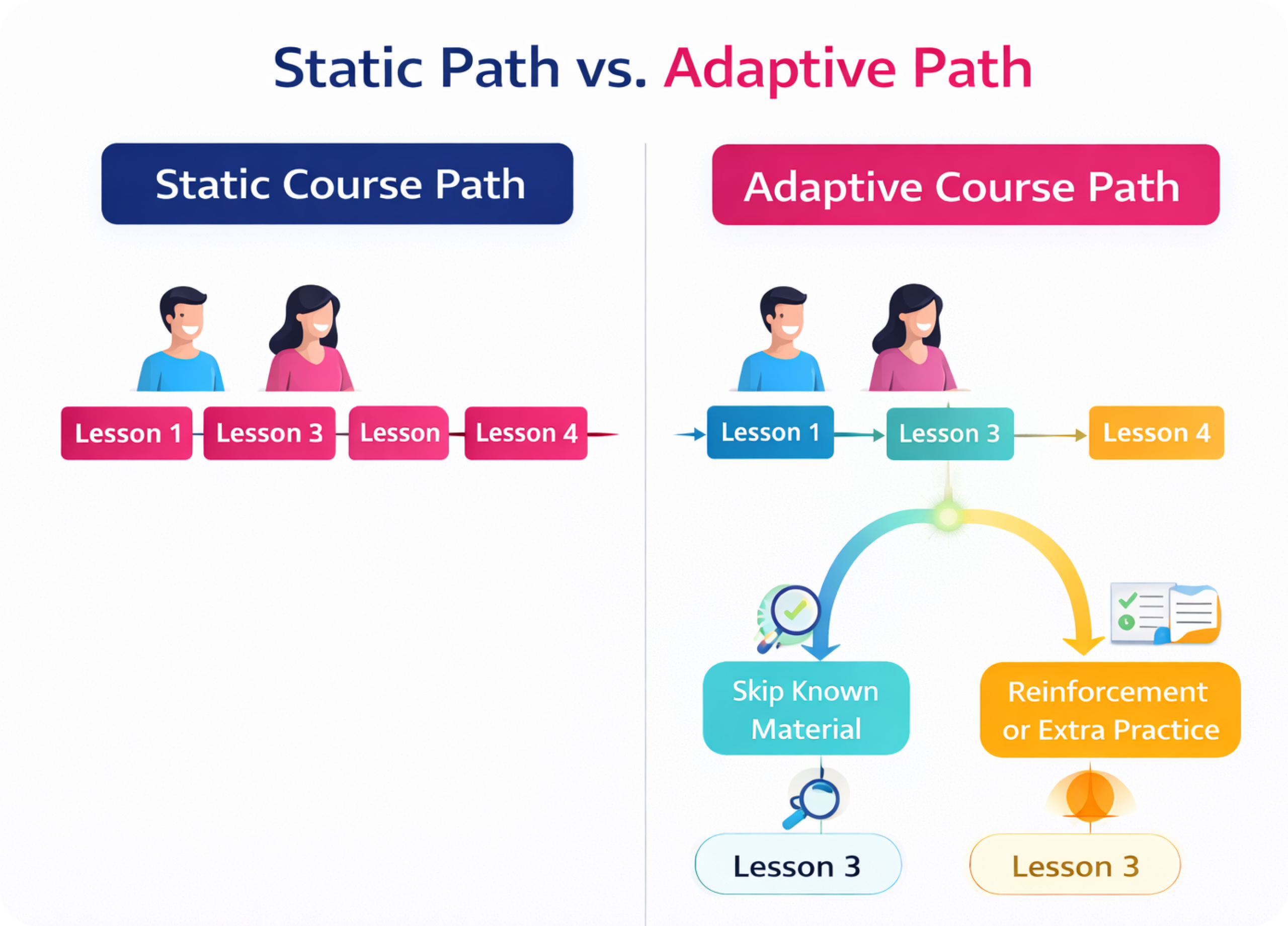
Adaptive learning is often discussed alongside personalization, but it solves a slightly different problem. Personalization usually determines which content or path is most relevant to a learner. Adaptive learning changes the path itself based on demonstrated performance. That means a learner who already understands a concept may move faster, skip unnecessary material, or receive a different next step. A learner who is struggling may get additional practice, reinforcement, or alternate explanations.
This is useful because static training is often inefficient. Experienced learners sit through content they already know. Less prepared learners move forward without enough support. Adaptive learning helps reduce both problems by focusing effort where it is actually needed. Research reviews of personalized adaptive learning have found positive effects on engagement, learning, and performance, which helps explain why adaptive models continue to gain attention in learning design.
It is especially valuable in technical training, certification pathways, product readiness, and other contexts where mastery matters more than simple completion. In those environments, the ability to adjust sequence or difficulty can improve both efficiency and retention.
Generative AI Applications in Employee Training
Generative AI has become one of the fastest-moving parts of the learning discussion, but the most useful applications are usually straightforward.
It can help training teams draft outlines, summarize source material, create first-pass quizzes, repurpose content into new formats, and support translation or localization. That makes it valuable not because it replaces instructional design, but because it accelerates work that can otherwise slow teams down.
Some of the strongest enterprise use cases include:
- Turning technical documents into job aids
- Converting process guides into slide decks
- Repurposing webinars into text, audio, or video formats
- Creating alternate content formats for different learning preferences
- Speeding up localization for global audiences
Content operations are a major challenge in enterprise learning. Teams are often expected to support more programs, more audiences, more updates, and faster turnaround without a matching increase in headcount. In that environment, generative AI can be useful because it helps accelerate tasks such as drafting, repurposing, summarizing, and adapting content into different formats, which makes it easier to keep learning materials current and scalable.
At the same time, its limitations need to be taken seriously. Generative AI is not a substitute for instructional judgment, subject-matter expertise, or governance. It can miss context, introduce inaccuracies, or produce material that sounds polished without being genuinely useful. In regulated or high-stakes environments, careful review remains essential.
AI ROI and Metrics
AI in learning only becomes meaningful when it improves outcomes that matter. In most enterprise environments, that means looking beyond activity counts and asking whether learning is becoming easier to complete, less expensive to run, more effective for the learner, and more valuable to the business.
One of the clearest benefits is efficiency. Virtasant reports that AI-driven corporate learning can improve learning efficiency by 57%, which helps explain why AI-supported personalization often leads to stronger engagement and more consistent course completion than static training programs. When the learning experience feels more relevant, learners are less likely to disengage partway through.
Cost is another important part of the picture. Organizations adopting AI in L&D are often trying to reduce the manual effort involved in recommendations, reporting, content operations, and oversight. An IBM report highlighted that companies implementing AI in their learning and development saw cost savings of 30%, which reinforces the broader case for using AI to streamline training operations rather than simply layering on new tools.
Retention matters as well. LinkedIn Learning reports that 94% of employees would stay at a company longer if it invested in their career development. That does not make AI the reason people stay, but it does show why personalized development matters. When employees can see clearer growth opportunities and more relevant learning pathways, training is more likely to support retention rather than feel disconnected from career progression.
Taken together, these measures create a more useful way to think about AI ROI in learning. The value is rarely captured in one number. More often, it shows up across several related outcomes:
- Stronger engagement and course completion
- Greater learning efficiency
- Lower administrative and training costs
- Better knowledge retention
- Higher perceived value of development
- Stronger alignment between learning and workforce needs
For enterprise organizations, that broader view of ROI is usually the most credible one. AI is useful when it helps learning teams improve the learner experience, reduce operational friction, and make it easier to connect development with measurable workforce outcomes.
Platforms such as ExpertusONE make that visibility easier to act on through tools like the Insights dashboard, which helps teams track progress, completion, and learning activity more clearly across large programs.
The Future of AI in Learning
The future of AI in learning is likely to be shaped less by a single breakthrough and more by a steady expansion of what learning platforms can do well. As AI becomes more deeply embedded in enterprise learning systems, the experience is likely to become more responsive, more personalized, and more useful to both learners and learning teams. Instead of relying on fixed sequences for broad groups of learners, organizations will be able to create learning paths based on role, skills, performance, and development goals, making training more relevant and more efficient.
Assessment and content discovery are also likely to become more dynamic. AI-powered assessments can adjust difficulty and content as a learner progresses, while recommendation engines can surface relevant learning resources based on previous activity, interests, and skills data. In large organizations, this can make learning environments feel easier to navigate and better matched to individual needs.
Natural language tools and predictive analytics are likely to play a larger role as well. Virtual assistants can help employees ask questions, get guidance, and receive support in the moment, while predictive analytics can help organizations spot skill gaps earlier and make better decisions about where development is needed most. Together, those capabilities give both learners and managers a clearer picture of progress and needs.
Over time, this should lead to a more individualized model of learning. Employees will be less constrained by predetermined curricula and more likely to move through learning journeys shaped by their strengths, gaps, roles, and goals. For organizations, that means not only a better learner experience, but also better-informed training plans and a stronger connection between learning and workforce development.
As these capabilities mature, platforms such as ExpertusONE are increasingly positioned to support a more connected model of learning that brings together AI, skills, discovery, analytics, and enterprise-scale delivery in one system.
Key Takeaways
- AI is becoming more important in learning because organizations need more scalable ways to build skills and respond to changing workforce needs.
The most practical benefits of AI in enterprise learning include better discovery, more relevant personalization, stronger administrative efficiency, faster content operations, and better analytics.
Personalized learning becomes more useful when it is tied to role, skill, career goals, and real learner context rather than broad audience assumptions.
Adaptive learning adds another layer of value by changing the learning path based on performance, not just profile data.
Generative AI can help accelerate drafting, repurposing, summarizing, translating, and content support, but it still needs human review and governance.
For enterprise organizations, the strongest case for AI is operational. It helps learning teams deliver more relevant learning while managing complexity more effectively.
FAQs
AI in learning and development refers to the use of technologies such as machine learning, predictive analytics, natural language processing, and generative AI to improve how learning is delivered, personalized, managed, and measured.
AI personalizes training by using data such as role, skills, goals, prior learning activity, and behavior to recommend content or pathways that are more relevant to each learner. IDC specifically points to personalized learning paths tailored to job roles, career goals, and skill levels.
Adaptive learning is a training approach in which the learning path changes based on learner performance. It may adjust sequence, difficulty, reinforcement, or progression depending on what the learner demonstrates.
Generative AI can help training teams draft content, summarize source material, generate knowledge checks, repurpose content into different formats, and support translation or localization. Its strongest enterprise use cases usually involve speeding up content operations while keeping human review in place.
AI can improve learning ROI by making learning easier to find, more relevant to the learner, faster to create, easier to administer, and easier to measure. In practice, ROI is often visible across engagement, progression, efficiency, capability development, and better visibility into outcomes.
They should look for strong discovery, personalization, reporting, skills support, governance, and the ability to support multiple audiences without adding complexity. For enterprise organizations, AI is most useful when it is built into a broader platform that supports operational scale and control.
About the Author:
Ferik Ferizaj is ExpertusONE’s Learning Transformation Advisor and enterprise learning platform expert with over a decade of experience designing and implementing large-scale learning solutions. He helps organizations connect learning strategy, technology, and business objectives in a way that actually scales. With a background leading L&D and go-to-market strategy at a major ERP vendor, Ferik brings a unique product and buyer-side perspective to learning transformation conversations.
Key Terms:
- AI in Learning and Development
- AI-Powered Learning
- Personalized Learning
- Adaptive Learning
- Generative AI in Training
- Skills-Based Learning
- Learning Analytics
- Enterprise Learning Platform
Why Does AI Matter in Enterprise Learning?
Learning and development teams are being asked to do more than manage catalogs and track completions. In many organizations, they are expected to help people adapt to changing job requirements, support faster onboarding, strengthen customer and partner education, enable internal mobility, and contribute more directly to workforce capability building.
That expectation is growing at the same time that skills are changing more quickly. The World Economic Forum’s research found that employers expect 44% of workers’ core skills to change within five years and that six in ten workers will require training before 2027. Yet only half of workers are seen as having access to adequate training opportunities. For large organizations, that creates a familiar tension. The need for workforce development is increasing, but traditional learning models often remain too rigid to keep pace.
This helps explain why AI has become more relevant in enterprise learning. It offers a way to make learning systems more responsive without turning every update into another manual process. In practical terms, that can mean helping learners find more relevant content, supporting more tailored learning paths, reducing repetitive work for administrators, and improving visibility into patterns that would otherwise be difficult to see.
LinkedIn’s Workplace Learning Report reflects the broader shift in expectations. It describes L&D as being at the center of organizational agility in the AI era, which is a useful way to think about the role enterprise learning now plays. Learning teams are no longer judged only on completions and content availability. They are increasingly expected to help the organization adapt faster, build critical capabilities, and support change more directly.
For enterprise organizations, the appeal of AI is not simply that it is new. It is that it can help simplify complexity. In a large learning environment, even modest improvements in discovery, personalization, reporting, and administrative efficiency can make a noticeable difference to both the learner experience and the operating model behind it. That is also why AI tends to be most useful when it is part of a broader platform strategy rather than a disconnected point solution. When learning management, learner discovery, skills development, reporting, and extended enterprise delivery work together, AI has a much stronger foundation to build on.
What Does AI in Learning and Development Include?
One reason the AI conversation often feels vague is that the term is used to describe several different technologies at once. In practice, AI in learning and development is not one feature. It is a group of capabilities that solves different kinds of problems.
Some AI tools focus on recommendations and pattern recognition. These are the systems that help a platform suggest relevant content, identify likely next steps, or surface patterns in learner behavior. Others focus on predictive analytics, using historical data to forecast future outcomes or highlight emerging trends. Natural language processing supports language-based interactions, such as chat interfaces or tools that interpret written prompts. Generative AI adds another layer by helping create, summarize, classify, edit, and transform content into new formats.
That distinction matters because different forms of AI create value in different ways. A chatbot that answers common learner questions addresses one need. A recommendation engine that makes a large content library easier to navigate addresses another issue. A natural-language reporting tool that helps administrators generate reports without building them manually serves a different purpose again. Generative AI, meanwhile, is especially relevant where learning teams need to draft, repurpose, or localize content more efficiently.
For most enterprise learning teams, the strongest use cases are the ones that improve everyday work. They tend to center on a few practical areas:
- Making learning easier to discover
- Improving the relevance of what learners see
- Simplifying reporting and analytics
- Reducing repetitive support or administrative work
- Speeding up content creation and transformation
- Helping leaders see patterns in learning and skills data
IDC’s guidance on AI and enterprise skills supports that practical framing. It argues that organizations should use AI and generative AI to improve and speed training, and it points specifically to more personalized upskilling and reskilling tied to roles, skills, and learning styles. That is useful because it keeps the conversation grounded in workforce development rather than novelty.
Seen that way, AI becomes easier to evaluate. The question is not whether a learning platform “has AI.” The more useful question is where AI improves the actual work of learning teams and the experience of learners. In most cases, the strongest answers are familiar ones: better discovery, better personalization, more efficient reporting, faster content work, stronger skills alignment, and clearer analytics.
The Benefits of AI-powered Learning
Much of the interest in AI comes down to a simple question: what actually gets better?
In enterprise learning, the answer usually falls into four broad areas. AI can improve how people find learning, how relevant learning feels, how efficiently the learning function operates, and how clearly leaders can understand impact.
Better Discovery in Large Learning Environments
Large organizations rarely struggle because they have too little learning content. More often, they struggle because they have too much content spread across too many systems. Employees may have access to internal courses, external libraries, videos, webinars, job aids, product content, certifications, and policy materials, yet still find it difficult to identify what is most relevant. Even motivated learners can spend too much time searching or default to whatever is easiest to find rather than what would actually be most useful.
AI helps reduce that friction by surfacing content based on a richer picture of the learner. Role, location, prior completions, peer behavior, declared interests, and current skills can all help shape more relevant recommendations. In a large learning environment, that can make the difference between a catalog that feels overwhelming and one that feels usable.
This is one reason AI-driven learner discovery has become such a practical use case. It does not require an organization to rebuild its learning strategy from scratch. It improves the experience by helping learners get to the right content more efficiently, which in turn supports stronger engagement and adoption. In practice, discovery works best when it is connected to learning paths, skills, reporting, and the broader learning ecosystem, rather than treated as a separate layer on top.
Platforms such as ExpertusONE support this kind of discovery through personalized learner dashboards and a more intuitive learning experience, which helps large content environments feel easier to navigate.
More Relevant Learning Experiences
One of the clearest benefits of AI in learning is that it makes personalization more practical.
AI helps move beyond that model by supporting recommendations and pathways shaped by more specific signals, including:
- Job role
- Prior completions
- Current skill needs
- Career goals
- Assessment results
- Learner behavior over time
This matters because relevance affects both engagement and efficiency. When learners spend less time navigating generic pathways and more time with content that connects to their work, the experience becomes more useful, and the training investment becomes more productive.
IDC’s recent guidance on AI and enterprise skills makes that case directly. It recommends personalized learning paths tailored to job roles, career goals, and skill levels, and argues that AI-enabled training tools can personalize courses to employees’ roles, skills, and learning styles in ways that support faster and better skilling outcomes.
For enterprise organizations, that kind of personalization is most useful when it operates inside a structured system rather than as a loose recommendation layer. Personalized learning paths, skills-aware recommendations, and audience-specific delivery all help make AI more useful because they give it better context. This is also where a platform like ExpertusONE starts to make sense in the story. The value is not just that AI can recommend something. The value is that those recommendations sit inside a broader learning environment designed for complexity.
Less Manual Administration
Another major benefit of AI-powered learning is operational efficiency. Enterprise learning teams spend a great deal of time on work that is necessary but repetitive. That may include answering common learner questions, managing assignments, generating standard reports, monitoring participation, or helping people find the right resource. AI can streamline parts of that work and make the overall learning operation easier to manage.
Chat-based support can give learners a self-service way to resolve common issues. Natural-language search and reporting can make reporting easier and more accessible. Recommendation logic can reduce some of the manual effort involved in steering people toward the right learning. Pattern detection can make it easier to see where learners are dropping off or where a particular audience may need more support.
None of that removes the need for strong administration. What it can do is reduce the amount of time the learning team spends on routine activity, creating more room for program design, stakeholder alignment, and workforce planning. In a large organization, even small gains in efficiency can have a meaningful cumulative effect. That is one reason enterprise buyers often care as much about AI’s operational value as they do about the learner experience itself.
Better Insight into Learning Impact
AI can also help organizations understand learning more clearly. As learning becomes more closely tied to workforce development, leaders need better answers to practical questions. Which programs are driving engagement? Where are learners dropping off? Which audiences may need additional support? Are particular pathways associated with stronger retention, readiness, or skill development?
Machine learning and predictive analytics can help identify patterns in learning and business data that would be difficult to spot through manual reporting alone. That does not mean every organization needs complex predictive models across its entire learning environment. It does mean AI can make reporting more useful and analysis more actionable.
McKinsey’s work on upskilling and reskilling for the generative AI era reinforces the need for more systematic, scaled approaches to workforce development. Once organizations start thinking about learning as part of a broader capability strategy, visibility becomes more important. Better data helps teams make better decisions, spot weak points earlier, and show how learning is contributing to business priorities.
This matters most at the enterprise level, where learning leaders are often expected to show not just activity, but impact. Better visibility supports better decisions, faster course correction, and stronger alignment between learning strategy and business priorities. That is also why analytics and reporting features tend to matter so much in enterprise learning platforms. They are not just administrative tools. They shape how learning is understood across the organization.
AI for L&D Leaders
For learning leaders, AI is not just another feature category to evaluate. It is part of a broader shift in how learning teams operate and how they support the business. The value is not simply that AI can automate tasks. It is that it can help L&D make learning more responsive, reduce operational friction, and make better-informed decisions about where to invest time and budget.
What matters most is where AI improves the work learning teams are already trying to do: supporting learners more effectively, simplifying reporting, improving discovery, creating and adapting content more efficiently, and linking learning activity more closely to workforce needs.
Supporting learners without adding support burden
One of the clearest uses of AI in learning is learner support. Chatbots and virtual assistants can help answer common questions, guide learners to relevant resources, and reduce the volume of routine requests that would otherwise land with administrators or program managers.
That can be especially useful in large organizations where learners need quick answers about enrollments, deadlines, course access, or what to take next. In that context, conversational support is not just a convenience feature. It can make the platform easier to use while reducing repetitive support work for the learning team.
The quality of that experience still matters. Simple chat tools may only recognize keywords and route learners to pre-written responses, while more advanced tools can interpret natural language and respond more flexibly. That added flexibility can be valuable, but it also increases the need for review and governance, particularly when the system is being used to guide learners through important decisions.
Making reporting more accessible
Reporting is another area where AI can make a meaningful difference for L&D teams. Many organizations still rely on reporting processes that are time-consuming, rigid, or too dependent on technical support. Natural language queries and related tools can make reporting easier by allowing administrators to ask for information in plain language rather than building every report manually. That can lower the reporting burden and make it easier for learning teams to answer new questions quickly.
For L&D leaders, this matters because reporting is not just a compliance exercise. It is how they monitor adoption, track completion, identify lagging audiences, and show progress to stakeholders. When reporting becomes easier to access and easier to interpret, the team can spend less time assembling data and more time acting on it.
This is also where enterprise platforms can add practical value. ExpertusONE’s reporting and analytics capabilities, including the Insights dashboard, fit naturally into this part of the story because they help learning teams move from raw activity data to more useful operational visibility.
Using analytics to support better decisions
Beyond reporting, AI can strengthen the strategic role of L&D by helping leaders see patterns that are harder to spot through manual analysis alone.
That may include identifying which learning paths are driving engagement, where drop-off points are appearing, which audiences are not progressing as expected, or where skill gaps are becoming more visible. In more mature environments, it can also help leaders explore how learning relates to broader outcomes such as retention, readiness, or internal mobility.
This kind of visibility matters because L&D leaders are increasingly expected to do more than report activity. They need to explain how learning supports workforce capability and business priorities. Better analytics does not solve that challenge on its own, but it gives leaders a stronger foundation for making decisions, prioritizing investment, and showing the value of learning more clearly.
Improving discovery and relevance
Recommendation tools can use signals such as role, location, prior learning activity, skills, and peer behavior to surface more relevant content. That makes discovery easier for learners, but it also helps learning teams get more value from the content they already have. In large learning environments, better discovery can improve engagement without requiring the team to build entirely new programs from scratch.
For L&D leaders, that makes recommendations more than a learner experience enhancement. They become part of a broader strategy for improving relevance, increasing adoption, and reducing the friction that comes with large content ecosystems.
Scaling content creation and adaptation
Generative AI has also changed what learning teams can realistically produce, especially when resources are limited and demand is growing.
A single source asset can now be adapted into multiple formats more quickly. Long documents can be summarized into job aids. Process guidance can be turned into slides or short reinforcement content. Existing materials can be repurposed for different audiences or delivery contexts. For learning teams supporting multiple regions, languages, or roles, this can make content operations much more scalable.
At the same time, the caution here is important. Generative AI can accelerate production, but it does not replace instructional judgment, subject-matter expertise, or governance. It can miss context, introduce inaccuracies, or produce content that sounds polished without being especially useful. In regulated or high-stakes environments, review remains essential.
Investing in AI with the right expectations
For L&D leaders, the right question is rarely whether AI sounds promising. It is whether the investment will improve the work of the learning function in ways that are practical, measurable, and sustainable.
That means looking beyond the feature list. Real AI costs may include data preparation, technical infrastructure, governance, maintenance, and change management. It also means being selective about where AI is introduced first. In many cases, the best starting points are the areas where friction is already visible, such as learner support, discovery, reporting, or content operations.
The strongest AI strategy is usually the one that improves learning operations without creating unnecessary complexity. In that sense, AI is most useful when it supports the existing goals of the learning team: making learning easier to use, easier to manage, and more clearly tied to workforce development.
Why do AI and Personalization Work Better Together?
AI and personalization belong together because personalization is one of the clearest ways learners experience AI.
In enterprise learning, people increasingly expect the platform to help them find what matters instead of leaving them to work through a generic catalog. Organizations, meanwhile, need learning that reflects role, skill needs, business context, and career direction rather than simply presenting the same content to everyone. AI makes that kind of personalization more practical at scale by helping tailor learning paths, recommendations, and development experiences to the individual.
That matters for several reasons. Learning becomes more relevant when it clearly connects to the work someone does or the role they want to grow into. It becomes more efficient when employees can focus on the development that is most useful now rather than spending time on broad pathways that only partly apply to them. And it becomes easier to connect learning with workforce development when training is aligned to real roles and skill needs.
In practice, this kind of personalization depends on more than a recommendation engine alone. It works best when it is supported by structured learning paths, skills data, audience segmentation, and reporting that helps teams understand what is working. That is where a platform such as ExpertusONE becomes especially useful. Features such as personalized learning paths, AI-driven content recommendations, skills tracking, extended enterprise audience management, and learning analytics dashboards all help make personalized learning more practical at scale.
The Business Case for AI-driven Personalization
Personalization is often described as a learner experience benefit, but its value is broader than that. In enterprise learning, personalization can also improve how organizations build skills, support retention, and respond to changing business needs.
Learning experience platforms have helped push this shift by using AI to make training, skilling, and development more responsive to the individual. That can include tailoring content to role and skill level, delivering learning in the most appropriate format, and using timely nudges or reminders to keep progress moving. The result is not simply a more polished learner experience. It is a more targeted approach to development that helps employees focus on what matters most for their work and growth.
The business implications of that approach can be significant. Organizations using learning experience platforms have been associated with stronger results across several workforce and performance measures.
According to an IDC report, organizations using learning experience management vendors were more likely to report stronger workforce and business outcomes, including:
- 99% higher likelihood of improving revenue through better skills alignment, development, and deployment
- 76% higher likelihood of extending average employee tenure through visible investment in skills growth
- 67% higher likelihood of lowering voluntary and involuntary employee attrition
- 54% higher likelihood of improving employee and workforce performance
- 50% greater likelihood of aligning and redeploying headcount around changing business needs without derailing employee career paths
These kinds of outcomes reinforce an important point. AI-driven personalization is not only about making learning feel more relevant to the individual learner, although it does that as well. It can also help organizations align development more closely with workforce needs, improve retention, and respond more effectively when priorities shift.
What are Useful Personalization Strategies in Enterprise Learning?
While personalization is easy to support in theory, it becomes more challenging to implement well in a large organization. In practice, the most effective enterprise personalization strategies usually combine several simple inputs rather than trying to generate a completely unique path for every learner from the beginning.
Start with Roles
Role-based pathways are often the most effective way to make learning immediately relevant. A field technician does not need the same development path as a first-line manager, and a new sales rep does not need the same starting point as a product specialist. Designing around roles gives learners a credible sense that the platform understands their context, while also giving learning leaders a straightforward way to organize content around business needs.
Add Skills
Skills-based logic adds another layer of flexibility to personalization. When learning is tied to skills, the platform can recommend development based on gaps, aspirations, assessments, or changing business priorities. This becomes even more valuable as organizations move toward skills-based workforce strategies. McKinsey’s guidance on upskilling and reskilling for the generative AI era reinforces the need for scaled approaches to capability building, which is exactly where skills-informed personalization becomes useful.
Use Behavior Signals
Behavioral data also plays an important role in making personalization more useful over time. Search history, completions, ratings, repeated visits, and peer patterns can all help refine recommendations as the learner interacts with the platform. This is what makes AI-driven discovery more useful than a static catalog. The system can learn from what learners actually do, not only from what they are assigned.
Account for Audience Complexity
Enterprise learning rarely serves employees alone, which is why personalization has to account for audience complexity from the start. Partners, customers, franchisees, dealers, and contractors may all need different journeys, permissions, content sets, and reporting rules. Personalization should reflect that reality rather than assuming one audience model. In practice, enterprise learning has to personalize across populations, not only within a single employee audience.
Respect Timing and Context
Timing and business context are just as important as the learner profile. What a new hire needs in the first month is different from what an experienced employee needs while preparing for a leadership move. What a team needs before a product launch is different from what it needs after. Effective personalization strategies take account of stage, timing, and immediate business context, not just static learner attributes.
Taken together, these strategies make personalization feel more practical. They show that enterprise personalization is not about chasing novelty. It is about making learning more relevant and more usable in a way that scales.
Adaptive Learning: A More Dynamic Approach
Adaptive learning is often discussed alongside personalization, but it solves a slightly different problem. Personalization usually determines which content or path is most relevant to a learner. Adaptive learning changes the path itself based on demonstrated performance. That means a learner who already understands a concept may move faster, skip unnecessary material, or receive a different next step. A learner who is struggling may get additional practice, reinforcement, or alternate explanations.
This is useful because static training is often inefficient. Experienced learners sit through content they already know. Less prepared learners move forward without enough support. Adaptive learning helps reduce both problems by focusing effort where it is actually needed. Research reviews of personalized adaptive learning have found positive effects on engagement, learning, and performance, which helps explain why adaptive models continue to gain attention in learning design.
It is especially valuable in technical training, certification pathways, product readiness, and other contexts where mastery matters more than simple completion. In those environments, the ability to adjust sequence or difficulty can improve both efficiency and retention.
Generative AI Applications in Employee Training
Generative AI has become one of the fastest-moving parts of the learning discussion, but the most useful applications are usually straightforward.
It can help training teams draft outlines, summarize source material, create first-pass quizzes, repurpose content into new formats, and support translation or localization. That makes it valuable not because it replaces instructional design, but because it accelerates work that can otherwise slow teams down.
Some of the strongest enterprise use cases include:
- Turning technical documents into job aids
- Converting process guides into slide decks
- Repurposing webinars into text, audio, or video formats
- Creating alternate content formats for different learning preferences
- Speeding up localization for global audiences
Content operations are a major challenge in enterprise learning. Teams are often expected to support more programs, more audiences, more updates, and faster turnaround without a matching increase in headcount. In that environment, generative AI can be useful because it helps accelerate tasks such as drafting, repurposing, summarizing, and adapting content into different formats, which makes it easier to keep learning materials current and scalable.
At the same time, its limitations need to be taken seriously. Generative AI is not a substitute for instructional judgment, subject-matter expertise, or governance. It can miss context, introduce inaccuracies, or produce material that sounds polished without being genuinely useful. In regulated or high-stakes environments, careful review remains essential.
AI ROI and Metrics
AI in learning only becomes meaningful when it improves outcomes that matter. In most enterprise environments, that means looking beyond activity counts and asking whether learning is becoming easier to complete, less expensive to run, more effective for the learner, and more valuable to the business.
One of the clearest benefits is efficiency. Virtasant reports that AI-driven corporate learning can improve learning efficiency by 57%, which helps explain why AI-supported personalization often leads to stronger engagement and more consistent course completion than static training programs. When the learning experience feels more relevant, learners are less likely to disengage partway through.
Cost is another important part of the picture. Organizations adopting AI in L&D are often trying to reduce the manual effort involved in recommendations, reporting, content operations, and oversight. An IBM report highlighted that companies implementing AI in their learning and development saw cost savings of 30%, which reinforces the broader case for using AI to streamline training operations rather than simply layering on new tools.
Retention matters as well. LinkedIn Learning reports that 94% of employees would stay at a company longer if it invested in their career development. That does not make AI the reason people stay, but it does show why personalized development matters. When employees can see clearer growth opportunities and more relevant learning pathways, training is more likely to support retention rather than feel disconnected from career progression.
Taken together, these measures create a more useful way to think about AI ROI in learning. The value is rarely captured in one number. More often, it shows up across several related outcomes:
- Stronger engagement and course completion
- Greater learning efficiency
- Lower administrative and training costs
- Better knowledge retention
- Higher perceived value of development
- Stronger alignment between learning and workforce needs
For enterprise organizations, that broader view of ROI is usually the most credible one. AI is useful when it helps learning teams improve the learner experience, reduce operational friction, and make it easier to connect development with measurable workforce outcomes.
Platforms such as ExpertusONE make that visibility easier to act on through tools like the Insights dashboard, which helps teams track progress, completion, and learning activity more clearly across large programs.
The Future of AI in Learning
The future of AI in learning is likely to be shaped less by a single breakthrough and more by a steady expansion of what learning platforms can do well. As AI becomes more deeply embedded in enterprise learning systems, the experience is likely to become more responsive, more personalized, and more useful to both learners and learning teams. Instead of relying on fixed sequences for broad groups of learners, organizations will be able to create learning paths based on role, skills, performance, and development goals, making training more relevant and more efficient.
Assessment and content discovery are also likely to become more dynamic. AI-powered assessments can adjust difficulty and content as a learner progresses, while recommendation engines can surface relevant learning resources based on previous activity, interests, and skills data. In large organizations, this can make learning environments feel easier to navigate and better matched to individual needs.
Natural language tools and predictive analytics are likely to play a larger role as well. Virtual assistants can help employees ask questions, get guidance, and receive support in the moment, while predictive analytics can help organizations spot skill gaps earlier and make better decisions about where development is needed most. Together, those capabilities give both learners and managers a clearer picture of progress and needs.
Over time, this should lead to a more individualized model of learning. Employees will be less constrained by predetermined curricula and more likely to move through learning journeys shaped by their strengths, gaps, roles, and goals. For organizations, that means not only a better learner experience, but also better-informed training plans and a stronger connection between learning and workforce development.
As these capabilities mature, platforms such as ExpertusONE are increasingly positioned to support a more connected model of learning that brings together AI, skills, discovery, analytics, and enterprise-scale delivery in one system.
Key Takeaways
- AI is becoming more important in learning because organizations need more scalable ways to build skills and respond to changing workforce needs.
The most practical benefits of AI in enterprise learning include better discovery, more relevant personalization, stronger administrative efficiency, faster content operations, and better analytics.
Personalized learning becomes more useful when it is tied to role, skill, career goals, and real learner context rather than broad audience assumptions.
Adaptive learning adds another layer of value by changing the learning path based on performance, not just profile data.
Generative AI can help accelerate drafting, repurposing, summarizing, translating, and content support, but it still needs human review and governance.
For enterprise organizations, the strongest case for AI is operational. It helps learning teams deliver more relevant learning while managing complexity more effectively.
FAQs
AI in learning and development refers to the use of technologies such as machine learning, predictive analytics, natural language processing, and generative AI to improve how learning is delivered, personalized, managed, and measured.
AI personalizes training by using data such as role, skills, goals, prior learning activity, and behavior to recommend content or pathways that are more relevant to each learner. IDC specifically points to personalized learning paths tailored to job roles, career goals, and skill levels.
Adaptive learning is a training approach in which the learning path changes based on learner performance. It may adjust sequence, difficulty, reinforcement, or progression depending on what the learner demonstrates.
Generative AI can help training teams draft content, summarize source material, generate knowledge checks, repurpose content into different formats, and support translation or localization. Its strongest enterprise use cases usually involve speeding up content operations while keeping human review in place.
AI can improve learning ROI by making learning easier to find, more relevant to the learner, faster to create, easier to administer, and easier to measure. In practice, ROI is often visible across engagement, progression, efficiency, capability development, and better visibility into outcomes.
They should look for strong discovery, personalization, reporting, skills support, governance, and the ability to support multiple audiences without adding complexity. For enterprise organizations, AI is most useful when it is built into a broader platform that supports operational scale and control.
About the Author:
Ferik Ferizaj is ExpertusONE’s Learning Transformation Advisor and enterprise learning platform expert with over a decade of experience designing and implementing large-scale learning solutions. He helps organizations connect learning strategy, technology, and business objectives in a way that actually scales. With a background leading L&D and go-to-market strategy at a major ERP vendor, Ferik brings a unique product and buyer-side perspective to learning transformation conversations.


