
BLOG
The Complete Guide to Employee Training Engagement: Why Employees Disengage and How to Fix It.
Author: Trestin Miller

BLOG
The Complete Guide to Employee Training Engagement: Why Employees Disengage and How to Fix It.
Author: Trestin Miller
Summary:
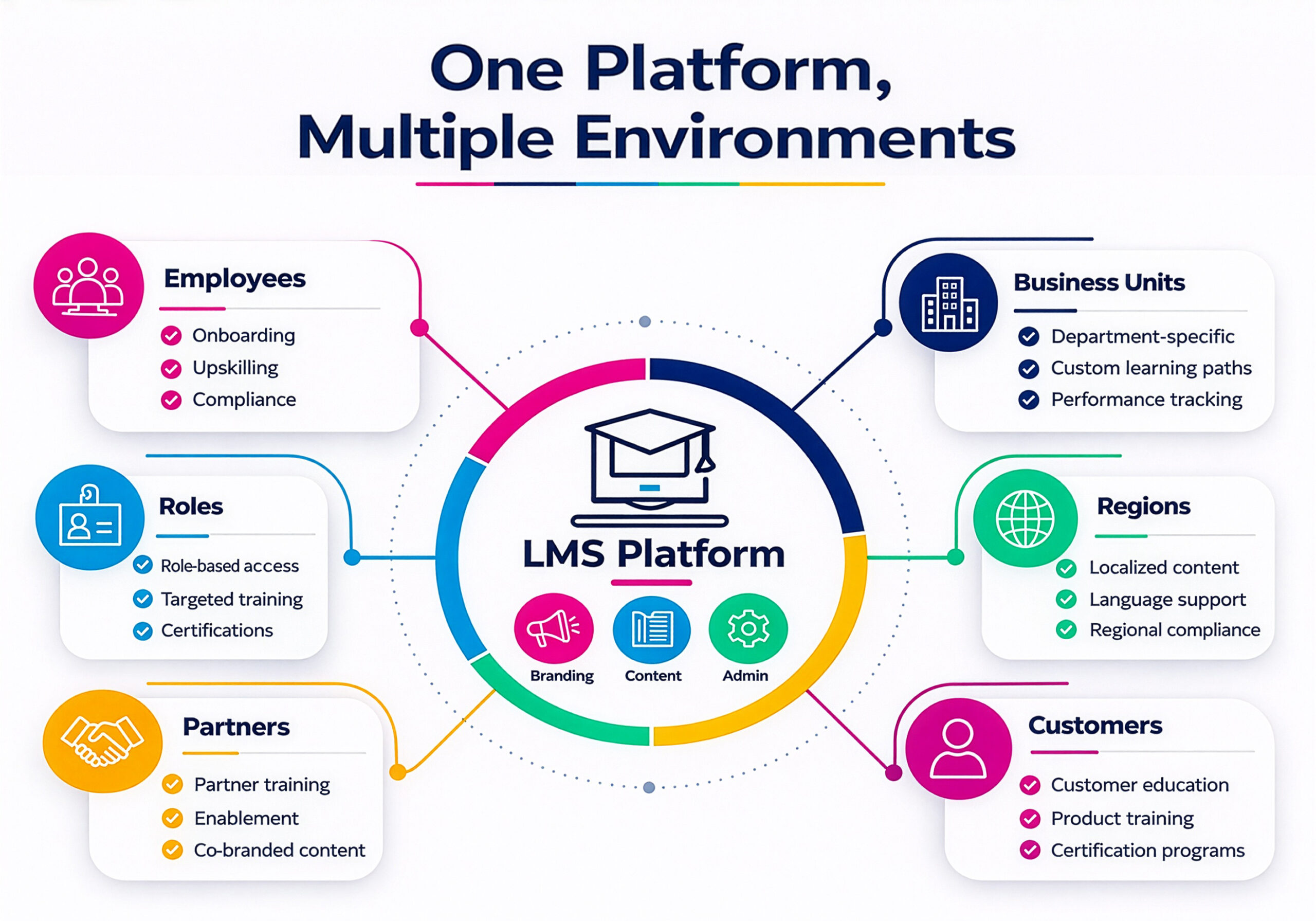
Knowing how to engage employees in training helps enterprise organizations create more connected, supportive, and growth-focused learning experiences. This guide explores how training can boost engagement across onboarding, upskilling, remote work, manager enablement, and career development. It also explains the role of a modern LMS, the features that make the biggest difference, and the training goals that support stronger retention. You will also learn practical ways to measure whether your employee development efforts are increasing participation, encouraging progress, and improving long-term workforce outcomes.
Key Terms:
- Employee Training Engagement
- Employee Engagement Strategy
- Employee Development
- Employee Retention
- Increase Training Participation
- Remote Employee Engagement
- Employee Onboarding
- Skills Development
- LMS Engagement Features
Why Do Employee Engagement and Development Matter?
Employee engagement is often discussed as a culture issue, but for enterprise organizations, it is also a learning and development issue. Gallup reports that global employee engagement recently fell to 21%, with lost productivity costing the world economy an estimated $438 billion. Gallup also says 70% of the variance in a team’s engagement is related to management, which makes day-to-day support, clarity, and development far more important than surface-level engagement initiatives.
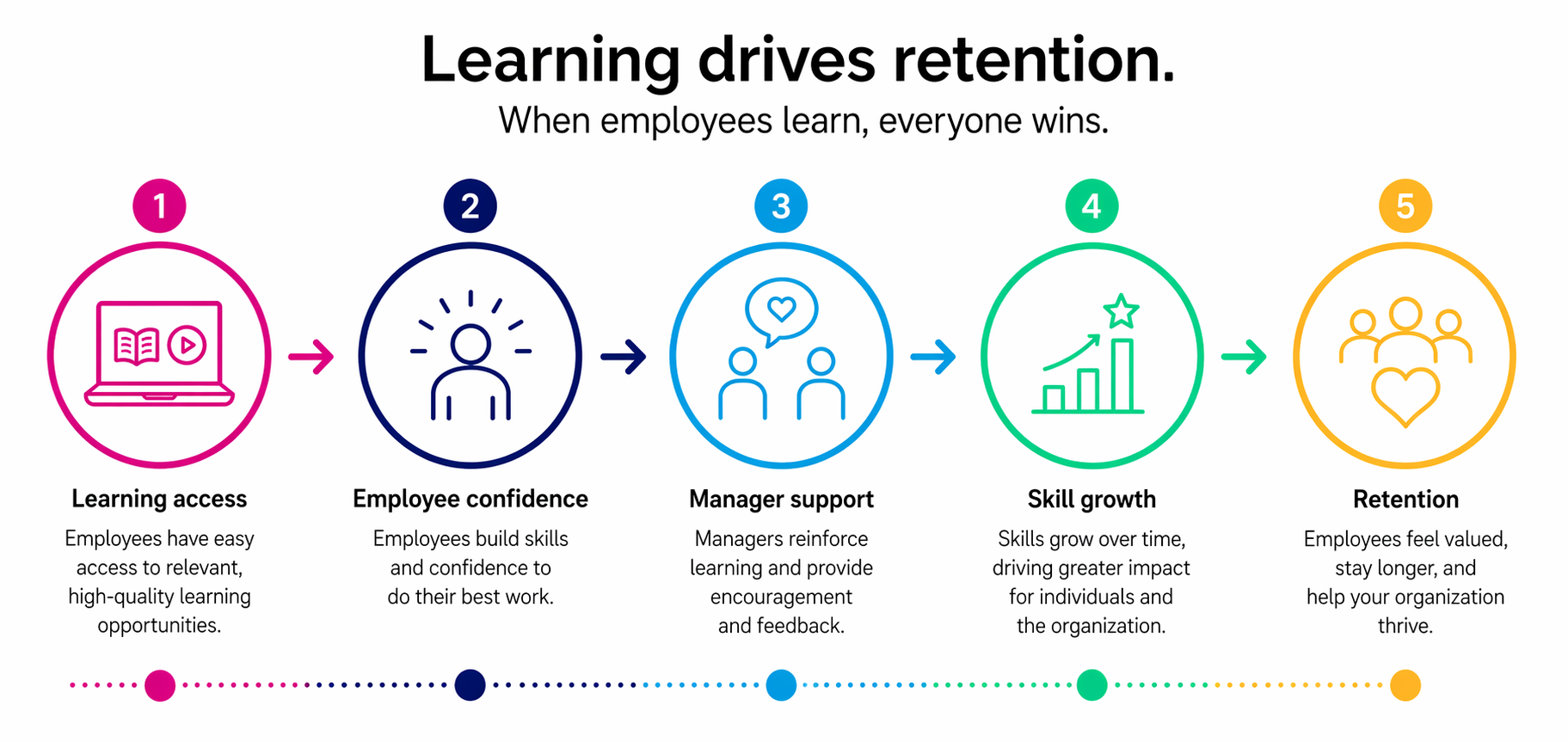
That is why training plays a larger role in the employee experience than many organizations expect. It shapes how employees are onboarded, how quickly they build confidence, how managers reinforce progress, and how clearly people can see opportunities to grow.
When learning is difficult to find, disconnected from role expectations, or limited to mandatory completions, it becomes another administrative task. When it is accessible, relevant, and tied to real development, it can help employees feel more supported and more invested in their work.
This matters even more as workforce expectations and skill needs continue to change. The World Economic Forum says employers expect 39% of workers’ core skills to change by 2030, while LinkedIn’s Workplace Learning Report highlights career progress as people’s number one motivation to learn. In that environment, employee training is not just about participation. It is about helping people stay capable, connected, and able to move forward inside the organization.
What are the Benefits of Engaging Employee Training?
When employee training is done well, it improves more than course completion. It can help organizations create a more consistent, more supportive employee experience across onboarding, ongoing development, and internal mobility.
One of the clearest benefits is faster readiness. When employees know what they need to complete, where to find it, and how it connects to their role, they ramp more efficiently. That matters for new hires, but it also matters when employees take on new responsibilities, move into leadership roles, or need to build new skills quickly.
A second benefit is stronger visibility into growth. Employees are more likely to stay engaged when they can see how development connects to progression. That includes role-based learning, skills development, stretch opportunities, mentoring, and leadership pathways. Gallup’s research found that one in four U.S. employees say they lack advancement opportunities, while LinkedIn continues to tie learning and career development closely to retention.
A third benefit is better consistency across distributed organizations. Large companies often struggle with uneven learning experiences across teams, locations, and work arrangements. A stronger engagement-focused training strategy helps reduce that fragmentation by giving employees a clearer path through required learning, optional development, and manager-supported growth.
This is also where learning starts to matter to the business in a more visible way. Engagement-focused training can support faster onboarding, better manager follow-through, stronger participation in optional learning, and a clearer connection between development and retention. It gives organizations a practical way to make growth more visible and more manageable without adding more chaos to the learning environment.
Six Engagement Strategies
Training can support employee engagement in many ways, but some approaches are consistently more useful than others. The goal is not to create more learning for its own sake. It is to design learning in a way that helps employees feel supported, capable, and able to move forward.
1. Use Onboarding to Create Clarity Early
Onboarding is often the first real learning experience an employee has with the organization. It sets expectations, establishes tone, and shapes how quickly someone moves from uncertainty to confidence. If onboarding feels fragmented, overly manual, or difficult to follow, employees start their experience with friction. If it feels clear, well-organized, and connected to the role, they start with momentum.
That is why onboarding should be treated as an engagement tool, not just an HR process. It can help employees understand what the organization does, what their role requires, and where to find support. It can also give managers a more structured way to reinforce expectations during the early weeks of employment.
This is especially important in large organizations where employees may be joining complex teams, using multiple systems, or working across locations. A strong onboarding experience helps reduce avoidable confusion and gives people a clearer sense of where they fit.
2. Make Upskilling Part of the Employee Experience
Employees are more likely to stay engaged when they believe the organization is investing in their future, not just their current responsibilities. Upskilling matters because it shows that development is ongoing and that growth is part of the job, not something separate from it.
This matters even more now because workforce skill needs are changing quickly. As job requirements evolve, employees need a way to build new capabilities without feeling like they are falling behind. Upskilling can create that sense of forward motion. It helps people build confidence, stay relevant, and see a clearer path to future opportunities.
The practical challenge is that upskilling only helps if employees can navigate it. A large content library is not enough. Employees need relevant recommendations, visible pathways, and a simple way to understand what learning matters most for their role or next step.
3. Use Compliance and Certification Training to Reduce Friction
Compliance training is not always considered an engagement issue, but in many organizations, it is part of the employee experience, whether leaders acknowledge it or not. Employees feel friction when required training is hard to track, deadlines are unclear, or certification expectations are scattered across systems.
When required learning is easier to understand and easier to manage, it can reduce stress for both employees and managers. People know what is expected, where they stand, and what they need to complete next. That kind of clarity matters, especially in regulated, technical, or operationally complex environments.
This does not make compliance training “engaging” in a superficial sense. It makes it manageable. And in enterprise settings, reducing avoidable confusion is often one of the most practical ways to improve the learning experience.
4. Use Recognition and Gamification Thoughtfully
Recognition can support engagement when it reinforces useful behavior. That might include milestones, badges, visible progress markers, topic expertise, or team-based learning challenges. The point is not to turn every training program into a game. It is to create signals that progress matters and that effort is visible.
This can be especially helpful when organizations want to encourage participation beyond mandatory learning. Optional development is easier to sustain when employees can see progress, receive recognition, and feel that ongoing learning is valued by the organization.
Used thoughtfully, gamification can also make development feel less transactional. It introduces momentum and positive reinforcement into training that might otherwise feel static or purely administrative.
5. Use Microlearning to Match the Pace of Work
Employees are more likely to engage with learning when it fits into the way they actually work. Long, static courses can still play a role, but they are not always the best fit for busy teams, distributed employees, or roles that rely on just-in-time learning.
Microlearning helps by making development easier to start and easier to revisit. Shorter, more focused learning experiences are often better suited to the workday. They can support reinforcement, refresh key concepts, and make learning feel more manageable.
This matters for engagement because attention is limited. Employees are more likely to return to learning when it feels useful and realistic, not when it feels like a separate event they need to carve time out for.
6. Use Interactive and Shared Learning to Build Connection
A surprising amount of disengagement comes from format. When learning is purely passive, employees often associate it with delay, obligation, or background admin. Interactive learning changes that by asking employees to respond, reflect, discuss, or apply.
That can include quizzes, polls, guided practice, short scenario-based content, live sessions, peer discussion, or collaborative learning moments. These experiences help employees participate rather than just consume. They also make it easier for managers and learning teams to see whether employees are following along or struggling with the material.
This is particularly valuable in distributed organizations where training can also serve as a structured point of connection. When teams are spread across locations, shared learning moments can help create visibility and participation that might otherwise be missing.
Remote Engagement
Remote and hybrid work changed more than where employees sit. It changed how they experience support, visibility, and belonging. In office-first environments, some engagement signals happen informally through quick conversations, shared routines, and easy access to colleagues. In distributed environments, many of those signals are weaker or more inconsistent.
That is one reason remote engagement needs its own strategy. Gallup’s research shows that fully remote employees can be highly engaged, but they are also more likely than some other groups to report stress, sadness, and loneliness. Flexibility alone does not solve the employee experience. Organizations still need ways to create clarity, connection, and support across distance.
Training plays an important role here because it is one of the few structured touchpoints the organization can intentionally design. It can help remote employees get oriented faster, access support more easily, and participate in shared experiences without relying on proximity.
For enterprise teams, that usually means a few practical things:
- Onboarding has to be easy to start and easy to follow
- Learning has to work across devices and locations
- Employees need both live and asynchronous ways to participate
- Managers need enough visibility to coach without micromanaging
- Optional learning should be available alongside required learning
- Collaboration should feel possible even when teams are distributed
This is also where accessibility matters. If remote or hybrid employees have to chase links, switch systems, or wait for manual guidance, learning starts to feel like a friction point. If they can access the right content in the flow of work, the experience is more likely to feel supportive and usable.
Case study: One innovative tech company required stronger onboarding support, compliance reporting, and Workday integration, and utilised ExpertusONE for a more unified onboarding experience for employees and clearer tracking for managers.
Retention-focused Goals
A useful way to plan engaging employee training is to start with the outcomes you want to improve. Instead of asking only what learning needs to be assigned, it is often more helpful to ask what kind of employee experience the organization wants to create.
For many enterprise teams, that leads to goals like these:
- Improve time to confidence: New hires and transitioning employees should not just complete training. They should understand what is expected, know where to find support, and feel capable in the role as quickly as possible.
- Increase participation in optional learning: If employees only ever touch required content, the learning environment may be functioning more like a compliance system than a development system. Optional learning participation is a useful sign that employees see value in the broader experience.
- Create clearer advancement pathways: Employees are more likely to stay engaged when they can see how learning connects to future opportunities. That includes skills, role progression, mentoring, leadership development, and internal mobility.
- Strengthen manager involvement: Managers play a central role in whether development turns into progress. They need simple ways to see learning activity, reinforce expectations, and support follow-through without taking on more administrative burden than they can realistically handle.
- Expand access across audiences: Distributed, frontline, deskless, and global employees should not have a weaker learning experience by default. Accessibility is part of retention because employees are less likely to stay engaged when development feels harder to reach for their role or work context.
- Measure more than completion: Completion data matters, but it does not tell the full story. Organizations should also look at optional learning, repeat participation, manager follow-up, time to readiness, and other signals that show whether learning is helping employees progress.
These goals align closely with broader retention pressure in the market. LinkedIn’s Workplace Learning Report says 88% of organizations are concerned about retention, which is one reason career development and internal growth continue to matter so much in learning strategy.
Why Use an LMS?
At enterprise scale, engagement problems are rarely caused by a lack of learning content. More often, they come from fragmentation. Content lives in too many places. Required training and development learning are disconnected. Managers cannot see progress clearly. Remote employees get a weaker experience than office-based teams. Career growth is discussed, but the systems employees use every day do not reflect it.
That is where a modern LMS becomes important. Not because the platform itself is the goal, but because it gives the organization a repeatable way to deliver learning, support managers, improve visibility, and make development easier to access.
A modern enterprise LMS should help organizations do a few things well:
- Bring required and optional learning into one environment
- Make discovery easier so employees can find what matters
- Support multiple learning formats, not just static courses
- Work across devices, locations, and work contexts
- Give managers and administrators clearer visibility into progress
- Connect learning to skills, roles, and growth over time
When an LMS does those things well, it becomes part of the employee experience rather than a separate system employees visit only when they are required to.
Key Platform Features for Employee Engagement
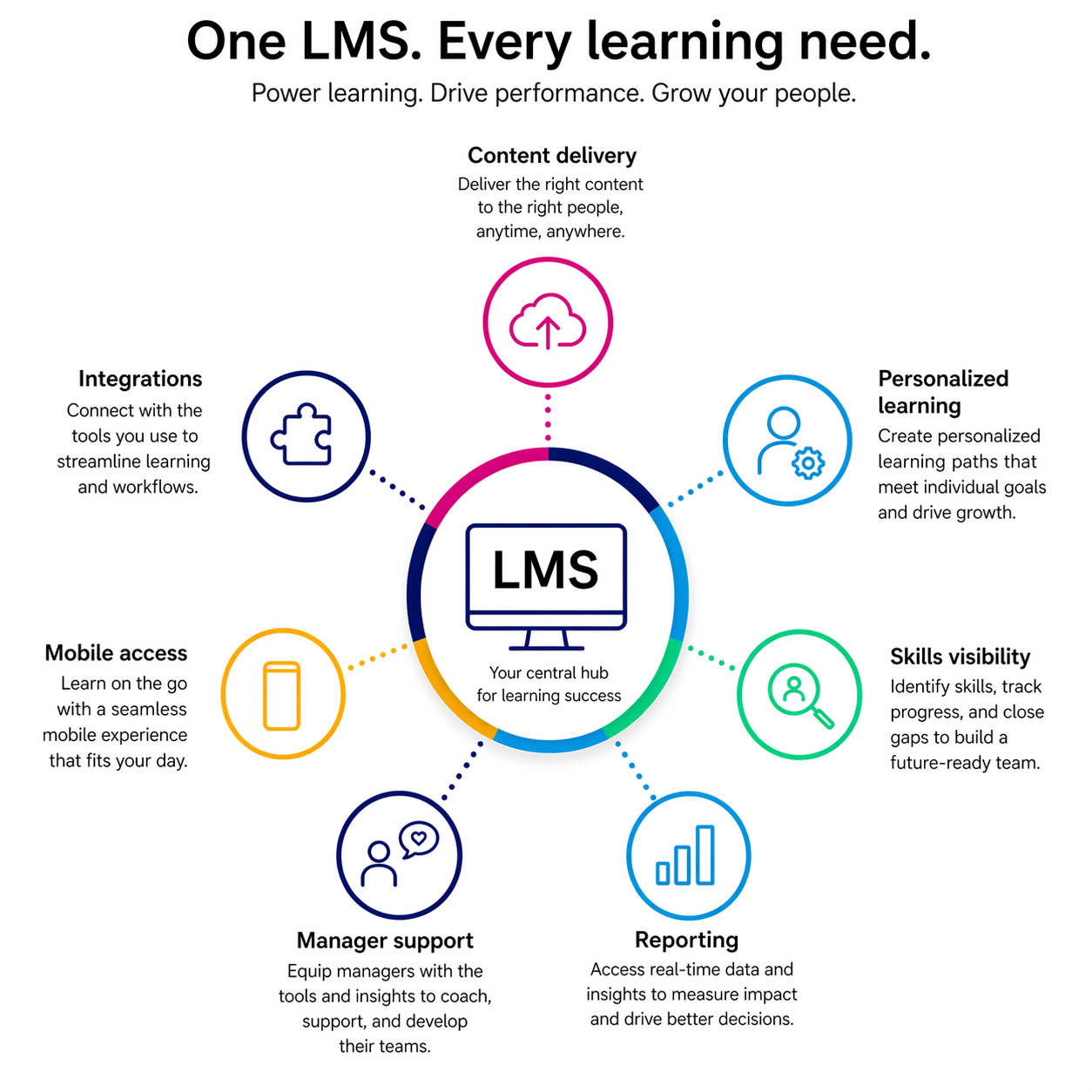
Not every LMS feature has a meaningful impact on employee engagement. The features that matter most are the ones that make learning easier to access, easier to participate in, and easier to connect to day-to-day work and long-term growth. For enterprise organizations, that usually means looking beyond basic course delivery and focusing on the capabilities that reduce friction, improve relevance, and make progress easier to support.
Interactive Content Tools
Interactive learning can make a noticeable difference in how employees experience training. When courses include quizzes, short scenarios, polls, video, or other in-course activities, learning feels more active and easier to stay with. That matters in onboarding, role training, leadership development, and any program where participation and retention are important.
Tools for interactive content creation can help teams move beyond static course formats and build learning experiences that feel more practical and more engaging. Instead of asking employees to click through passive material, interactive learning gives them more opportunities to respond, reflect, and apply what they are learning as they go.
Gamification and Recognition
Recognition can help learning feel more visible and more rewarding. Features like badges, achievement markers, milestones, and progress indicators can encourage employees to keep moving through training and stay involved with development over time.
This works best when recognition supports a meaningful learning activity. It can help reinforce progress through learning paths, encourage participation in optional development, and give employees a clearer sense that continued growth is noticed and valued.
Live Learning and Collaboration
Learning is often more engaging when it does not happen in isolation. Live sessions, shared discussions, peer learning, and collaborative experiences can make training feel more connected, especially when employees need space to ask questions, exchange ideas, or learn from one another.
This is particularly valuable in remote and hybrid environments, where learning can also help create connections across distance. Integrations with tools employees already use for communication and collaboration can make participation easier and help learning feel like part of the workday rather than a separate task.
Skills and Competency Visibility
Employees are more likely to stay engaged with development when they can see what they are working toward. Learning feels more useful when it is connected to clear skills, role expectations, and areas for growth rather than sitting in a disconnected course catalog.
Skills tracking, competency frameworks, and observation-based validation can help make development more visible for both employees and managers. That can lead to clearer development conversations, more targeted coaching, and a stronger sense of progress over time.
Personalized Discovery
Even a strong learning library can feel overwhelming if employees are left to sort through it on their own. Personalized discovery helps by surfacing content that is more relevant to a person’s role, goals, interests, or stage of development.
This can improve engagement in a simple but important way: it reduces the effort it takes to find useful learning. When employees can get to relevant content more quickly, development feels more focused and more manageable.
Mobile Access and Flexible Learning
Access has a direct impact on engagement. If learning is hard to reach or only works well in one setting, participation tends to drop. Flexible access matters for remote teams, frontline employees, traveling workers, and anyone trying to fit learning into a busy workday.
Mobile learning and cross-device access help make development easier to continue across locations and throughout the day. That flexibility can make a big difference in whether learning feels like a practical resource or just another system employees have to remember to visit.
Reporting and Manager Visibility
Manager support often shapes whether training leads to real progress. Employees may begin learning on their own, but continued development usually depends on whether managers can see what is happening and respond in a useful way.
Reporting and visibility tools help managers and learning teams track participation, progress, and development activity more clearly. That makes it easier to identify where support is needed, reinforce learning at the right time, and keep development moving beyond the initial assignment.
Retention Features
Some platform capabilities matter specifically because they support continuity over time. They help employees keep moving instead of stalling after onboarding or mandatory learning.
Skills And Competency Checklists
These help employees see where they stand and what they still need to build. That matters for retention because growth feels more real when it is visible.
Microlearning Support
Shorter learning formats are easier to revisit and easier to fit into the workday. That supports long-term participation, not just one-time completions.
Personalized Learning Paths
Employees are more likely to stay engaged when they can see a next step. Personalization helps reduce the sense of drift that often follows broad, unstructured content libraries.
Better Learning Data
Stronger visibility into participation, progress, and activity helps managers and learning teams understand where employees are moving forward and where support is needed.
Mobile Learning Access
Flexible access matters because employees do not all work at a desk. Mobile learning is especially important for field, frontline, traveling, and distributed employees.
Integrated Live Learning
When live learning can happen inside the broader training environment, it becomes easier to launch, easier to join, and easier to connect to ongoing development.
Case study: One ExpertusONE customer estimates that the average training time dropped from one year to six months after the organization improved the learning experience and standardized training delivery.
Empowering Employees
“Empowerment” can sound vague in employee engagement content, but in practice it usually comes down to something more concrete. Employees feel more empowered when they can understand expectations, access what they need, and make visible progress.
Personalized Learning
Employees are more likely to engage when content feels relevant to their role, interests, or next step rather than generic and one-size-fits-all.
Clear Expectations
People need to know what is required, what is optional, what is overdue, and what success looks like. Clarity reduces unnecessary friction.
Flexible Access
Self-paced learning, mobile access, and the ability to continue across devices all make it easier for employees to fit development into real work.
Connected Communication
Learning feels more useful when it sits closer to the systems and conversations employees already use. This is a natural place to link to integrations or learning in the flow of work.
Visible Progress
Employees benefit when they can see what they have completed, what is next, and where they may need support. Progress visibility helps people feel less like passive recipients of training and more like active participants in their own development.
Taken together, these elements make the learning experience feel more supportive and less administrative. That is a more practical way to think about empowerment than broad cultural language alone.
How To Measure What Matters
Engagement strategies often lose momentum because the organization measures only completions. Completion data is useful, but it does not show whether learning is supporting confidence, growth, or retention.
A stronger measurement approach usually includes four layers:
- Access and reach: Are employees logging in, finding content, and using the learning environment across devices, teams, and locations?
- Quality of participation: Are employees engaging only with required content, or are they also returning for optional learning, live sessions, and skill development?
- Manager reinforcement: Are managers reviewing progress, following up, and using the learning activity as part of coaching and development conversations?
- Business outcomes: Are you seeing changes in time to readiness, optional learning participation, skill growth, internal mobility, or retention-related signals?
The goal is not to turn employee engagement into a perfect formula. It is to create a more useful picture of whether training is helping people move forward. In enterprise environments, that kind of visibility matters because learning teams are increasingly expected to show how development connects to business outcomes, not just activity.
Where Does ExpertusONE Fit?
For enterprise organizations, employee training depends on more than content. It depends on whether learning is easy to access, relevant to different audiences, connected to growth, and manageable at scale.
That is where ExpertusONE fits. The platform is designed to help organizations deliver structured onboarding, support ongoing employee development, create more engaging learning experiences, and give managers better visibility into progress. It also supports the flexibility enterprise teams need across mobile learning, integrations, skills development, and multiple learning formats.
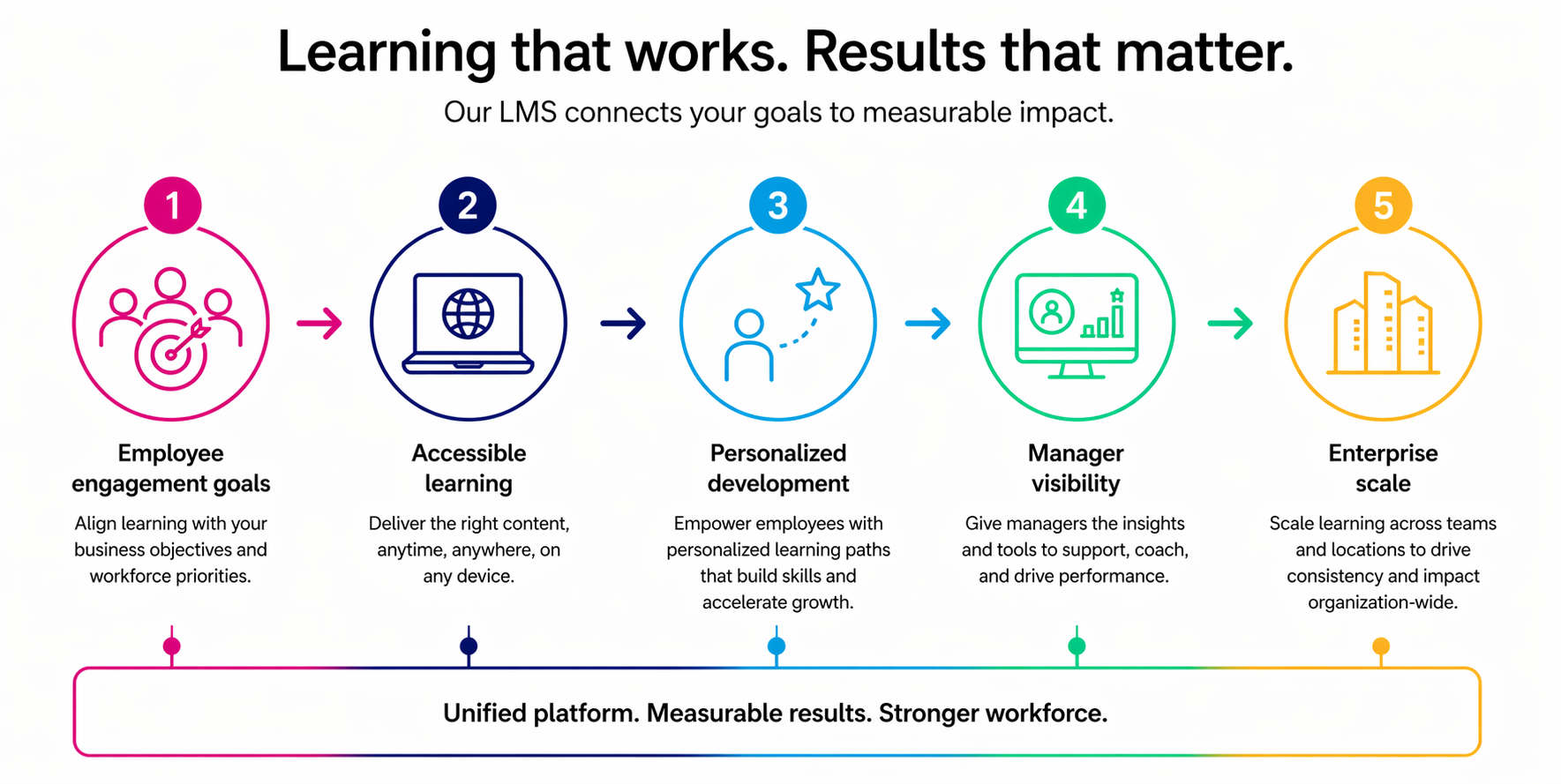
For organizations trying to improve engagement, retention, and workforce readiness, the goal is not just to launch more training. It is to create a learning experience that employees can actually use, and managers can actually support. ExpertusONE helps bring those pieces together in one environment, so learning feels more connected to everyday work and long-term growth.
Key Takeaways
Training supports engagement when learning is relevant, accessible, and connected to employee growth.
Strong engagement strategies usually combine onboarding, upskilling, manager support, and interactive learning.
Remote and hybrid teams need training experiences that create consistency, visibility, and connection across distance.
A modern LMS should support more than course delivery. It should improve discovery, access, personalization, and progress tracking.
The most important engagement features often include interactive content, personalized discovery, collaboration, mobile access, skills visibility, and reporting.
Success should be measured through participation quality, optional learning, manager follow-through, time to readiness, and development outcomes.
FAQs
Training improves engagement when it reduces uncertainty, makes learning relevant, supports managers, and helps employees see progress. Gallup’s research shows that purpose and management both have a strong effect on engagement, which is why onboarding, career development, and manager reinforcement all matter so much.
Because distributed work weakens many of the informal signals that support belonging and clarity, Gallup’s data shows that remote workers can be highly engaged, but they also report lower well-being and higher emotional strain than some other groups. Thoughtfully designed training gives organizations one of the clearest ways to create connection and structure across distance.
It can. LinkedIn says 88% of organizations are concerned about retention and that providing learning opportunities is the number one retention strategy in its research. Training does not solve every retention problem, but it directly supports several of the biggest ones.
Because the core problem is often fragmentation, a modern LMS can unify required learning, optional development, discovery, collaboration, reporting, and manager visibility in one repeatable system. That makes the employee experience easier to navigate and the learning strategy easier to scale.
Yes, when it is used practically. The main value is usually better discovery, more relevant recommendations, less searching, and clearer learning paths. AI is most useful when it quietly makes the experience easier and more relevant, not when it becomes the headline on its own.
About the Author
Trestin Miller is ExpertusONE’s Principal Learning Systems Advisor, specializing in enterprise learning platform modernization, integrations, and operational scale. He works closely with organizations navigating complex migrations, system design, and long-term optimization, translating technical complexity into clear, actionable guidance. Known for his steady, consultative approach, Trestin is a trusted subject-matter expert in enterprise learning operations and systems strategy.
Summary:
Knowing how to engage employees in training helps enterprise organizations create more connected, supportive, and growth-focused learning experiences. This guide explores how training can boost engagement across onboarding, upskilling, remote work, manager enablement, and career development. It also explains the role of a modern LMS, the features that make the biggest difference, and the training goals that support stronger retention. You will also learn practical ways to measure whether your employee development efforts are increasing participation, encouraging progress, and improving long-term workforce outcomes.
Key Terms:
- Employee Training Engagement
- Employee Engagement Strategy
- Employee Development
- Employee Retention
- Increase Training Participation
- Remote Employee Engagement
- Employee Onboarding
- Skills Development
- LMS Engagement Features
Why Do Employee Engagement and Development Matter?
Employee engagement is often discussed as a culture issue, but for enterprise organizations, it is also a learning and development issue. Gallup reports that global employee engagement recently fell to 21%, with lost productivity costing the world economy an estimated $438 billion. Gallup also says 70% of the variance in a team’s engagement is related to management, which makes day-to-day support, clarity, and development far more important than surface-level engagement initiatives.
That is why training plays a larger role in the employee experience than many organizations expect. It shapes how employees are onboarded, how quickly they build confidence, how managers reinforce progress, and how clearly people can see opportunities to grow.
When learning is difficult to find, disconnected from role expectations, or limited to mandatory completions, it becomes another administrative task. When it is accessible, relevant, and tied to real development, it can help employees feel more supported and more invested in their work.
This matters even more as workforce expectations and skill needs continue to change. The World Economic Forum says employers expect 39% of workers’ core skills to change by 2030, while LinkedIn’s Workplace Learning Report highlights career progress as people’s number one motivation to learn. In that environment, employee training is not just about participation. It is about helping people stay capable, connected, and able to move forward inside the organization.
What are the Benefits of Engaging Employee Training?
When employee training is done well, it improves more than course completion. It can help organizations create a more consistent, more supportive employee experience across onboarding, ongoing development, and internal mobility.
One of the clearest benefits is faster readiness. When employees know what they need to complete, where to find it, and how it connects to their role, they ramp more efficiently. That matters for new hires, but it also matters when employees take on new responsibilities, move into leadership roles, or need to build new skills quickly.
A second benefit is stronger visibility into growth. Employees are more likely to stay engaged when they can see how development connects to progression. That includes role-based learning, skills development, stretch opportunities, mentoring, and leadership pathways. Gallup’s research found that one in four U.S. employees say they lack advancement opportunities, while LinkedIn continues to tie learning and career development closely to retention.
A third benefit is better consistency across distributed organizations. Large companies often struggle with uneven learning experiences across teams, locations, and work arrangements. A stronger engagement-focused training strategy helps reduce that fragmentation by giving employees a clearer path through required learning, optional development, and manager-supported growth.
This is also where learning starts to matter to the business in a more visible way. Engagement-focused training can support faster onboarding, better manager follow-through, stronger participation in optional learning, and a clearer connection between development and retention. It gives organizations a practical way to make growth more visible and more manageable without adding more chaos to the learning environment.
Six Engagement Strategies
Training can support employee engagement in many ways, but some approaches are consistently more useful than others. The goal is not to create more learning for its own sake. It is to design learning in a way that helps employees feel supported, capable, and able to move forward.
1. Use Onboarding to Create Clarity Early
Onboarding is often the first real learning experience an employee has with the organization. It sets expectations, establishes tone, and shapes how quickly someone moves from uncertainty to confidence. If onboarding feels fragmented, overly manual, or difficult to follow, employees start their experience with friction. If it feels clear, well-organized, and connected to the role, they start with momentum.
That is why onboarding should be treated as an engagement tool, not just an HR process. It can help employees understand what the organization does, what their role requires, and where to find support. It can also give managers a more structured way to reinforce expectations during the early weeks of employment.
This is especially important in large organizations where employees may be joining complex teams, using multiple systems, or working across locations. A strong onboarding experience helps reduce avoidable confusion and gives people a clearer sense of where they fit.
2. Make Upskilling Part of the Employee Experience
Employees are more likely to stay engaged when they believe the organization is investing in their future, not just their current responsibilities. Upskilling matters because it shows that development is ongoing and that growth is part of the job, not something separate from it.
This matters even more now because workforce skill needs are changing quickly. As job requirements evolve, employees need a way to build new capabilities without feeling like they are falling behind. Upskilling can create that sense of forward motion. It helps people build confidence, stay relevant, and see a clearer path to future opportunities.
The practical challenge is that upskilling only helps if employees can navigate it. A large content library is not enough. Employees need relevant recommendations, visible pathways, and a simple way to understand what learning matters most for their role or next step.
3. Use Compliance and Certification Training to Reduce Friction
Compliance training is not always considered an engagement issue, but in many organizations, it is part of the employee experience, whether leaders acknowledge it or not. Employees feel friction when required training is hard to track, deadlines are unclear, or certification expectations are scattered across systems.
When required learning is easier to understand and easier to manage, it can reduce stress for both employees and managers. People know what is expected, where they stand, and what they need to complete next. That kind of clarity matters, especially in regulated, technical, or operationally complex environments.
This does not make compliance training “engaging” in a superficial sense. It makes it manageable. And in enterprise settings, reducing avoidable confusion is often one of the most practical ways to improve the learning experience.
4. Use Recognition and Gamification Thoughtfully
Recognition can support engagement when it reinforces useful behavior. That might include milestones, badges, visible progress markers, topic expertise, or team-based learning challenges. The point is not to turn every training program into a game. It is to create signals that progress matters and that effort is visible.
This can be especially helpful when organizations want to encourage participation beyond mandatory learning. Optional development is easier to sustain when employees can see progress, receive recognition, and feel that ongoing learning is valued by the organization.
Used thoughtfully, gamification can also make development feel less transactional. It introduces momentum and positive reinforcement into training that might otherwise feel static or purely administrative.
5. Use Microlearning to Match the Pace of Work
Employees are more likely to engage with learning when it fits into the way they actually work. Long, static courses can still play a role, but they are not always the best fit for busy teams, distributed employees, or roles that rely on just-in-time learning.
Microlearning helps by making development easier to start and easier to revisit. Shorter, more focused learning experiences are often better suited to the workday. They can support reinforcement, refresh key concepts, and make learning feel more manageable.
This matters for engagement because attention is limited. Employees are more likely to return to learning when it feels useful and realistic, not when it feels like a separate event they need to carve time out for.
6. Use Interactive and Shared Learning to Build Connection
A surprising amount of disengagement comes from format. When learning is purely passive, employees often associate it with delay, obligation, or background admin. Interactive learning changes that by asking employees to respond, reflect, discuss, or apply.
That can include quizzes, polls, guided practice, short scenario-based content, live sessions, peer discussion, or collaborative learning moments. These experiences help employees participate rather than just consume. They also make it easier for managers and learning teams to see whether employees are following along or struggling with the material.
This is particularly valuable in distributed organizations where training can also serve as a structured point of connection. When teams are spread across locations, shared learning moments can help create visibility and participation that might otherwise be missing.
Remote Engagement
Remote and hybrid work changed more than where employees sit. It changed how they experience support, visibility, and belonging. In office-first environments, some engagement signals happen informally through quick conversations, shared routines, and easy access to colleagues. In distributed environments, many of those signals are weaker or more inconsistent.
That is one reason remote engagement needs its own strategy. Gallup’s research shows that fully remote employees can be highly engaged, but they are also more likely than some other groups to report stress, sadness, and loneliness. Flexibility alone does not solve the employee experience. Organizations still need ways to create clarity, connection, and support across distance.
Training plays an important role here because it is one of the few structured touchpoints the organization can intentionally design. It can help remote employees get oriented faster, access support more easily, and participate in shared experiences without relying on proximity.
For enterprise teams, that usually means a few practical things:
- Onboarding has to be easy to start and easy to follow
- Learning has to work across devices and locations
- Employees need both live and asynchronous ways to participate
- Managers need enough visibility to coach without micromanaging
- Optional learning should be available alongside required learning
- Collaboration should feel possible even when teams are distributed
This is also where accessibility matters. If remote or hybrid employees have to chase links, switch systems, or wait for manual guidance, learning starts to feel like a friction point. If they can access the right content in the flow of work, the experience is more likely to feel supportive and usable.
Case study: One innovative tech company required stronger onboarding support, compliance reporting, and Workday integration, and utilised ExpertusONE for a more unified onboarding experience for employees and clearer tracking for managers.
Retention-focused Goals
A useful way to plan engaging employee training is to start with the outcomes you want to improve. Instead of asking only what learning needs to be assigned, it is often more helpful to ask what kind of employee experience the organization wants to create.
For many enterprise teams, that leads to goals like these:
- Improve time to confidence: New hires and transitioning employees should not just complete training. They should understand what is expected, know where to find support, and feel capable in the role as quickly as possible.
- Increase participation in optional learning: If employees only ever touch required content, the learning environment may be functioning more like a compliance system than a development system. Optional learning participation is a useful sign that employees see value in the broader experience.
- Create clearer advancement pathways: Employees are more likely to stay engaged when they can see how learning connects to future opportunities. That includes skills, role progression, mentoring, leadership development, and internal mobility.
- Strengthen manager involvement: Managers play a central role in whether development turns into progress. They need simple ways to see learning activity, reinforce expectations, and support follow-through without taking on more administrative burden than they can realistically handle.
- Expand access across audiences: Distributed, frontline, deskless, and global employees should not have a weaker learning experience by default. Accessibility is part of retention because employees are less likely to stay engaged when development feels harder to reach for their role or work context.
- Measure more than completion: Completion data matters, but it does not tell the full story. Organizations should also look at optional learning, repeat participation, manager follow-up, time to readiness, and other signals that show whether learning is helping employees progress.
These goals align closely with broader retention pressure in the market. LinkedIn’s Workplace Learning Report says 88% of organizations are concerned about retention, which is one reason career development and internal growth continue to matter so much in learning strategy.
Why Use an LMS?
At enterprise scale, engagement problems are rarely caused by a lack of learning content. More often, they come from fragmentation. Content lives in too many places. Required training and development learning are disconnected. Managers cannot see progress clearly. Remote employees get a weaker experience than office-based teams. Career growth is discussed, but the systems employees use every day do not reflect it.
That is where a modern LMS becomes important. Not because the platform itself is the goal, but because it gives the organization a repeatable way to deliver learning, support managers, improve visibility, and make development easier to access.
A modern enterprise LMS should help organizations do a few things well:
- Bring required and optional learning into one environment
- Make discovery easier so employees can find what matters
- Support multiple learning formats, not just static courses
- Work across devices, locations, and work contexts
- Give managers and administrators clearer visibility into progress
- Connect learning to skills, roles, and growth over time
When an LMS does those things well, it becomes part of the employee experience rather than a separate system employees visit only when they are required to.
Key Platform Features for Employee Engagement
Not every LMS feature has a meaningful impact on employee engagement. The features that matter most are the ones that make learning easier to access, easier to participate in, and easier to connect to day-to-day work and long-term growth. For enterprise organizations, that usually means looking beyond basic course delivery and focusing on the capabilities that reduce friction, improve relevance, and make progress easier to support.
Interactive Content Tools
Interactive learning can make a noticeable difference in how employees experience training. When courses include quizzes, short scenarios, polls, video, or other in-course activities, learning feels more active and easier to stay with. That matters in onboarding, role training, leadership development, and any program where participation and retention are important.
Tools for interactive content creation can help teams move beyond static course formats and build learning experiences that feel more practical and more engaging. Instead of asking employees to click through passive material, interactive learning gives them more opportunities to respond, reflect, and apply what they are learning as they go.
Gamification and Recognition
Recognition can help learning feel more visible and more rewarding. Features like badges, achievement markers, milestones, and progress indicators can encourage employees to keep moving through training and stay involved with development over time.
This works best when recognition supports a meaningful learning activity. It can help reinforce progress through learning paths, encourage participation in optional development, and give employees a clearer sense that continued growth is noticed and valued.
Live Learning and Collaboration
Learning is often more engaging when it does not happen in isolation. Live sessions, shared discussions, peer learning, and collaborative experiences can make training feel more connected, especially when employees need space to ask questions, exchange ideas, or learn from one another.
This is particularly valuable in remote and hybrid environments, where learning can also help create connections across distance. Integrations with tools employees already use for communication and collaboration can make participation easier and help learning feel like part of the workday rather than a separate task.
Skills and Competency Visibility
Employees are more likely to stay engaged with development when they can see what they are working toward. Learning feels more useful when it is connected to clear skills, role expectations, and areas for growth rather than sitting in a disconnected course catalog.
Skills tracking, competency frameworks, and observation-based validation can help make development more visible for both employees and managers. That can lead to clearer development conversations, more targeted coaching, and a stronger sense of progress over time.
Personalized Discovery
Even a strong learning library can feel overwhelming if employees are left to sort through it on their own. Personalized discovery helps by surfacing content that is more relevant to a person’s role, goals, interests, or stage of development.
This can improve engagement in a simple but important way: it reduces the effort it takes to find useful learning. When employees can get to relevant content more quickly, development feels more focused and more manageable.
Mobile Access and Flexible Learning
Access has a direct impact on engagement. If learning is hard to reach or only works well in one setting, participation tends to drop. Flexible access matters for remote teams, frontline employees, traveling workers, and anyone trying to fit learning into a busy workday.
Mobile learning and cross-device access help make development easier to continue across locations and throughout the day. That flexibility can make a big difference in whether learning feels like a practical resource or just another system employees have to remember to visit.
Reporting and Manager Visibility
Manager support often shapes whether training leads to real progress. Employees may begin learning on their own, but continued development usually depends on whether managers can see what is happening and respond in a useful way.
Reporting and visibility tools help managers and learning teams track participation, progress, and development activity more clearly. That makes it easier to identify where support is needed, reinforce learning at the right time, and keep development moving beyond the initial assignment.
Retention Features
Some platform capabilities matter specifically because they support continuity over time. They help employees keep moving instead of stalling after onboarding or mandatory learning.
Skills And Competency Checklists
These help employees see where they stand and what they still need to build. That matters for retention because growth feels more real when it is visible.
Microlearning Support
Shorter learning formats are easier to revisit and easier to fit into the workday. That supports long-term participation, not just one-time completions.
Personalized Learning Paths
Employees are more likely to stay engaged when they can see a next step. Personalization helps reduce the sense of drift that often follows broad, unstructured content libraries.
Better Learning Data
Stronger visibility into participation, progress, and activity helps managers and learning teams understand where employees are moving forward and where support is needed.
Mobile Learning Access
Flexible access matters because employees do not all work at a desk. Mobile learning is especially important for field, frontline, traveling, and distributed employees.
Integrated Live Learning
When live learning can happen inside the broader training environment, it becomes easier to launch, easier to join, and easier to connect to ongoing development.
Case study: One ExpertusONE customer estimates that the average training time dropped from one year to six months after the organization improved the learning experience and standardized training delivery.
Empowering Employees
“Empowerment” can sound vague in employee engagement content, but in practice it usually comes down to something more concrete. Employees feel more empowered when they can understand expectations, access what they need, and make visible progress.
Personalized Learning
Employees are more likely to engage when content feels relevant to their role, interests, or next step rather than generic and one-size-fits-all.
Clear Expectations
People need to know what is required, what is optional, what is overdue, and what success looks like. Clarity reduces unnecessary friction.
Flexible Access
Self-paced learning, mobile access, and the ability to continue across devices all make it easier for employees to fit development into real work.
Connected Communication
Learning feels more useful when it sits closer to the systems and conversations employees already use. This is a natural place to link to integrations or learning in the flow of work.
Visible Progress
Employees benefit when they can see what they have completed, what is next, and where they may need support. Progress visibility helps people feel less like passive recipients of training and more like active participants in their own development.
Taken together, these elements make the learning experience feel more supportive and less administrative. That is a more practical way to think about empowerment than broad cultural language alone.
How To Measure What Matters
Engagement strategies often lose momentum because the organization measures only completions. Completion data is useful, but it does not show whether learning is supporting confidence, growth, or retention.
A stronger measurement approach usually includes four layers:
- Access and reach: Are employees logging in, finding content, and using the learning environment across devices, teams, and locations?
- Quality of participation: Are employees engaging only with required content, or are they also returning for optional learning, live sessions, and skill development?
- Manager reinforcement: Are managers reviewing progress, following up, and using the learning activity as part of coaching and development conversations?
- Business outcomes: Are you seeing changes in time to readiness, optional learning participation, skill growth, internal mobility, or retention-related signals?
The goal is not to turn employee engagement into a perfect formula. It is to create a more useful picture of whether training is helping people move forward. In enterprise environments, that kind of visibility matters because learning teams are increasingly expected to show how development connects to business outcomes, not just activity.
Where Does ExpertusONE Fit?
For enterprise organizations, employee training depends on more than content. It depends on whether learning is easy to access, relevant to different audiences, connected to growth, and manageable at scale.
That is where ExpertusONE fits. The platform is designed to help organizations deliver structured onboarding, support ongoing employee development, create more engaging learning experiences, and give managers better visibility into progress. It also supports the flexibility enterprise teams need across mobile learning, integrations, skills development, and multiple learning formats.
For organizations trying to improve engagement, retention, and workforce readiness, the goal is not just to launch more training. It is to create a learning experience that employees can actually use, and managers can actually support. ExpertusONE helps bring those pieces together in one environment, so learning feels more connected to everyday work and long-term growth.
Key Takeaways
Training supports engagement when learning is relevant, accessible, and connected to employee growth.
Strong engagement strategies usually combine onboarding, upskilling, manager support, and interactive learning.
Remote and hybrid teams need training experiences that create consistency, visibility, and connection across distance.
A modern LMS should support more than course delivery. It should improve discovery, access, personalization, and progress tracking.
The most important engagement features often include interactive content, personalized discovery, collaboration, mobile access, skills visibility, and reporting.
Success should be measured through participation quality, optional learning, manager follow-through, time to readiness, and development outcomes.
FAQs
Training improves engagement when it reduces uncertainty, makes learning relevant, supports managers, and helps employees see progress. Gallup’s research shows that purpose and management both have a strong effect on engagement, which is why onboarding, career development, and manager reinforcement all matter so much.
Because distributed work weakens many of the informal signals that support belonging and clarity, Gallup’s data shows that remote workers can be highly engaged, but they also report lower well-being and higher emotional strain than some other groups. Thoughtfully designed training gives organizations one of the clearest ways to create connection and structure across distance.
It can. LinkedIn says 88% of organizations are concerned about retention and that providing learning opportunities is the number one retention strategy in its research. Training does not solve every retention problem, but it directly supports several of the biggest ones.
Because the core problem is often fragmentation, a modern LMS can unify required learning, optional development, discovery, collaboration, reporting, and manager visibility in one repeatable system. That makes the employee experience easier to navigate and the learning strategy easier to scale.
Yes, when it is used practically. The main value is usually better discovery, more relevant recommendations, less searching, and clearer learning paths. AI is most useful when it quietly makes the experience easier and more relevant, not when it becomes the headline on its own.
About the Author
Trestin Miller is ExpertusONE’s Principal Learning Systems Advisor, specializing in enterprise learning platform modernization, integrations, and operational scale. He works closely with organizations navigating complex migrations, system design, and long-term optimization, translating technical complexity into clear, actionable guidance. Known for his steady, consultative approach, Trestin is a trusted subject-matter expert in enterprise learning operations and systems strategy.


