
BLOG
The Complete Guide to Smarter Employee Training
 Author: Greg Bashar
BLOG
The Complete Guide to Smarter Employee Training
Author: Greg Bashar
Employee training helps enterprise organizations improve performance, support compliance, strengthen retention, and prepare employees for change. But effective training is not just about delivering more courses. It is about making learning relevant, accessible, and measurable across different roles, regions, and business priorities without creating more complexity.
This guide explains what employee training means in a modern enterprise, why it matters, which types of training organizations need most, and how to build a program that supports both immediate job performance and long-term workforce development.
Key Terms:
- Employee Training
- Employee Training Program
- Employee Training Software
- Corporate Training
- Workplace Learning
- Employee Development
- Upskilling and Reskilling
- Enterprise Learning Platform
What Does Employee Training Mean Today?
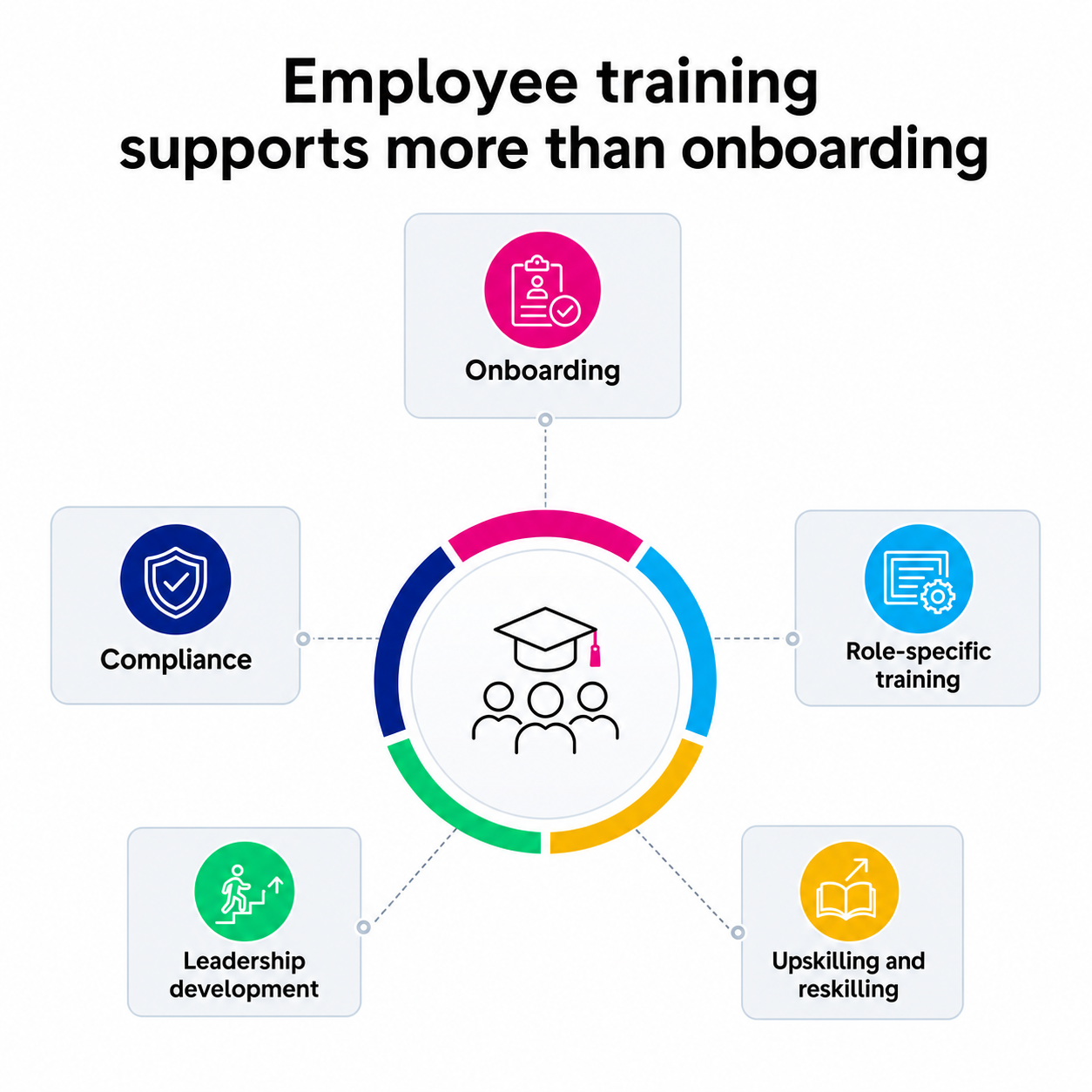
Employee training is the structured process of helping people gain the knowledge, skills, and confidence they need to perform in their current roles and prepare for future ones. In enterprise organizations, this usually includes a mix of onboarding, compliance, role-based learning, leadership development, product and process training, and upskilling over time.
That definition is broader than many organizations have used in the past. Training is no longer limited to new-hire orientation or annual compliance modules. It now plays a direct role in employee experience, business agility, operational consistency, and retention. Gallup reports that U.S. employee engagement fell to 31% in 2024, the lowest level in a decade, and only 30% of employees strongly agree that someone at work encourages their development. In that environment, training can either reinforce relevance and growth or become another disconnected requirement.
Why Does Employee Training Matter?
The business case for employee training is straightforward. Effective training helps employees become productive faster, perform more consistently, make fewer mistakes, and build confidence in their roles. It also gives organizations a way to respond to change without relying entirely on external hiring. That matters because skill disruption is no longer occasional. It is ongoing. The World Economic Forum says employers expect 39% of workers’ core skills to change by 2030.
Training also matters for retention. LinkedIn reports that 88% of organizations are concerned with retention, and that providing learning opportunities is the number one retention strategy. Gallup similarly finds that organizations making a strategic investment in employee development are twice as likely to retain employees and report 11% greater profitability.
For employees, the value is practical. Training can improve job performance, build career momentum, open paths to internal mobility, and make change feel more manageable. For the business, it supports readiness, consistency, and resilience.
The Main Objectives of an Effective Employee Training Program
Training works best when organizations are clear about what they are trying to achieve. In large organizations, the most common objectives usually fall into a few categories.
Improve Job Performance
At the most basic level, training should help people do their work better. That includes role-specific knowledge, systems training, product training, process training, and performance support that reduces ramp time and improves quality.
Personalize the Learning Experience
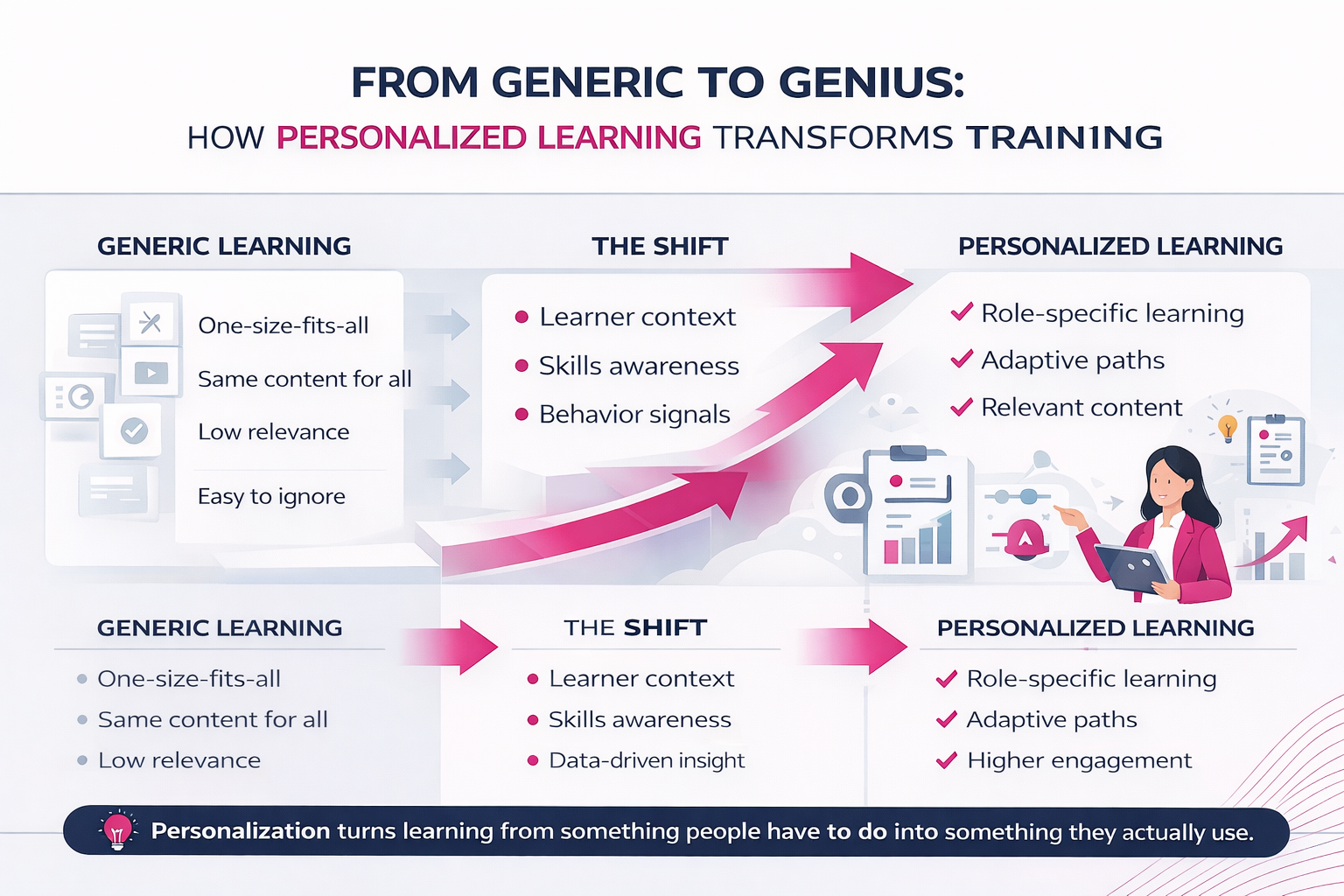
Generic training often underperforms because it treats every learner the same. Employees are more likely to engage when training reflects their role, experience level, goals, and current responsibilities. ExpertusONE supports this with AI-driven recommendations that can surface more relevant learning based on job title, interests, assignments, and prior activity.
Create Clear Learning Pathways
Employees need to understand why training matters and where it leads. Clear pathways help connect required learning, role readiness, certifications, and development opportunities so training feels purposeful rather than fragmented.
Support Compliance and Risk Reduction
In regulated industries, especially, employee training has to do more than inform. It has to prove completion, reinforce requirements, and help organizations maintain visibility across large populations. ExpertusONE supports this with compliance reporting and analytics, automated reminders, and content versioning to help ensure the right learners receive the right training at the right time.
Encourage Ongoing Development
A good program should not stop after onboarding. It should help employees build new capabilities over time, whether that means expanding technical knowledge, preparing for leadership, or moving into adjacent roles. This is especially important now that employees increasingly connect learning with adaptability. LinkedIn’s Workplace Learning Report found that 68% of employees agree that learning helps them adapt during times of change.
Essential Types of Employee Training
Most enterprise organizations do not need one kind of training. They need a balanced portfolio that supports both immediate performance and long-term development.
Onboarding Training
Onboarding gives employees their first experience of how the organization works. It should cover role expectations, systems, processes, policies, and the knowledge people need to become productive without overwhelming them. Content should remain accessible beyond the first few weeks so employees can revisit it when needed. Interactive learning elements, short modules, and live virtual sessions can make onboarding more useful and easier to reinforce over time.
Compliance Training
Compliance training protects the organization while helping employees understand the standards that apply to their role. In enterprise environments, that usually means recurring assignments, certification tracking, reminders, audit visibility, and reporting by team, role, or region. It also helps when the system can manage version control and automate routine tracking so compliance work does not become overly manual.
Role-specific Training
Employees need training tied directly to the work they do. That may include product knowledge, operational procedures, service workflows, software training, or sales enablement. The more specific the training is to day-to-day execution, the more likely it is to improve performance. Personalization and role-based assignments can help make this kind of training more relevant.
Leadership and Manager Development
Many organizations say managers are critical to performance and retention, but do not train them with the same rigor they expect elsewhere. Leadership and manager development should help people build practical skills in communication, coaching, decision-making, and team support. Clear learning pathways and ongoing development matter here because strong managers have a direct impact on employee experience and performance.
Upskilling and Reskilling
Upskilling helps employees grow in their current trajectory. Reskilling helps them prepare for different responsibilities as business needs change. This has become more important as roles evolve and organizations need to build talent internally. Skills-focused learning, personalized recommendations, and clearer visibility into progress can make this type of development easier to support at scale.
Certification and Advancement Training
Some organizations also need structured certification programs, not only for regulatory reasons but to support career growth and internal advancement. Training can provide employees with a clearer path to readiness, promotion, and specialization. This is especially useful when organizations can track demonstrated skills, progress milestones, and completion status in a more structured way.
What Do Employees Expect from Training?
Employee expectations have changed. Training is more likely to succeed when it reflects how people actually work.
Employees increasingly expect flexibility, relevance, and access across devices and locations. They also want learning that fits naturally into their workflow instead of forcing them into a disconnected system. Mobile access, microlearning, interactive video, collaboration, and strong integrations all play an important role in modern learning design.
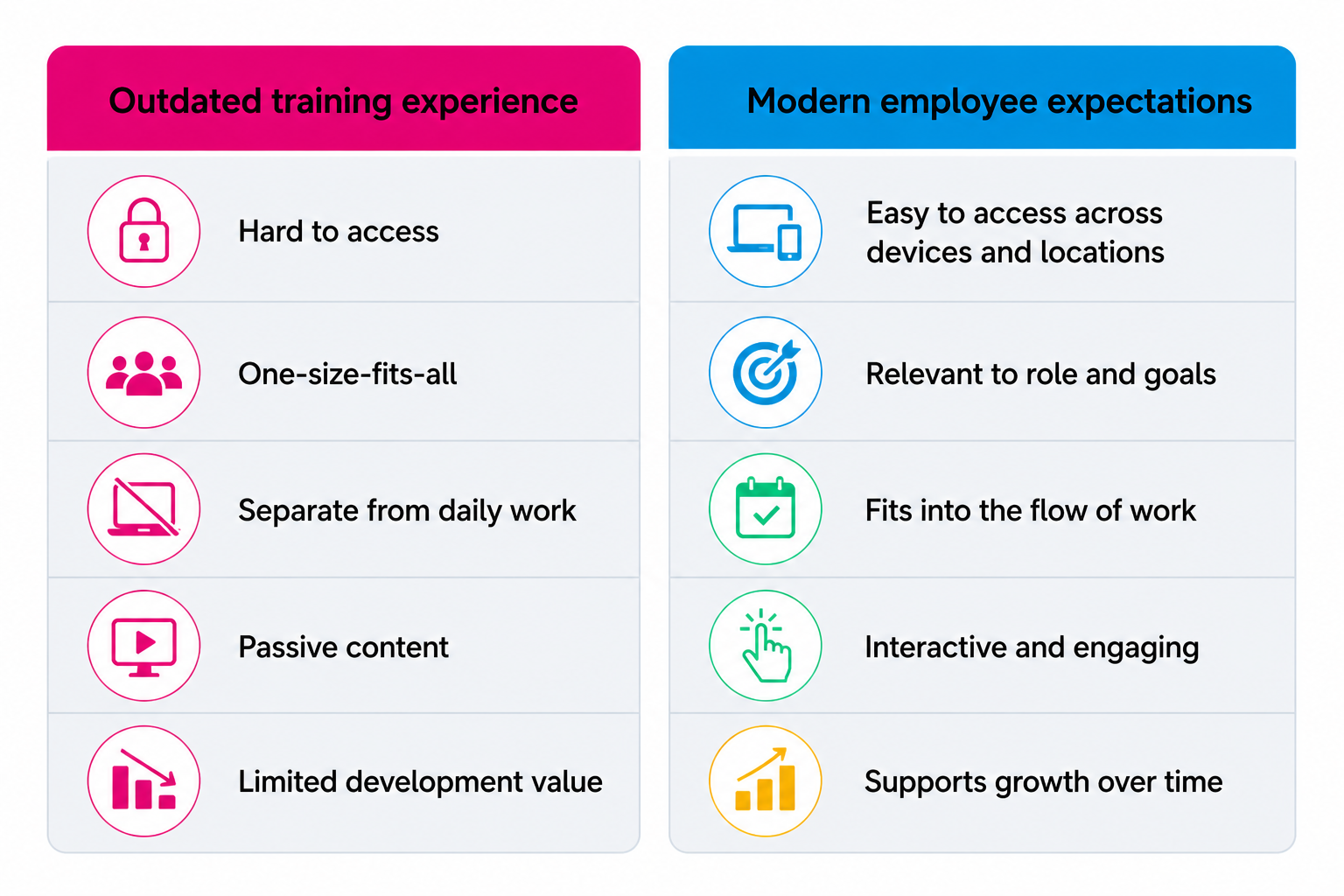
That shift reflects a broader change in the workplace. Employees already move between communication, productivity, and business systems throughout the day. Training programs that sit too far outside that environment create friction and are harder to sustain. Learning tends to be more effective when it is easy to access within the tools and workflows employees already use.
Employees also respond better to training that is active rather than passive. Video, quizzes, polls, simulations, scenario-based learning, discussion, and live Q&A can all help improve participation, retention, and application. Interactive content often makes training feel more useful, more engaging, and easier to revisit over time.
Signs Your Employee Training Program Needs to Change
Many organizations do not rethink employee training because of theory. They do it because the current approach is no longer delivering the results the business needs.
A training program often needs updating when the technology feels outdated, engagement is low, employees complete training without applying it, or the organization has become too complex for a fragmented approach. In some cases, the program may still focus heavily on onboarding while offering too little support for ongoing development, compliance, or changing skill needs.
Common warning signs include:
- Employees complete training, but do not retain or apply it.
- Training is difficult to access across remote, hybrid, mobile, or frontline environments.
- Reporting depends too heavily on manual work.
- Compliance requirements are becoming harder to manage.
- The organization has outgrown legacy systems or point solutions.
- Training feels too generic to support specific roles or goals.
- Learning opportunities taper off after onboarding.
When several of these issues appear at once, the problem is usually bigger than content alone. It often points to gaps in the structure, delivery model, and operational design of the training program.
Questions to Ask Employees About Training
One of the most effective ways to improve employee training is to ask employees directly about their experience. Their feedback can reveal whether training feels useful, relevant, and easy to complete, or whether it is creating unnecessary friction.
A few questions are especially helpful:
- Do employees find the training useful and worth their time?
- Is the purpose of the training clear?
- Does it support the requirements of their role?
- Does it create opportunities for development and growth?
- Does the experience fit how they actually work, whether in an office, remotely, or across different locations?
These questions can help organizations identify common issues around relevance, clarity, role alignment, development value, and accessibility. This matters because employees usually disengage from training for practical reasons. They may not see how it connects to their work, may struggle to fit it into the day, or may find the experience itself too difficult to navigate.
Current Trends in Employee Training
Several trends are shaping employee training today, and most reflect a broader shift away from one-size-fits-all learning:
- Continuous skill development: Employee training is moving away from occasional updates and toward ongoing learning. As roles, tools, and business priorities change more quickly, organizations need training programs that help employees build and refresh skills over time rather than relying only on one-time learning events.
- Career-linked learning: Employees increasingly expect training to support more than immediate job requirements. They want learning that helps them grow, prepare for new responsibilities, and see a clearer path for development within the organization.
- Interactive and collaborative formats: Training is becoming more engaging and participatory. Instead of relying only on static modules, many organizations are using video, live sessions, discussions, simulations, and other interactive elements to improve attention, reinforcement, and practical application.
- Greater personalization: Relevance has become a major priority. Training is more effective when it reflects the learner’s role, skill level, goals, and current responsibilities. Personalized recommendations, role-based assignments, and tailored learning paths can all help make training more useful.
- More practical uses of AI: AI is becoming part of employee training in more grounded ways. Its value often comes from helping learners discover relevant content, supporting more personalized experiences, reducing administrative effort, and making large learning environments easier to navigate.
- Stronger focus on skills visibility: Organizations increasingly want clearer insight into the skills employees are building and where gaps remain. That is making skills tracking, progress visibility, and more structured development planning more important parts of modern training strategies.
Taken together, these trends point in the same direction. Employee training is becoming more continuous, more personalized, more skills-focused, and more closely connected to how people actually work.
Employee Training for the Future of Work
Employee training has become part of how organizations prepare for future work, not just current work. As roles change, tools evolve, and teams become more distributed, organizations need training programs that can adapt without becoming more fragmented.
That means training has to support multiple audiences, multiple delivery models, and multiple types of business change. It also has to be available beyond a single location or format. In remote and hybrid environments, training technology can directly affect whether employees stay connected to their work, understand expectations, and have access to the knowledge they need when they need it.
In practical terms, that means enterprise organizations should look for training systems that support mobile access, learning in the flow of work, personalized recommendations, skills visibility, and a mix of live, self-paced, and interactive learning. Seamless integrations matter as well, since training is more effective when it fits into the systems employees already use. Just as important are analytics, automation, certification tracking, and governance features that help organizations manage training consistently across large, complex environments. As employee training becomes more continuous and skills-focused, the systems behind it need to make learning easier to deliver, easier to access, and easier to measure at scale.
What Effective Employee Training Looks Like at Enterprise Scale
At enterprise scale, effective employee training usually shares a few clear characteristics. The goal is not just to deliver content. It is to create a training environment that is useful for employees, manageable for administrators, and consistent enough to support the business across teams, regions, and use cases.
Effective employee training at enterprise scale usually includes a few essential characteristics:
- Easy to access: Training should be simple to find and complete across devices, locations, and work environments. When access is difficult, even strong content becomes harder to use consistently.
- Relevant to the role: Training is more effective when employees can clearly connect it to their responsibilities. Role-specific learning is more likely to improve performance than generic content alone.
- Built for required learning and long-term growth: A strong program should support onboarding, compliance, and process training while also helping employees build new skills over time.
- Visible without creating manual work: Managers and administrators need clear insight into participation, completion, progress, and gaps. That visibility should not depend on manual reporting or disconnected systems.
- Connected to existing workflows: Training works better when it fits into the tools and systems employees already use. This reduces friction and makes learning feel like part of the job.
- Able to show completion, progress, and impact: Enterprise organizations need evidence that training is being completed and supporting business priorities. That includes clear reporting on activity, progress, and outcomes.
These characteristics matter because, as training expands across audiences and use cases, the challenge becomes larger than content alone. Organizations need a way to deliver learning consistently, maintain governance, reduce manual effort, and measure outcomes across a more complex environment.
That is why many enterprises move away from fragmented learning ecosystems over time. The issue is not only learner experience. It is also operational control. A platform approach becomes more valuable when the business needs to support multiple audiences, maintain consistency, and scale training without creating more complexity.
Key Takeaways
Employee training should do more than support onboarding. In enterprise organizations, it also plays a critical role in performance, compliance, retention, and long-term workforce development.
Effective training is not just about delivering content. It also depends on relevance, accessibility, consistency, and the ability to measure progress across teams and environments.
- Most organizations need a mix of training types. This usually includes onboarding, compliance, role-specific learning, leadership development, and upskilling.
Training programs need to evolve as the business changes. When training becomes too manual, too generic, too hard to access, or too limited, it stops supporting the organization effectively.
At enterprise scale, training systems need to do more than deliver courses. They also need to support governance, visibility, and operational efficiency across a complex organization.
FAQs
Employee training is the structured process of helping employees build the knowledge and skills they need to perform effectively in their current roles and prepare for future responsibilities.
It improves productivity, consistency, compliance readiness, and employee development. It also supports retention and adaptability as business needs change. Organizations investing strategically in employee development report stronger retention and profitability outcomes.
Common signs include low engagement, poor retention of information, outdated technology, weak reporting, increased compliance complexity, and a program that focuses only on onboarding instead of ongoing development.
They should look for flexibility, personalization, analytics, compliance support, integrations, mobile access, live and self-paced delivery, and governance that can scale across different audiences and regions. ExpertusONE supports these needs with capabilities such as AI-driven recommendations, interactive content creation, compliance reporting, live learning, integrations, and skills progress tracking.
 About the author:
Greg Basher
Senior Learning Advisor
With more than 18 years of experience helping enterprise organizations make smart, confident LMS and learning-technology decisions. He partners with L&D and business leaders to align learning platforms with real operational needs, long-term strategy, and measurable outcomes. Greg has advised global brands including Stanley Black & Decker, The Hartford, Estée Lauder, and Toyota, and is known for bringing clarity to complex, high-stakes learning initiatives.
Employee training helps enterprise organizations improve performance, support compliance, strengthen retention, and prepare employees for change. But effective training is not just about delivering more courses. It is about making learning relevant, accessible, and measurable across different roles, regions, and business priorities without creating more complexity.
This guide explains what employee training means in a modern enterprise, why it matters, which types of training organizations need most, and how to build a program that supports both immediate job performance and long-term workforce development.
Key Terms:
- Employee Training
- Employee Training Program
- Employee Training Software
- Corporate Training
- Workplace Learning
- Employee Development
- Upskilling and Reskilling
- Enterprise Learning Platform
What Does Employee Training Mean Today?
Employee training is the structured process of helping people gain the knowledge, skills, and confidence they need to perform in their current roles and prepare for future ones. In enterprise organizations, this usually includes a mix of onboarding, compliance, role-based learning, leadership development, product and process training, and upskilling over time.
That definition is broader than many organizations have used in the past. Training is no longer limited to new-hire orientation or annual compliance modules. It now plays a direct role in employee experience, business agility, operational consistency, and retention. Gallup reports that U.S. employee engagement fell to 31% in 2024, the lowest level in a decade, and only 30% of employees strongly agree that someone at work encourages their development. In that environment, training can either reinforce relevance and growth or become another disconnected requirement.
Why Does Employee Training Matter?
The business case for employee training is straightforward. Effective training helps employees become productive faster, perform more consistently, make fewer mistakes, and build confidence in their roles. It also gives organizations a way to respond to change without relying entirely on external hiring. That matters because skill disruption is no longer occasional. It is ongoing. The World Economic Forum says employers expect 39% of workers’ core skills to change by 2030.
Training also matters for retention. LinkedIn reports that 88% of organizations are concerned with retention, and that providing learning opportunities is the number one retention strategy. Gallup similarly finds that organizations making a strategic investment in employee development are twice as likely to retain employees and report 11% greater profitability.
For employees, the value is practical. Training can improve job performance, build career momentum, open paths to internal mobility, and make change feel more manageable. For the business, it supports readiness, consistency, and resilience.
The Main Objectives of an Effective Employee Training Program
Training works best when organizations are clear about what they are trying to achieve. In large organizations, the most common objectives usually fall into a few categories.
Improve Job Performance
At the most basic level, training should help people do their work better. That includes role-specific knowledge, systems training, product training, process training, and performance support that reduces ramp time and improves quality.
Personalize the Learning Experience
Generic training often underperforms because it treats every learner the same. Employees are more likely to engage when training reflects their role, experience level, goals, and current responsibilities. ExpertusONE supports this with AI-driven recommendations that can surface more relevant learning based on job title, interests, assignments, and prior activity.
Create Clear Learning Pathways
Employees need to understand why training matters and where it leads. Clear pathways help connect required learning, role readiness, certifications, and development opportunities so training feels purposeful rather than fragmented.
Support Compliance and Risk Reduction
In regulated industries, especially, employee training has to do more than inform. It has to prove completion, reinforce requirements, and help organizations maintain visibility across large populations. ExpertusONE supports this with compliance reporting and analytics, automated reminders, and content versioning to help ensure the right learners receive the right training at the right time.
Encourage Ongoing Development
A good program should not stop after onboarding. It should help employees build new capabilities over time, whether that means expanding technical knowledge, preparing for leadership, or moving into adjacent roles. This is especially important now that employees increasingly connect learning with adaptability. LinkedIn’s Workplace Learning Report found that 68% of employees agree that learning helps them adapt during times of change.
Essential Types of Employee Training
Most enterprise organizations do not need one kind of training. They need a balanced portfolio that supports both immediate performance and long-term development.
Onboarding Training
Onboarding gives employees their first experience of how the organization works. It should cover role expectations, systems, processes, policies, and the knowledge people need to become productive without overwhelming them. Content should remain accessible beyond the first few weeks so employees can revisit it when needed. Interactive learning elements, short modules, and live virtual sessions can make onboarding more useful and easier to reinforce over time.
Compliance Training
Compliance training protects the organization while helping employees understand the standards that apply to their role. In enterprise environments, that usually means recurring assignments, certification tracking, reminders, audit visibility, and reporting by team, role, or region. It also helps when the system can manage version control and automate routine tracking so compliance work does not become overly manual.
Role-specific Training
Employees need training tied directly to the work they do. That may include product knowledge, operational procedures, service workflows, software training, or sales enablement. The more specific the training is to day-to-day execution, the more likely it is to improve performance. Personalization and role-based assignments can help make this kind of training more relevant.
Leadership and Manager Development
Many organizations say managers are critical to performance and retention, but do not train them with the same rigor they expect elsewhere. Leadership and manager development should help people build practical skills in communication, coaching, decision-making, and team support. Clear learning pathways and ongoing development matter here because strong managers have a direct impact on employee experience and performance.
Upskilling and Reskilling
Upskilling helps employees grow in their current trajectory. Reskilling helps them prepare for different responsibilities as business needs change. This has become more important as roles evolve and organizations need to build talent internally. Skills-focused learning, personalized recommendations, and clearer visibility into progress can make this type of development easier to support at scale.
Certification and Advancement Training
Some organizations also need structured certification programs, not only for regulatory reasons but to support career growth and internal advancement. Training can provide employees with a clearer path to readiness, promotion, and specialization. This is especially useful when organizations can track demonstrated skills, progress milestones, and completion status in a more structured way.
What Do Employees Expect from Training?
Employee expectations have changed. Training is more likely to succeed when it reflects how people actually work.
Employees increasingly expect flexibility, relevance, and access across devices and locations. They also want learning that fits naturally into their workflow instead of forcing them into a disconnected system. Mobile access, microlearning, interactive video, collaboration, and strong integrations all play an important role in modern learning design.
That shift reflects a broader change in the workplace. Employees already move between communication, productivity, and business systems throughout the day. Training programs that sit too far outside that environment create friction and are harder to sustain. Learning tends to be more effective when it is easy to access within the tools and workflows employees already use.
Employees also respond better to training that is active rather than passive. Video, quizzes, polls, simulations, scenario-based learning, discussion, and live Q&A can all help improve participation, retention, and application. Interactive content often makes training feel more useful, more engaging, and easier to revisit over time.
Signs Your Employee Training Program Needs to Change
Many organizations do not rethink employee training because of theory. They do it because the current approach is no longer delivering the results the business needs.
A training program often needs updating when the technology feels outdated, engagement is low, employees complete training without applying it, or the organization has become too complex for a fragmented approach. In some cases, the program may still focus heavily on onboarding while offering too little support for ongoing development, compliance, or changing skill needs.
Common warning signs include:
- Employees complete training, but do not retain or apply it.
- Training is difficult to access across remote, hybrid, mobile, or frontline environments.
- Reporting depends too heavily on manual work.
- Compliance requirements are becoming harder to manage.
- The organization has outgrown legacy systems or point solutions.
- Training feels too generic to support specific roles or goals.
- Learning opportunities taper off after onboarding.
When several of these issues appear at once, the problem is usually bigger than content alone. It often points to gaps in the structure, delivery model, and operational design of the training program.
Questions to Ask Employees About Training
One of the most effective ways to improve employee training is to ask employees directly about their experience. Their feedback can reveal whether training feels useful, relevant, and easy to complete, or whether it is creating unnecessary friction.
A few questions are especially helpful:
- Do employees find the training useful and worth their time?
- Is the purpose of the training clear?
- Does it support the requirements of their role?
- Does it create opportunities for development and growth?
- Does the experience fit how they actually work, whether in an office, remotely, or across different locations?
These questions can help organizations identify common issues around relevance, clarity, role alignment, development value, and accessibility. This matters because employees usually disengage from training for practical reasons. They may not see how it connects to their work, may struggle to fit it into the day, or may find the experience itself too difficult to navigate.
Current Trends in Employee Training
Several trends are shaping employee training today, and most reflect a broader shift away from one-size-fits-all learning:
- Continuous skill development: Employee training is moving away from occasional updates and toward ongoing learning. As roles, tools, and business priorities change more quickly, organizations need training programs that help employees build and refresh skills over time rather than relying only on one-time learning events.
- Career-linked learning: Employees increasingly expect training to support more than immediate job requirements. They want learning that helps them grow, prepare for new responsibilities, and see a clearer path for development within the organization.
- Interactive and collaborative formats: Training is becoming more engaging and participatory. Instead of relying only on static modules, many organizations are using video, live sessions, discussions, simulations, and other interactive elements to improve attention, reinforcement, and practical application.
- Greater personalization: Relevance has become a major priority. Training is more effective when it reflects the learner’s role, skill level, goals, and current responsibilities. Personalized recommendations, role-based assignments, and tailored learning paths can all help make training more useful.
- More practical uses of AI: AI is becoming part of employee training in more grounded ways. Its value often comes from helping learners discover relevant content, supporting more personalized experiences, reducing administrative effort, and making large learning environments easier to navigate.
- Stronger focus on skills visibility: Organizations increasingly want clearer insight into the skills employees are building and where gaps remain. That is making skills tracking, progress visibility, and more structured development planning more important parts of modern training strategies.
Taken together, these trends point in the same direction. Employee training is becoming more continuous, more personalized, more skills-focused, and more closely connected to how people actually work.
Employee Training for the Future of Work
Employee training has become part of how organizations prepare for future work, not just current work. As roles change, tools evolve, and teams become more distributed, organizations need training programs that can adapt without becoming more fragmented.
That means training has to support multiple audiences, multiple delivery models, and multiple types of business change. It also has to be available beyond a single location or format. In remote and hybrid environments, training technology can directly affect whether employees stay connected to their work, understand expectations, and have access to the knowledge they need when they need it.
In practical terms, that means enterprise organizations should look for training systems that support mobile access, learning in the flow of work, personalized recommendations, skills visibility, and a mix of live, self-paced, and interactive learning. Seamless integrations matter as well, since training is more effective when it fits into the systems employees already use. Just as important are analytics, automation, certification tracking, and governance features that help organizations manage training consistently across large, complex environments. As employee training becomes more continuous and skills-focused, the systems behind it need to make learning easier to deliver, easier to access, and easier to measure at scale.
What Effective Employee Training Looks Like at Enterprise Scale
At enterprise scale, effective employee training usually shares a few clear characteristics. The goal is not just to deliver content. It is to create a training environment that is useful for employees, manageable for administrators, and consistent enough to support the business across teams, regions, and use cases.
Effective employee training at enterprise scale usually includes a few essential characteristics:
- Easy to access: Training should be simple to find and complete across devices, locations, and work environments. When access is difficult, even strong content becomes harder to use consistently.
- Relevant to the role: Training is more effective when employees can clearly connect it to their responsibilities. Role-specific learning is more likely to improve performance than generic content alone.
- Built for required learning and long-term growth: A strong program should support onboarding, compliance, and process training while also helping employees build new skills over time.
- Visible without creating manual work: Managers and administrators need clear insight into participation, completion, progress, and gaps. That visibility should not depend on manual reporting or disconnected systems.
- Connected to existing workflows: Training works better when it fits into the tools and systems employees already use. This reduces friction and makes learning feel like part of the job.
- Able to show completion, progress, and impact: Enterprise organizations need evidence that training is being completed and supporting business priorities. That includes clear reporting on activity, progress, and outcomes.
These characteristics matter because, as training expands across audiences and use cases, the challenge becomes larger than content alone. Organizations need a way to deliver learning consistently, maintain governance, reduce manual effort, and measure outcomes across a more complex environment.
That is why many enterprises move away from fragmented learning ecosystems over time. The issue is not only learner experience. It is also operational control. A platform approach becomes more valuable when the business needs to support multiple audiences, maintain consistency, and scale training without creating more complexity.
Key Takeaways
- Employee training should do more than support onboarding. In enterprise organizations, it also plays a critical role in performance, compliance, retention, and long-term workforce development.
Effective training is not just about delivering content. It also depends on relevance, accessibility, consistency, and the ability to measure progress across teams and environments.
- Most organizations need a mix of training types. This usually includes onboarding, compliance, role-specific learning, leadership development, and upskilling.
Training programs need to evolve as the business changes. When training becomes too manual, too generic, too hard to access, or too limited, it stops supporting the organization effectively.
At enterprise scale, training systems need to do more than deliver courses. They also need to support governance, visibility, and operational efficiency across a complex organization.
FAQs
Employee training is the structured process of helping employees build the knowledge and skills they need to perform effectively in their current roles and prepare for future responsibilities.
It improves productivity, consistency, compliance readiness, and employee development. It also supports retention and adaptability as business needs change. Organizations investing strategically in employee development report stronger retention and profitability outcomes.
Common signs include low engagement, poor retention of information, outdated technology, weak reporting, increased compliance complexity, and a program that focuses only on onboarding instead of ongoing development.
They should look for flexibility, personalization, analytics, compliance support, integrations, mobile access, live and self-paced delivery, and governance that can scale across different audiences and regions. ExpertusONE supports these needs with capabilities such as AI-driven recommendations, interactive content creation, compliance reporting, live learning, integrations, and skills progress tracking.
About the author:
Greg Bashar is the Senior Learning Advisor at ExpertusONE with more than 18 years of experience helping enterprise organizations make smart, confident LMS and learning-technology decisions. He partners with L&D and business leaders to align learning platforms with real operational needs, long-term strategy, and measurable outcomes. Greg has advised global brands including Stanley Black & Decker, The Hartford, Estée Lauder, and Toyota, and is known for bringing clarity to complex, high-stakes learning initiatives.


