
BLOG
The Complete Guide to Partner Training
 Author: Ramesh Ramani
BLOG
The Complete Guide to Partner Training
Author: Ramesh Ramani
Partner training helps companies educate the external organizations and individuals who sell, distribute, implement, support, or represent their products and services. For channel-led businesses, this training is essential to brand consistency, partner readiness, compliance, customer experience, and long-term growth. The right partner training program gives every partner the knowledge, tools, and confidence to perform well, while giving the business better visibility into engagement, progress, and results.
Key Terms:
- Partner Training
- Channel Partner Training
- Partner Enablement
- Partner LMS
- Reseller Training
- Franchisee Training
- Distributor Training
- Extended Enterprise Training
What is Partner Training?
Partner training is the structured education of external stakeholders who represent, sell, distribute, support, or deliver your products and services
These partners may include:
- Resellers
- Distributors
- Franchisees
- Vendors
- Contractors
- Dealers
- Implementation partners
- Service partners
Unlike employee training, partner training is designed for people outside your organization. They may not use your internal systems every day. They may work across different regions, business models, product lines, or customer segments. They may also represent more than one brand. That makes partner training both important and difficult.
A good partner training program gives external teams the information they need to represent your business accurately and confidently. That usually includes product knowledge, sales messaging, compliance requirements, brand standards, customer experience expectations, certification paths, and ongoing updates.
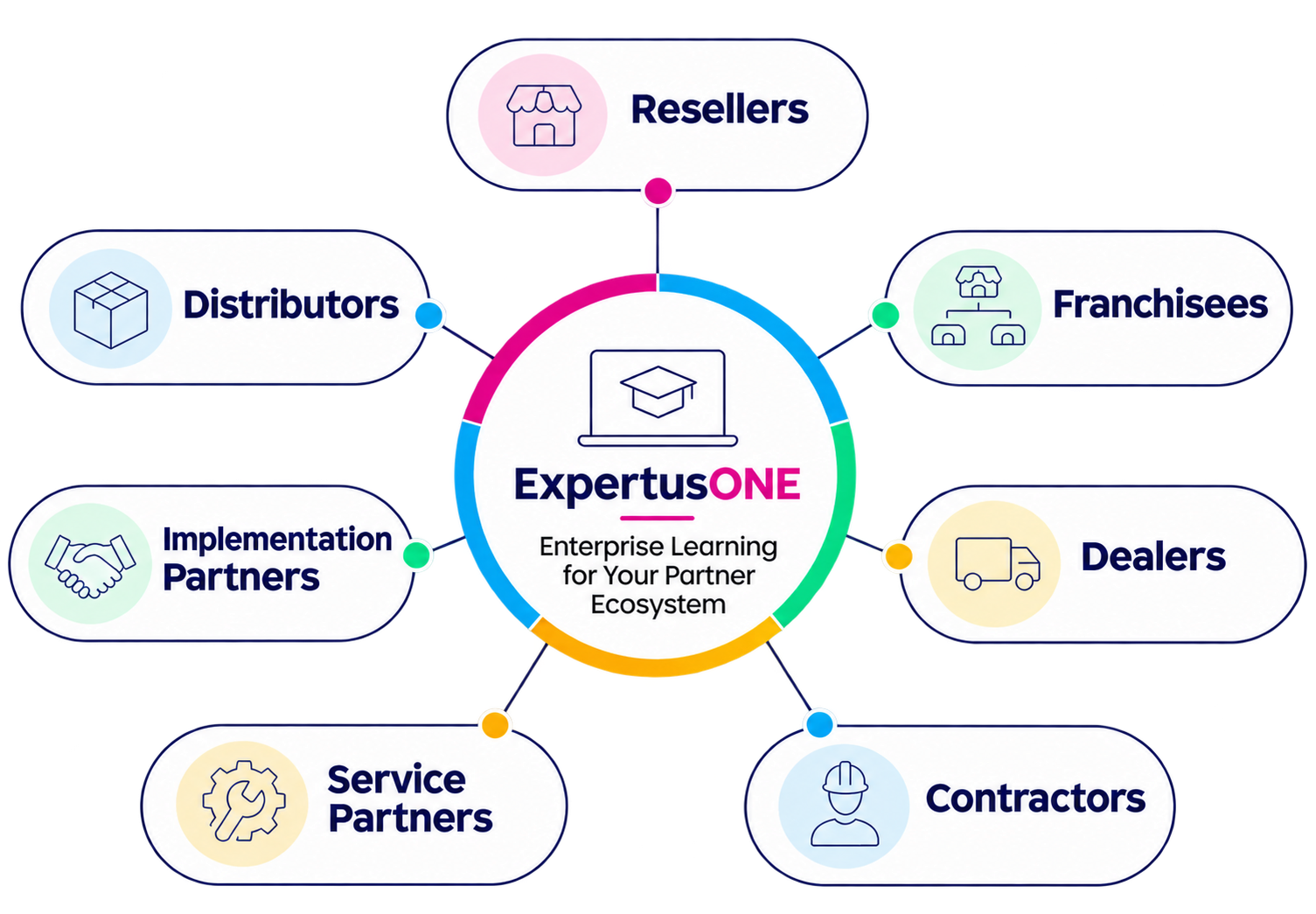
For companies that rely on indirect sales or external delivery networks, partner training is not just an L&D activity. It is part of partner enablement, revenue operations, customer experience, and brand governance.
The need is widespread. The CMO Survey report found that 66.5% of companies use channel partners, while marketers identified data sharing, trust, and loyalty as key challenges in managing those partner relationships.
Why Does Partner Training Matter?
Partners often sit between your business and the customer. They explain your products. They answer questions. They influence buying decisions. They deliver services. They shape the customer’s impression of your brand.
When partners are well trained, they can represent your business with more confidence and consistency. When they are not, the risks become visible quickly: inconsistent messaging, slower onboarding, missed compliance requirements, poor customer experiences, and uneven performance across the partner network.
Partner training helps organizations:
- Build consistency across regions, channels, and partner types
- Help partners understand products, services, and positioning
- Reduce reliance on one-off support from internal teams
- Improve partner onboarding and time to readiness
- Support compliance, certification, and safety requirements
- Strengthen partner loyalty by giving partners resources that help them succeed
- Give the business better visibility into partner engagement and knowledge gaps
This matters even more as partner ecosystems become more complex. McKinsey has estimated that business ecosystems could represent a $70 trillion to $100 trillion revenue pool by 2030, around 30% of the global economy. That broader shift makes partner enablement a more strategic priority for organizations that depend on external networks to grow.
Common Types of Partner Training
Different partners need different training. A reseller does not need the same learning path as a franchisee, and a distributor does not need the same content as an implementation partner.
The goal is not to create one large training library and expect every partner to find what they need. The goal is to deliver the right training to the right partner at the right time.
Reseller Training
Resellers need to understand how to position, explain, and sell your products accurately.
Their training should usually cover product features, pricing, competitive differentiators, sales messaging, customer objections, and qualification criteria. It may also include demo guidance, proposal support, certification requirements, and updates on new releases or promotions.
Good reseller training helps partners sell with more confidence. It also reduces the risk of inconsistent messaging, inaccurate claims, or missed opportunities caused by gaps in product knowledge.
Distributor Training
Distributors often need training that supports operational accuracy as well as product understanding.
This may include product handling, inventory processes, order fulfillment, logistics, compliance requirements, warranty procedures, and customer communication standards. In some industries, distributor training may also need to cover safety rules, documentation requirements, or regional regulations.
Effective distributor training helps products move through the channel more smoothly and consistently. It gives distributors the information they need to support customers while protecting quality, compliance, and brand reputation.
Franchisee Training
Franchisee training needs to balance local execution with consistent brand standards.
A franchisee may need onboarding, operational procedures, customer service expectations, marketing rules, brand guidelines, compliance training, systems training, and product or service education. Training may also vary by location, region, market maturity, or franchisee role.
Strong franchisee training helps each location deliver a consistent customer experience while giving franchise owners and teams the knowledge they need to operate successfully.
Vendor and Service Partner Training
Vendors and service partners often need training that helps them work within your standards, systems, and customer expectations.
This can include product knowledge, technical guidance, implementation methods, service procedures, data security requirements, documentation standards, and escalation processes. For more complex products or regulated environments, service partner training may also include formal certification or renewal requirements.
The aim is to make sure external service providers can deliver work that meets your organization’s standards, even though they sit outside your internal team.
Contractor Training
Contractor training is usually focused, practical, and time-sensitive.
Contractors may need to understand policies, safety procedures, project requirements, compliance expectations, tools, workflows, or customer-specific instructions. Because contractors are often brought in for a defined task or period, training should be easy to access, easy to complete, and clearly tied to the work they need to perform.
Good contractor training reduces onboarding friction and helps external workers become productive without creating unnecessary administrative overhead.
Dealer Training
Dealer training is especially important for organizations that rely on external sales or service networks.
Dealers may need product education, sales enablement, service procedures, warranty guidance, financing information, compliance updates, and brand messaging. They may also need regular updates as products, promotions, or market conditions change.
A structured dealer training program helps create consistency across locations and gives dealers the confidence to represent the brand accurately.
Implementation Partner Training
Implementation partners need deeper training on how to configure, deploy, integrate, or support a product or service.
Their training may include technical workflows, implementation methodology, customer onboarding standards, integration requirements, troubleshooting, security practices, and post-launch support. In many cases, implementation partner training should include certification paths to confirm readiness.
This type of training is especially important when partner performance directly affects customer adoption, satisfaction, and long-term success.
How to Build an Effective Partner Training Program
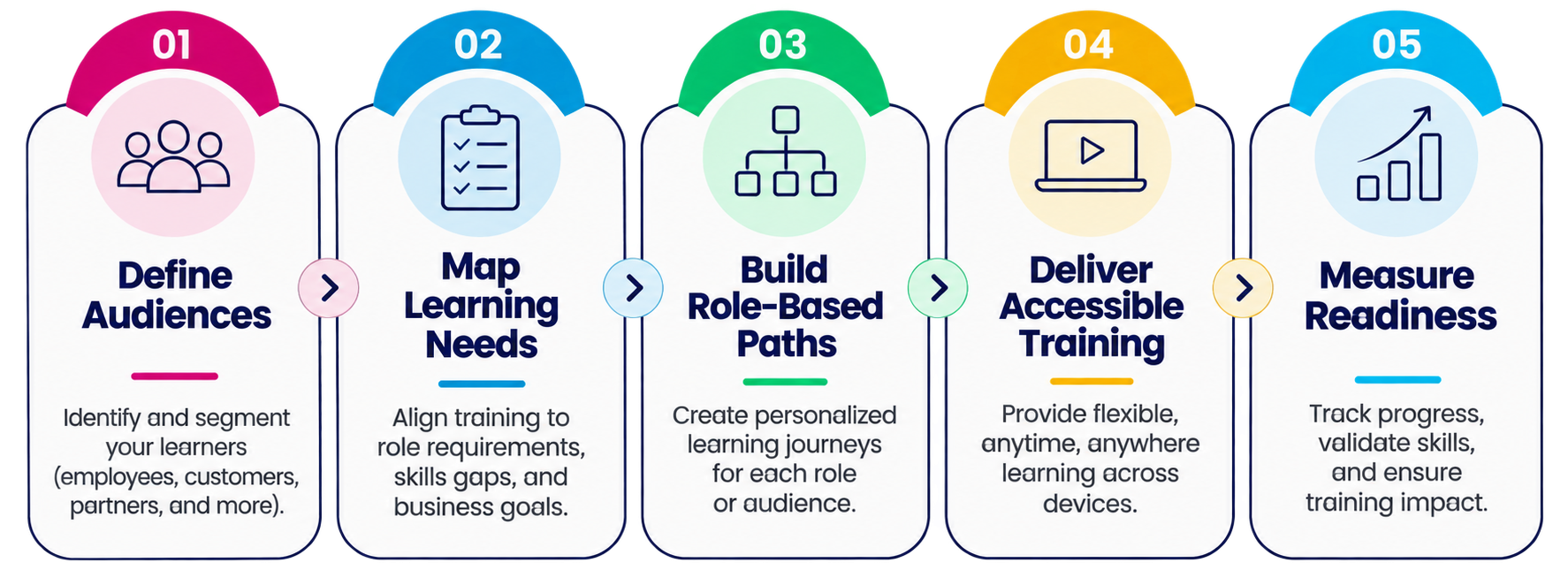
A strong partner training program starts with structure.
The first step is to define your partner audiences. Group partners by role, region, product line, maturity, certification level, or business need. This helps prevent the program from becoming too generic.
Next, identify what each group needs to know. A new reseller may need onboarding, product positioning, and sales enablement. A certified service partner may need advanced technical training and renewal requirements. A franchisee may need operational standards, brand guidance, and compliance updates.
From there, build training around clear outcomes. Good partner training should answer practical questions:
- What should this partner be able to do after training?
- What knowledge do they need to represent the brand correctly?
- What compliance or certification requirements must they meet?
- What content should be mandatory, recommended, or optional?
- How will the business measure readiness?
The best programs are also easy to access. Partners are busy, distributed, and often working outside your systems. Training needs to be available on demand, mobile-friendly, and simple to navigate.
Interactivity can help when it supports the learning goal. Short assessments, scenarios, product simulations, guided practice, and knowledge checks can make training more useful than static content alone. This is especially helpful for complex products, compliance-heavy roles, technical workflows, and certification-based partner programs.
Finally, partner training should be measured. Completion data is useful, but it is not enough by itself. Organizations should also look at engagement, assessment results, certification status, content usage, partner readiness, support volume, sales performance, customer satisfaction, or other indicators tied to the purpose of the program.
What to Look For in a Partner Training LMS
Partner training usually becomes difficult when companies try to manage it with systems built only for employees.
External training has different requirements. You need to support people who are outside the organization, often across multiple companies, countries, languages, brands, and permission levels.
A partner training LMS should support:
- Multi-audience learning: The platform should make it easy to create different experiences for different partner groups. Resellers, distributors, franchisees, contractors, and service partners may all need separate learning paths, portals, branding, permissions, and reporting views.
- Personalized learning paths: Partners should not have to search through irrelevant content. Learning paths should be based on role, region, certification level, product focus, or partner type.
- Mobile access: Partners may need to complete or reference training while traveling, selling, supporting customers, or working in the field. Mobile access helps learning fit into the flow of work.
- Global and multilingual support: For global partner networks, training must be consistent without being rigid. Multilingual content, regional flexibility, and localized experiences help partners learn in a way that fits their market.
- Compliance and certification tracking: Many partner programs require proof of training. The LMS should support certifications, deadlines, renewals, completion tracking, and reporting, especially in regulated or safety-sensitive industries.
- Analytics and reporting: Training teams need visibility into who is completing training, where partners are struggling, which content is being used, and where gaps exist. Strong reporting helps connect partner training to business outcomes.
- Integrations: Partner training is often connected to CRM, partner relationship management, sales enablement, HR, identity management, content systems, or eCommerce tools. Integrations reduce manual work and make training data more useful.
- Content creation and interactive learning: Teams should be able to create, update, and deliver partner training efficiently. Interactive content, assessments, and knowledge checks can help partners apply what they learn.
- eCommerce support, where relevant: Some organizations sell partner training, certification, or premium education. In those cases, eCommerce functionality can support paid programs and new revenue opportunities.
ROI and the Business Case for Partner Training
The business case for partner training is usually built around scale, consistency, and performance.
Without a structured training program, partner enablement often depends on manual support: repeated calls, one-off presentations, shared documents, email updates, regional workarounds, and inconsistent onboarding. That approach may work for a small partner network, but it becomes harder to manage as the business grows.
A partner training LMS can reduce that burden by making training repeatable, trackable, and easier to update. Instead of recreating the same training for every partner group, teams can deliver consistent learning paths and adapt them by role, region, or certification level.
The return is not only operational. Better-trained partners can ramp faster, represent the brand more accurately, answer customer questions more confidently, and stay aligned with product, compliance, and messaging changes.
Useful ROI indicators may include:
- Faster partner onboarding
- Lower training delivery costs
- Reduced manual administration
- Higher certification completion
- Better partner retention
- Fewer support requests
- Stronger content engagement
- Improved partner readiness
- Better visibility into performance gaps
The clearest business case comes when training is connected to measurable partner outcomes. That might mean sales readiness, implementation quality, compliance completion, customer satisfaction, or partner productivity.
How Does ExpertusONE Support Partner Training?
ExpertusONE helps organizations deliver scalable partner training across complex extended enterprise networks.
With ExpertusONE, organizations can create targeted learning experiences for different partner audiences, including resellers, franchisees, distributors, contractors, service partners, and other external stakeholders. Each group can receive training that reflects its role, goals, permissions, and business requirements.
The platform supports branded partner experiences, mobile learning, personalized learning paths, analytics, compliance tracking, integrations, and flexible content delivery. This helps organizations provide consistent training without forcing every partner into the same experience.
For global or multi-audience programs, ExpertusONE helps simplify administration while giving learning teams better visibility into partner engagement and readiness. Partners can access relevant training more easily, while the business can monitor progress, identify gaps, and improve the program over time.
The result is a partner training experience that is easier to manage, easier for partners to use, and better aligned with business goals.
How To Measure L&D Success
Measurement should reflect what the strategy is trying to achieve. Different audiences need different indicators, and different objectives call for different evidence.
An onboarding program may focus on time to proficiency and manager confidence. A compliance program may focus on completion, timeliness, certification status, and audit readiness. A customer education program may care more about adoption or support outcomes. A partner training program may care more about certification coverage and consistency.
In most enterprise environments, the right model is a mix of learning and business indicators, such as:
- Completion and assessment performance
- Certification status
- Engagement and usage
- Time to proficiency
- Manager confidence in readiness
- Customer adoption or support outcomes
- Sales productivity trends
- Compliance risk indicators
The goal is not to report more data. It is to create a clearer link between learning activity and business outcomes, so teams can show how training supports performance, reduces risk, and improves results.
Key Takeaways
- Partner training helps external teams represent your products, services, brand, and customer standards more consistently.
- Effective partner education should be tailored by audience, including resellers, distributors, franchisees, dealers, contractors, and service partners.
Strong programs focus on role-specific learning paths, easy access, practical content, certification, and ongoing updates.
- A partner training LMS helps organizations scale training beyond employees while maintaining visibility, governance, and consistency.
- Key platform requirements include multi-audience support, mobile access, multilingual delivery, analytics, compliance tracking, integrations, and personalized learning.
- Partner training can improve onboarding, reduce manual support, increase partner readiness, and strengthen long-term partner relationships.
FAQs
Partner training is useful for resellers, distributors, franchisees, vendors, contractors, dealers, service partners, implementation partners, and other external organizations that work with or represent your business.
Partner training commonly includes product knowledge, sales messaging, brand standards, compliance requirements, customer experience guidance, technical training, certifications, onboarding, and ongoing updates.
An LMS helps organizations deliver partner training at scale. It makes training easier to assign, access, track, update, and measure across different partner audiences, regions, and requirements.
Important features include multi-audience support, personalized learning paths, mobile access, multilingual support, certification tracking, analytics, integrations, content creation tools, and eCommerce support where paid training or certification is required.
A strong learning and development strategy helps organizations connect training to business needs, learner needs, and long-term capability building. This guide explains what an L&D strategy is, why it matters more now, what the strongest strategies have in common, and how different training priorities fit into one enterprise approach.
It also looks at the practical side of modern strategy: how to support different audiences, how technology shapes delivery, what trends are changing expectations, and how to measure success in ways that matter to the business.
Key Terms:
- Learning and Development Strategy
- L&D Strategy
- Enterprise Learning Strategy
- Employee Training Strategy
- Corporate Learning and Development
- Learning Strategy Framework
- Enterprise Training Platform
- Learning and Development Metrics
What is a Learning and Development Strategy?
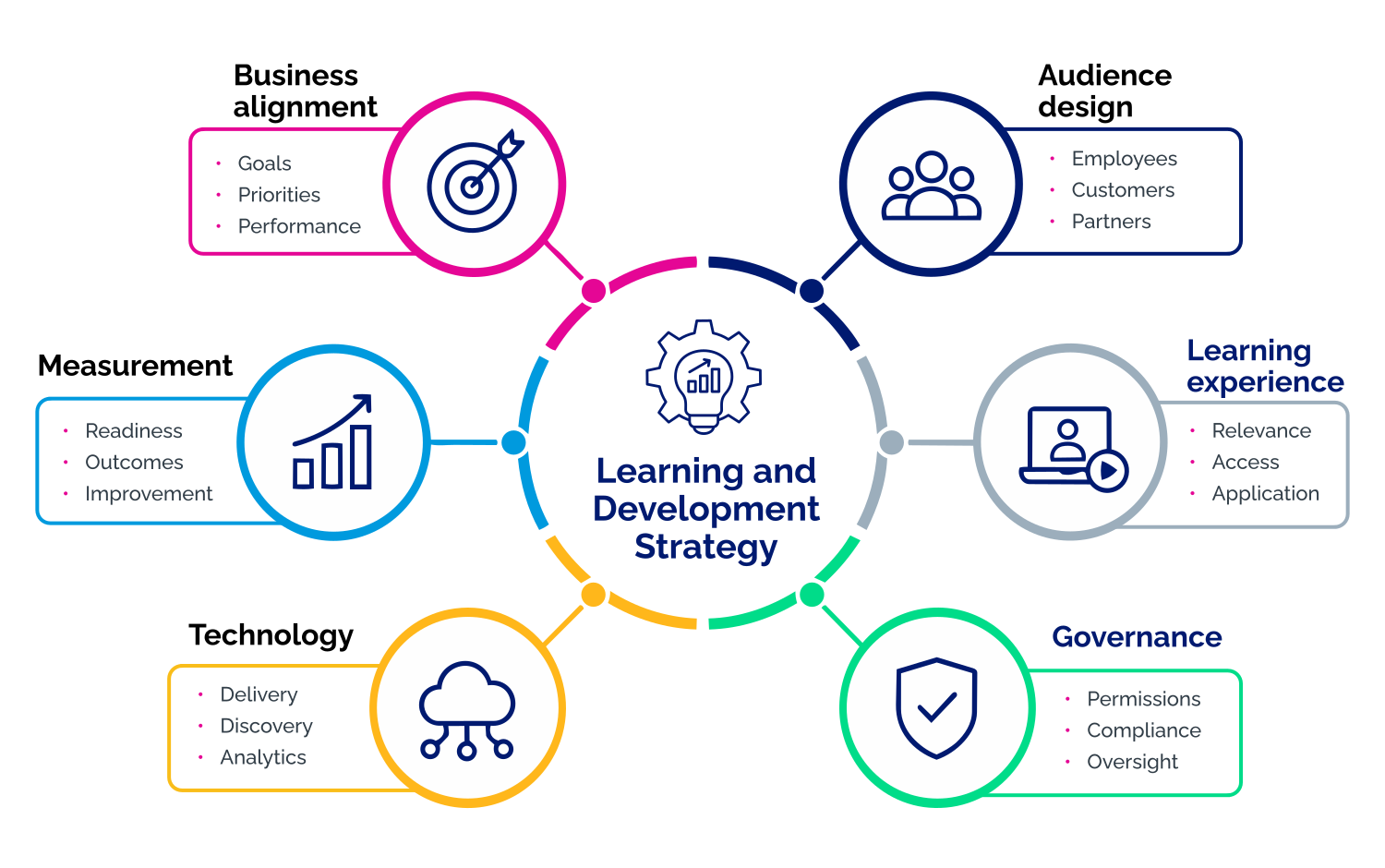
A learning and development strategy is the plan an organization uses to build capability over time. It defines who learning is for, what outcomes matter, how programs will be delivered, and how success will be measured. In enterprise settings, that usually goes well beyond employee training alone and can include onboarding, leadership development, customer education, partner training, compliance, and skills development.
That is why L&D strategy should not be treated as a content plan. It has to connect learning design, learner experience, governance, reporting, and technology. When those pieces are disconnected, training can become harder to scale, harder to govern, and harder to tie back to business outcomes.
A useful way to think about strategy is as an operating model for learning. It answers a few core questions:
- What business priorities should learning support?
- Which audiences need what kind of training?
- How should learning be delivered and reinforced?
- What systems and workflows will support it?
- How will the organization know whether it is working?
Why Does L&D Strategy Matter More Now?
Skills Are Changing Faster
The case for a stronger L&D strategy starts with the pace of skills change. The World Economic Forum says employers expect 39% of workers’ core skills to change by 2030, and it reports that 50% of the workforce has already completed training as part of long-term learning strategies, up from 41% in 2023. That points to a clear shift: continuous learning is increasingly part of how organizations respond to business change, not just a support activity around it.
LinkedIn’s Workplace Learning Report reinforces the same pressure from another angle. It found that 49% of learning and talent development professionals say executives are concerned employees do not have the right skills to execute business strategy. In other words, skills gaps are no longer an abstract future issue. They are already shaping how leaders think about business readiness.
Work Is More Flexible and More Complex
The environment in which learning happens has also changed. CIPD’s research found that 74% of organizations have hybrid working in place, and it highlights management effectiveness, collaboration, culture, and technology difficulties among the main issues that arise in hybrid and remote work. That matters because training now has to work across more devices, more schedules, more locations, and more job contexts than many older learning models were built for.
For many organizations, that complexity extends beyond employees. Customers, partners, franchisees, and contractors may all need some form of training, certification, or enablement. A modern L&D strategy has to account for those audiences without turning every use case into a separate system or a separate process. ExpertusONE reflects that enterprise reality with support for employees, customers, and partners, along with multi-audience learning and distributed administration.
Learners Expect Development, Not Just Course Delivery
Learner expectations have changed too. LinkedIn says career progress is people’s number-one motivation to learn, and only 15% of employees say their manager helped them build a career plan in the past six months. The same report says only 36% of organizations qualify as “career development champions” with mature programs that produce stronger business results.
That makes strategy more important because it pushes L&D beyond administration. It is no longer enough to assign content and track completion. Learning needs to feel relevant to role growth, capability building, and performance in order to earn attention and drive adoption.
Common Challenges That Weaken L&D Strategy
Learning Is Not Clearly Tied to Business Priorities
One of the most common problems in L&D is that training exists, but its purpose is unclear. Programs are launched, courses are assigned, and activity is reported, yet the link to business outcomes remains vague. That makes it harder to prioritize investment and harder to improve what is not working. LinkedIn’s finding that 49% of L&D professionals see executive concern about strategy-aligned skills makes this challenge especially visible.
A stronger strategy starts with business questions rather than course categories. That may mean focusing on ramp time, compliance risk, customer adoption, partner readiness, internal mobility, or productivity depending on the organization’s priorities.
Training Feels Generic or Irrelevant
Blanket training may be easy to distribute, but it often creates a poor learner experience. When content is too broad, too long, or too disconnected from the learner’s role, people may complete it without seeing much value in it. That undermines engagement and makes future training feel easier to ignore.
This is where audience design becomes important. A better strategy separates audiences and objectives so that learning can be more targeted. For example, onboarding, certification, manager development, and customer education may all sit inside the same overall strategy while still using very different learning experiences and measures of success.
The Learner Experience Creates Friction
Even good content can underperform in a poor delivery environment. If learning is hard to find, difficult to access on mobile, or disconnected from the systems people use every day, friction replaces momentum.
That challenge shows up more sharply in flexible and hybrid work, where the learner may be moving between devices, locations, and collaboration tools. It also shows up in external training, where customers or partners are less likely to tolerate a clumsy experience. ExpertusONE addresses this kind of issue through mobile learning, multi-audience support, and learning features built around learner access and distributed delivery.
Teams are Supporting Too Many Audiences With Too Little Structure
Enterprise learning rarely serves one audience. Internal employees may need onboarding, compliance, and career development. External audiences may need product education, certification, or partner enablement. Without the right structure, that can create duplicated content, inconsistent permissions, administrative sprawl, and fragmented reporting.
This is where governance and architecture start to matter. ExpertusONE supports this kind of model by giving partner or audience administrators enough control to assign learning, manage enrollments, and monitor results, while central teams retain overall oversight. That balance is often what makes multi-audience learning practical at scale.
Reporting is Too Narrow
Many teams can report on completion. Fewer can show whether training changed readiness, reduced risk, improved ramp time, or supported customer outcomes. When reporting is narrow, L&D ends up with limited evidence for improvement and a weaker business case.
That is one reason modern strategies place more weight on analytics and operational visibility. ExpertusONE supports this with a unified analytics view, along with audit-ready reporting and reminders tied to required training. The bigger point is that reporting should help teams act, not just document activity.
The Core Elements of an Effective L&D Strategy
Align Learning With Business Priorities
The strongest strategies begin with business context, not course catalogs. Different priorities lead to different learning models. A compliance-heavy environment will need a different strategy from one focused on sales performance, partner readiness, or onboarding speed.
A practical starting point is to ask:
- What business problem should learning help solve?
- Which audience needs to change behavior or build capability?
- What should improve if the learning works?
- What evidence will count as success?
Those answers create the foundation for everything that follows.
Define Audiences and Objectives Clearly
Not all learners need the same experience, and not all programs should be measured the same way. A useful approach is to define both the audience and the objective before deciding how learning will be delivered.
That often means mapping training across two dimensions:
- Audience: employees, managers, customers, partners, contractors, or regulated roles
- Objective: onboarding, compliance, certification, role readiness, skills development, customer success, or leadership growth
This structure makes prioritization easier and helps organizations avoid programs that try to serve everyone at once.
Design Learning for Relevance, Access, and Application
An L&D strategy should improve usability as much as knowledge transfer. Depending on the need, that could include formal courses, short modules, instructor-led training, assessments, searchable resources, coaching, or observation-based evaluation.
The key question is not only what content to build. It is what kind of learning experience will help this audience apply what they learned. ExpertusONE’s Observation Checklist is a useful example of this principle in practice because it is designed to track learner competency in real time and connect that observation data to broader learning data.
That kind of functionality is especially helpful in environments where demonstrated performance matters as much as course completion.
Build Governance Into Delivery
As learning expands across audiences, regions, and business units, governance becomes essential. That includes role-based permissions, reporting access, content control, versioning, reminders, and policies around who can assign or manage training.
Governance matters most in complex environments such as regulated industries, global organizations, decentralized structures, and extended enterprise models. ExpertusONE supports these needs with capabilities such as automated alerts, real-time reminders, and audit-ready reporting, which are exactly the kinds of operational controls that become important when learning supports risk-sensitive work.
Choose Technology That Reduces Complexity
Technology should make strategy easier to execute, not harder to manage. Many organizations still deal with separate systems for delivery, discovery, skills, reporting, and external training. Over time, that creates more friction for administrators and a less consistent experience for learners.
A better approach is to choose technology around operating needs. Those may include centralized administration, flexible audience management, stronger learner discovery, mobile access, analytics, and support for both internal and external learning.
ExpertusONE supports this kind of approach by bringing LMS, personalized discovery, and skills capabilities together in one enterprise platform.
Measure, Review, and Improve Continuously
L&D strategy should not be static because business priorities, skill needs, and learner expectations do not stand still. The strongest strategies include a review cycle that looks at participation, assessment data, certification status, learner feedback, readiness, and business outcomes, then adjusts programs accordingly.
That makes better reporting more than a measurement issue. It becomes part of how the strategy evolves over time.
Building Strategy for Different Audiences and Objectives
Employee Training
Employee training often forms the base of the learning strategy, but the goal is not simply content delivery. It is helping people build capability in ways that support performance, adaptability, and retention.
LinkedIn’s report says 88% of organizations are concerned about employee retention and that providing learning opportunities is respondents’ top retention strategy. It also says 91% of L&D professionals agree continuous learning is more important than ever for career success. Those findings help explain why employee training works best when it is connected to development, not only required learning.
Onboarding
Onboarding has one of the clearest business cases in L&D because it affects speed to productivity, confidence, and consistency. A stronger onboarding strategy usually includes role-based pathways, staged learning, practical knowledge checks, and manager visibility into progress.
For roles where capability has to be demonstrated, not just taught, observation tools can add real value. ExpertusONE supports this with Observation Checklists that help managers and instructors assess learner competency in action rather than relying only on completion records.
Sales Enablement
Sales training works best when it stays close to the flow of work. Reps need product knowledge, messaging, coaching, and performance support without having to leave their core tools for long periods.
ExpertusONE supports this kind of approach by making learning easier to access in context. In one white paper, a Fortune 100 insurance company reported a 38% increase in salespeople accessing learning resources and a 20% uplift in salesperson productivity. The broader lesson is that sales learning tends to work better when access is frictionless, and reinforcement happens in context, not just through standalone training events.
Customer Education
Customer education belongs inside the broader L&D strategy when product adoption, customer success, retention, and support efficiency matter. Good customer training helps users get value faster and creates a more consistent post-sale experience.
That usually means combining self-service access, structured onboarding journeys, searchable resources, and sometimes paid training or certification. ExpertusONE supports this with audience-specific learning experiences and eCommerce capabilities, which can be especially useful for organizations that want training to function as both a service and a revenue-supporting capability.
Partner Training
Partner training requires a different balance of usability and control. Partners need the right content with minimal friction, while the business needs branding consistency, reporting, and appropriate permissions across different partner groups.
ExpertusONE supports this with distributed learning management capabilities that let partner administrators assign learning, manage enrollments, and monitor results while central teams retain overall oversight. That kind of approach fits well in partner ecosystems where training needs to scale without losing structure.
Compliance Training
Compliance is one of the clearest examples of why strategy matters. The challenge is not only assigning mandatory content. It is keeping training current, trackable, defensible, and manageable across deadlines, regions, and roles.
An effective compliance strategy often includes:
- Clear assignment rules
- Recertification workflows
- Reminders and deadline visibility
- Audit-ready reporting
- Content versioning
- Evidence of demonstrated competence where needed
ExpertusONE supports these compliance needs with capabilities such as automated alerts, real-time reminders, and audit-ready reporting built into the training workflow.
The Technology Foundation for Modern L&D Strategy
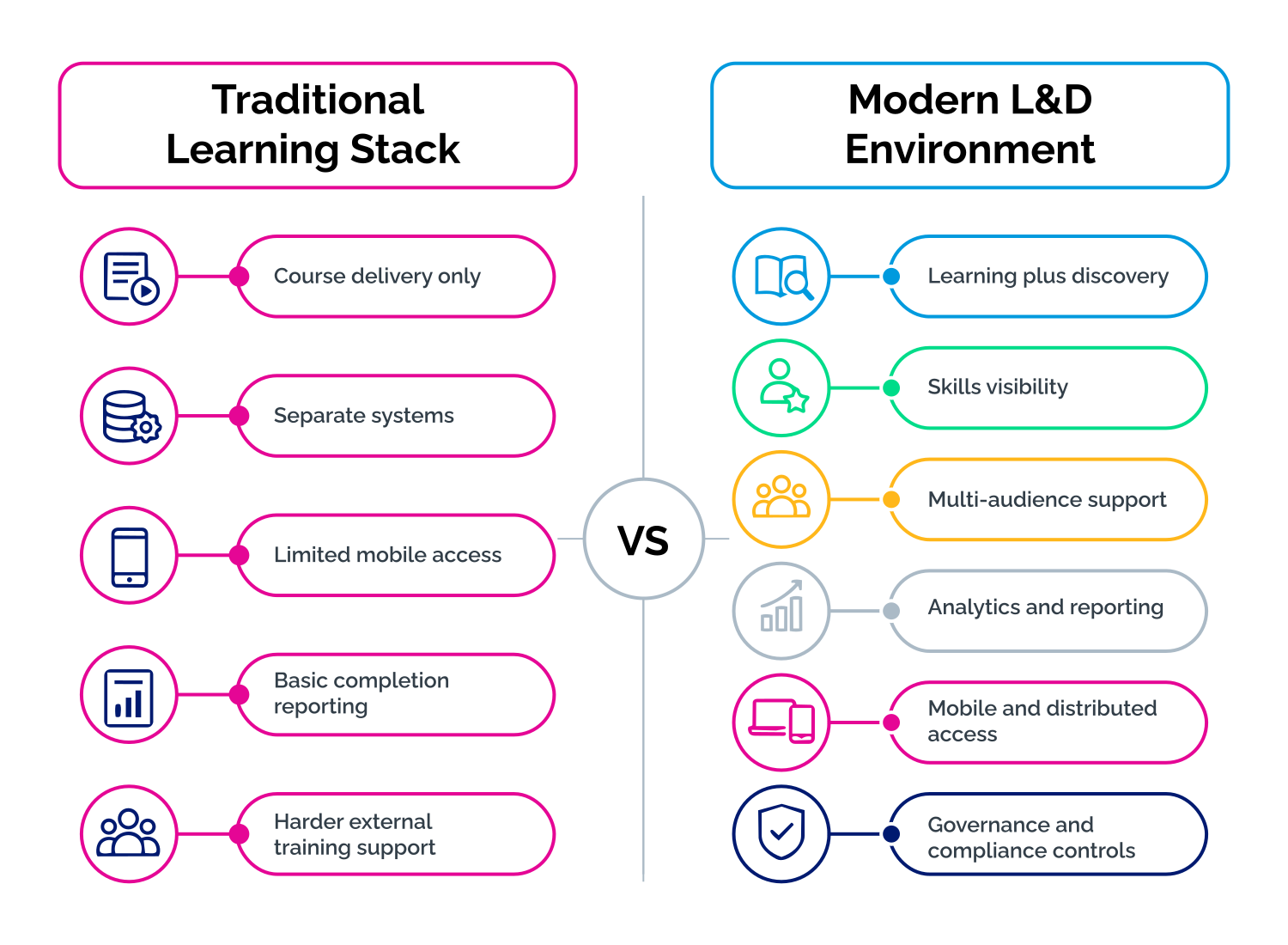
A traditional LMS still matters because organizations need assignment management, records, compliance tracking, and structured delivery. But modern L&D strategy usually needs more than that. It also needs better discovery, learner-facing usability, skills visibility, analytics, mobile access, and support for external audiences. ExpertusONE supports this broader model by bringing LMS, learning experience, skills, multi-audience support, mobile learning, and analytics together in one environment.
That matters because fragmented learning stacks create both learner friction and administrative overhead. A more unified environment can simplify governance, improve access, and make reporting easier to interpret across different audiences and use cases. In practice, that can be the difference between a strategy that is technically sound and one that is actually workable.
Trends Shaping Modern L&D Strategy
Several shifts are reshaping what a strong L&D strategy looks like. One is a higher standard for learning relevance. Broad, generic training is losing ground to experiences that feel more specific, actionable, and useful to the learner. That applies across audiences, not just employees. Customers, partners, sales teams, and internal roles all expect training that is tied to clear goals and designed for their context.
Another shift is the growing importance of digital experience. Learning technology is no longer judged only by whether it can assign and track courses. It is judged by how easy it is to use, how engaging it feels, and whether it supports more interactive, learner-friendly experiences. As expectations rise, organizations are putting more weight on personalization, flexible access, and learning environments that feel current rather than outdated.
There is also a stronger expectation that employers will take a more active role in capability building. Skills development, onboarding, and retention are becoming more tightly connected, which puts more pressure on organizations to create learning environments people can use anytime, anywhere, and across different stages of the employee experience. In that context, L&D strategy is becoming less about distributing training and more about creating a digital learning experience that supports growth, engagement, and long-term retention.
How To Measure L&D Success
Measurement should reflect what the strategy is trying to achieve. Different audiences need different indicators, and different objectives call for different evidence.
An onboarding program may focus on time to proficiency and manager confidence. A compliance program may focus on completion, timeliness, certification status, and audit readiness. A customer education program may care more about adoption or support outcomes. A partner training program may care more about certification coverage and consistency.
In most enterprise environments, the right model is a mix of learning and business indicators, such as:
- Completion and assessment performance
- Certification status
- Engagement and usage
- Time to proficiency
- Manager confidence in readiness
- Customer adoption or support outcomes
- Sales productivity trends
- Compliance risk indicators
The goal is not to report more data. It is to create a clearer link between learning activity and business outcomes, so teams can show how training supports performance, reduces risk, and improves results.
Key Takeaways
Strong L&D strategy connects learning to business goals, learner needs, and long-term capability building.
Effective programs are relevant, accessible, and designed for real job performance, not just course completion.
Enterprise strategies often need to support employees, customers, partners, and compliance requirements in one model.
Modern learning platforms should improve discovery, access, administration, and reporting, not just deliver courses.
Common strategy enablers include personalization, mobile access, multi-audience support, analytics, and governance.
Success should be measured through business and learner outcomes, not completions alone.
FAQs
It helps organizations make learning more relevant, scalable, and measurable. That matters in an environment where employers expect 39% of workers’ core skills to change by 2030, and many learning leaders already see executive concern about whether employees have the right skills to execute business strategy.
Most enterprise strategies should include business alignment, audience definition, learning design, governance, technology support, reporting, and continuous improvement. In many organizations, it also needs to support external audiences such as customers and partners.
Measure success by audience and objective, then combine operational indicators with business outcomes. Good measurement should help show whether learning is improving readiness, reducing risk, supporting retention, or driving performance, not just how many courses were completed.
ExpertusONE supports enterprise L&D strategy with a mix of LMS, learning experience, skills, analytics, multi-audience support, mobile learning, partner administration tools, customer enablement capabilities, compliance reporting, and observation-based competency tracking.


