
BLOG
The Complete Guide to Sales Enablement
 Author: Greg Bashar
BLOG
The Complete Guide to Sales Enablement
Author: Greg Bashar
Sales enablement is all about giving sales teams the training, content, coaching, tools, and data they need to sell more. As buying journeys become more digital and complex, sellers need support that is timely, relevant, and easy to access. A strong sales enablement strategy helps teams ramp faster, stay current on products and messaging, improve buyer conversations, and connect learning to business outcomes.
This guide explains how to build a scalable sales enablement program, use an LMS to support training and performance, choose the right technology, coach sellers more consistently, and measure enablement success.
Key Terms:
- Sales Enablement
- Sales Enablement Strategy
- Sales Enablement Training
- Sales Training
- Sales Coaching
- Sales Readiness
- Sales Enablement Software
- LMS for Sales Enablement
What is Sales Enablement?
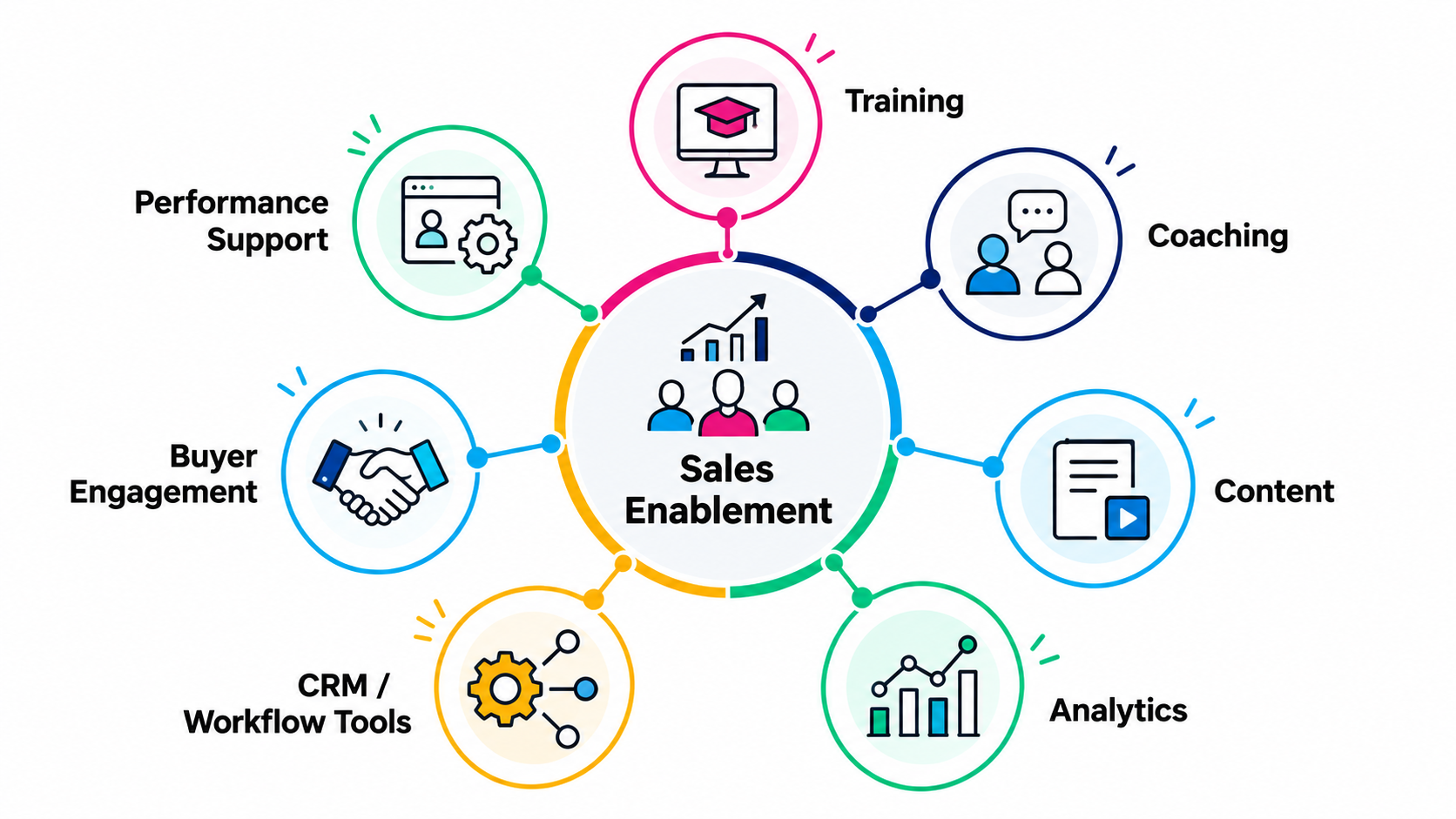
Sales enablement is the process of equipping sales teams with the information, content, training, coaching, tools, and support they need to sell more effectively.
Gartner defines sales enablement as providing the sales organization with the information, content, and tools that help sellers sell more effectively. In practice, that work often includes:
- Sales onboarding
- Product training
- Messaging and positioning support
- Buyer education
- Competitive readiness
- Sales process training
- Coaching and role-play
- Content management
- CRM and workflow integration
- Analytics and performance reporting
Sales enablement is broader than sales training. Training helps sellers learn. Enablement helps sellers perform.
That distinction matters. A sales rep may complete a product course and still struggle to explain the product in the context of a buyer’s industry, pain points, objections, or buying stage. Effective enablement closes that gap. It connects knowledge to action.
Why Does Sales Enablement Matter Now?
Sales has become more complex. Buyers do more independent research. Buying committees are larger. Sales cycles include more digital touchpoints. Sales teams often work across regions, channels, and hybrid environments. New products, messaging updates, market changes, and competitive shifts can quickly make yesterday’s training outdated.
At the same time, sales teams are under pressure to do more with less. Salesforce reports that non-selling tasks, including administrative work and meeting preparation, consume 70% of reps’ time. When sellers spend most of their day outside active selling, enablement has to reduce friction instead of adding to it.
Sales leaders see the opportunity. Salesforce’s State of Sales report found that the number-one growth tactic for sales leaders is improving sales enablement and training. The goal is not to create more content, more courses, or more tools. The goal is to help salespeople answer the buyer’s next question with confidence.
That requires enablement that is:
- Easy to access
- Relevant to the seller’s role
- Aligned with the sales process
- Connected to real performance data
- Available in the systems sellers already use
- Flexible enough to support ongoing change
How to Build a Sales Enablement Strategy?
A sales enablement strategy should start with the business problem, not the training calendar.
Too often, enablement begins with a familiar request: “We need a course.” But a course is only useful when it solves a real performance problem. Before building content, sales and enablement leaders should define what needs to improve.
Common goals include:
- Reducing sales ramp time
- Improving product knowledge
- Increasing win rates
- Standardizing messaging
- Supporting new product launches
- Improving partner or channel readiness
- Strengthening manager coaching
- Reducing time spent searching for content
- Connecting learning activity to sales outcomes
Align Enablement With the Sales Process
Sales enablement should follow the way sellers actually sell. That means training and content should be mapped to stages of the sales process. A rep preparing for a discovery call needs different support than a rep handling pricing objections, building a proposal, or renewing an enterprise account.
A practical sales enablement strategy should answer:
- What does the seller need to know at each stage?
- What content helps the buyer move forward?
- What skills are required for each sales motion?
- Where do sellers most often get stuck?
- What can managers coach in the moment?
- What data shows whether enablement is working?
This is also where CRM integration matters. If learning and sales systems are disconnected, enablement becomes harder to measure and harder for sellers to use. When enablement is connected to the sales workflow, sellers can access training, content, and reminders without leaving the tools they already rely on.
ExpertusONE, for example, supports learning inside familiar sales workflows through Salesforce, Slack, and Microsoft Teams integrations. Its sales enablement solution connects content creation, management, and tracking in one system, with Salesforce integration designed to link learning activity and training completion with sales performance metrics.
Prioritize Relevance
Sales teams do not need more generic content. They need content that fits their role, region, product line, customer segment, and sales motion.
A new enterprise account executive may need deep product and discovery training. A partner seller may need certification, brand messaging, and co-selling guidance. A field rep may need mobile access to short refreshers before a customer meeting.
The more specific enablement becomes, the more useful it is.
That does not mean every learner needs a fully custom program. It means enablement should be structured so the right learners receive the right materials at the right time.
Sales Enablement Training Best Practices
Sales enablement training should not end after onboarding.
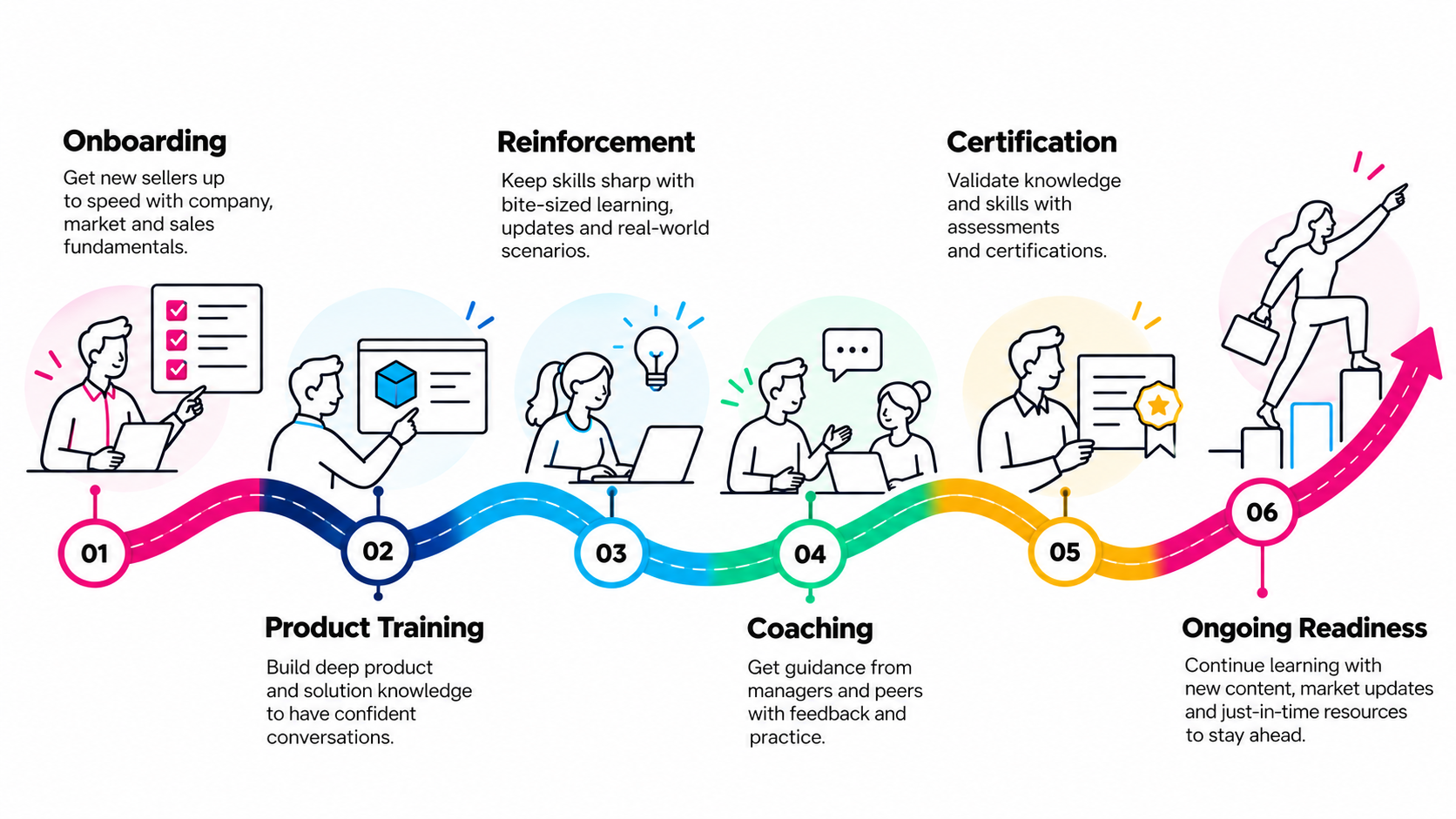
Onboarding matters. New sellers need to understand the company, product, messaging, market, sales process, tools, and expectations. But the most effective sales enablement programs continue long after ramp.
Gartner notes that nearly half of sellers believe the skills in their current role will be outdated within two to three years. That makes continuous training essential.
Start With Onboarding, Then Reinforce Over Time
Sales onboarding should help reps become productive faster. But one-time training rarely sticks on its own.
A stronger approach combines:
- Structured onboarding paths
- Product and messaging certifications
- Short refreshers after launch updates
- Scenario-based practice
- Manager coaching checkpoints
- Role-specific learning paths
- Content that sellers can revisit when needed
The goal is to move from “event-based training” to continuous readiness.
Use Microlearning for Moments of Need
Salespeople rarely have time to stop and search through long training modules during the workday. Microlearning helps by breaking information into shorter, easier-to-use formats.
Microlearning works especially well for:
- Product updates
- Competitive talking points
- Objection handling
- Compliance refreshers
- Short demos
- Messaging reminders
- New feature releases
- Deal-stage guidance
This is not about making training shorter for the sake of it. It is about making training usable when the seller needs it.
Personalize Training by Role and Need
Sales teams are not one audience.
Different sellers may need different enablement based on:
- Territory
- Product line
- Experience level
- Sales motion
- Customer segment
- Partner type
- Performance gaps
- Compliance requirements
Personalization helps sellers avoid irrelevant training and focus on the knowledge or skills most likely to improve performance.
AI can support this work by recommending learning paths, surfacing relevant content, and helping administrators match training to learner needs. The best use of AI in sales enablement is not hype. It is reducing manual work, improving relevance, and helping sellers find what they need faster.
Why Use an LMS for Sales Enablement?
Sales enablement becomes difficult to manage when training, content, coaching, data, and certifications live in separate systems.
An LMS can serve as the operational foundation for sales enablement by centralizing learning delivery, content access, tracking, reporting, compliance, and learner management. For large organizations, this matters because sales enablement often needs to support multiple teams, regions, products, and audiences at once.
A modern LMS can help organizations:
- Assign role-based training
- Manage onboarding paths
- Deliver mobile learning
- Track certifications
- Host product and messaging content
- Support live and virtual sessions
- Connect training to sales systems
- Report on learning progress
- Serve internal teams, partners, and external audiences
Make Training Accessible Anywhere
Salespeople are often on the move. They may be traveling, working remotely, preparing for a customer call, or supporting a partner conversation. Enablement needs to be available in those moments.
ExpertusONE’s sales enablement solution includes mobile access so salespeople can pull up critical content during calls, download videos for offline viewing, and launch classes from a mobile device.
That kind of access matters because enablement should not depend on where the seller happens to be working.
Centralize Sales Content
Sales content often becomes scattered. Product decks live in one folder. Competitive notes live somewhere else. Training courses sit in an LMS. Messaging updates live in a slide deck. Coaching notes stay with managers. Reps create their own versions when they cannot find what they need.
That creates risk. Sellers may use outdated messaging, miss important compliance updates, or lose time searching for basic information.
A centralized learning and content environment helps teams manage:
- Course content
- Product resources
- Sales playbooks
- Messaging updates
- Certification materials
- Coaching assets
- Compliance requirements
- Analytics and reporting
The result is not just easier administration. It is a more consistent buyer experience.
Connect Enablement to Data
Sales enablement leaders need to know what is working.
Gartner expects 65% of B2B sales organizations to move from intuition-based to data-driven decision-making by 2026, using technology that connects workflow, data, and analytics. Yet Gartner also notes that, on average, only 22% of the sales enablement budget is allocated to technology.
Without connected data, sales enablement teams may know who completed training, but not whether training changed behavior or improved outcomes.
A stronger system connects learning data with business questions:
- Are new reps ramping faster?
- Which teams are completing required training?
- Which content is being used?
- Where are sellers struggling?
- Which certifications correlate with performance?
- Which managers need more coaching visibility?
- Which regions need additional support?
Sales Coaching, Collaboration, and Performance Support
Training gives sellers knowledge. Coaching helps turn that knowledge into behavior.
Sales coaching is where managers help reps improve through feedback, practice, observation, and reinforcement. It may include call reviews, role-play, deal strategy, objection handling, pipeline inspection, or skill development.
The challenge is consistency. In many organizations, coaching depends heavily on the manager. Some teams get frequent, structured support. Others get occasional feedback when a deal is at risk.
A better approach makes coaching part of the enablement system.
Use Data to Guide Coaching
Managers should not have to guess where sellers need help.
Learning data, performance data, assessment results, and certification progress can help managers identify coaching opportunities. For example, a manager may see that a rep has completed product training but is struggling with discovery questions. Another rep may be strong in early-stage conversations but need help with negotiation.
Data does not replace manager judgment. It gives managers a clearer place to start.
Support Coaching in Hybrid Environments
Sales coaching no longer happens only in conference rooms or ride-alongs. Hybrid and remote teams need coaching that works across locations.
A learning platform can support:
- Virtual coaching sessions
- Recorded sessions
- Role-play activities
- Manager feedback
- Observation checklists
- Coaching assignments
- Peer collaboration
- Follow-up learning paths
ExpertusONE includes features such as Observation Checklist, data-driven insights, a Digital Content Player, and integrations that can support coaching, assessments, content delivery, and learning in the flow of work.
Encourage Peer Learning
Sales teams learn from each other.
High-performing reps often know which examples resonate, which objections are becoming common, and which messages are working in the field. Enablement programs should make that knowledge easier to share.
Collaborative learning can include discussion forums, shared resource libraries, manager-led sessions, group practice, feedback loops, and recognition for sellers who contribute useful examples.
This helps move enablement from a top-down program to a shared operating rhythm.
How to Choose Sales Enablement Software?
Sales enablement software should make it easier for sellers to learn, prepare, engage buyers, and improve performance. It should not become another disconnected tool.
When evaluating sales enablement platforms, look for technology that supports the full enablement lifecycle: onboarding, content, training, coaching, analytics, integrations, and continuous improvement.
Key Capabilities to Look For
A strong sales enablement platform should support:
- CRM integration: Sellers should be able to access enablement resources in the systems where they already work.
- Role-based learning paths: Training should reflect the needs of different teams, regions, roles, and sales motions.
- Mobile access: Sellers should be able to learn, review, and access content on the go.
- Content governance: Teams should be able to manage versions, update materials, and reduce outdated content.
- Reporting and analytics: Leaders should be able to track completion, engagement, readiness, certifications, and performance trends.
- Coaching support: Managers need tools to observe, guide, assess, and reinforce learning.
- Scalability: Enterprise sales enablement often includes global teams, partners, channels, compliance requirements, and multiple learner audiences.
- Ease of administration: Enablement teams should be able to assign training, update content, and generate reports without excessive manual work.
Avoid Tool Sprawl
Many sales teams already have too many systems. Adding another platform only helps if it reduces friction.
The question is not simply, “Does this tool have the right features?” The better question is, “Will this tool make sales enablement easier to use, easier to manage, and easier to measure?”
For sales organizations, that usually means choosing tools that integrate with CRM, communication platforms, content systems, and learning workflows.
Measuring Sales Enablement Success
Sales enablement should be measured by more than course completion.
Completion matters, especially for required training and certifications. But sales leaders also need to know whether enablement is improving readiness, productivity, and outcomes.
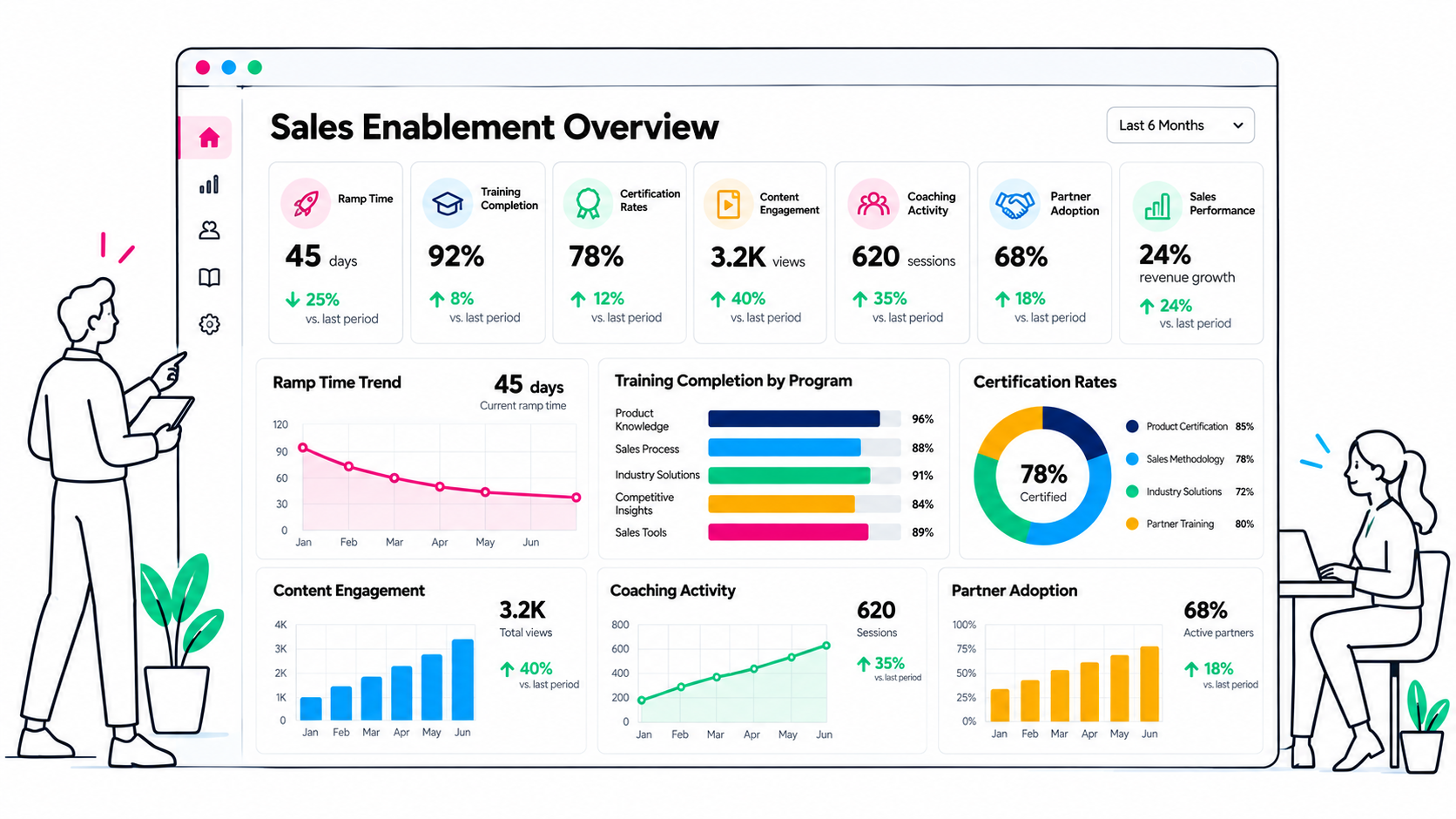
Useful sales enablement metrics include:
- Ramp time
- Training completion
- Certification rates
- Content engagement
- Coaching participation
- Assessment results
- Sales readiness scores
- Time spent selling
- Win rates
- Deal velocity
- Pipeline contribution
- Partner training adoption
- Compliance completion
- Manager coaching activity
Not every organization will track every metric. The best measurement strategy depends on the business goal.
If the goal is faster onboarding, ramp time and early productivity matter. If the goal is stronger messaging, assessment results and manager observation may matter more. If the goal is partner growth, certification completion and partner engagement may be more relevant.
Extend Enablement to Partners and Channel Teams
Sales enablement is not limited to internal sellers.
Many organizations rely on partners, resellers, franchisees, distributors, or external sales channels. These teams also need product knowledge, brand consistency, certification, messaging, and access to current resources.
Partner enablement creates a different set of challenges. External teams may not share the same systems, locations, languages, or workflows. They may need training that is structured, trackable, and easy to access without creating unnecessary administrative burden.
ExpertusONE’s partner training solution supports channel partners with interactive content, mobile access, distributed learning management, automated compliance tracking, and partner-specific portals. A Director of Operations at a cloud computing development organization said ExpertusONE played a significant role in the successful delivery and adoption of their partner certification program.
That is the larger value of a scalable learning platform: it can support internal sellers and external audiences without forcing every group into the same experience.
How Does ExpertusONE Support Sales Enablement?
ExpertusONE helps organizations deliver sales enablement through a learning platform designed for complex training environments.
For sales teams, ExpertusONE brings together content creation, learning management, mobile access, analytics, integrations, and workflow-based learning. Sellers can access training inside Salesforce, learn on mobile devices, receive reminders, complete required training, and connect learning activity with sales performance metrics.
For administrators and enablement leaders, ExpertusONE supports role-based assignments, tracking, content delivery, reporting, and multi-audience learning management. For extended enterprise teams, it can support partners, customers, distributors, and other external learners from a single learning environment.
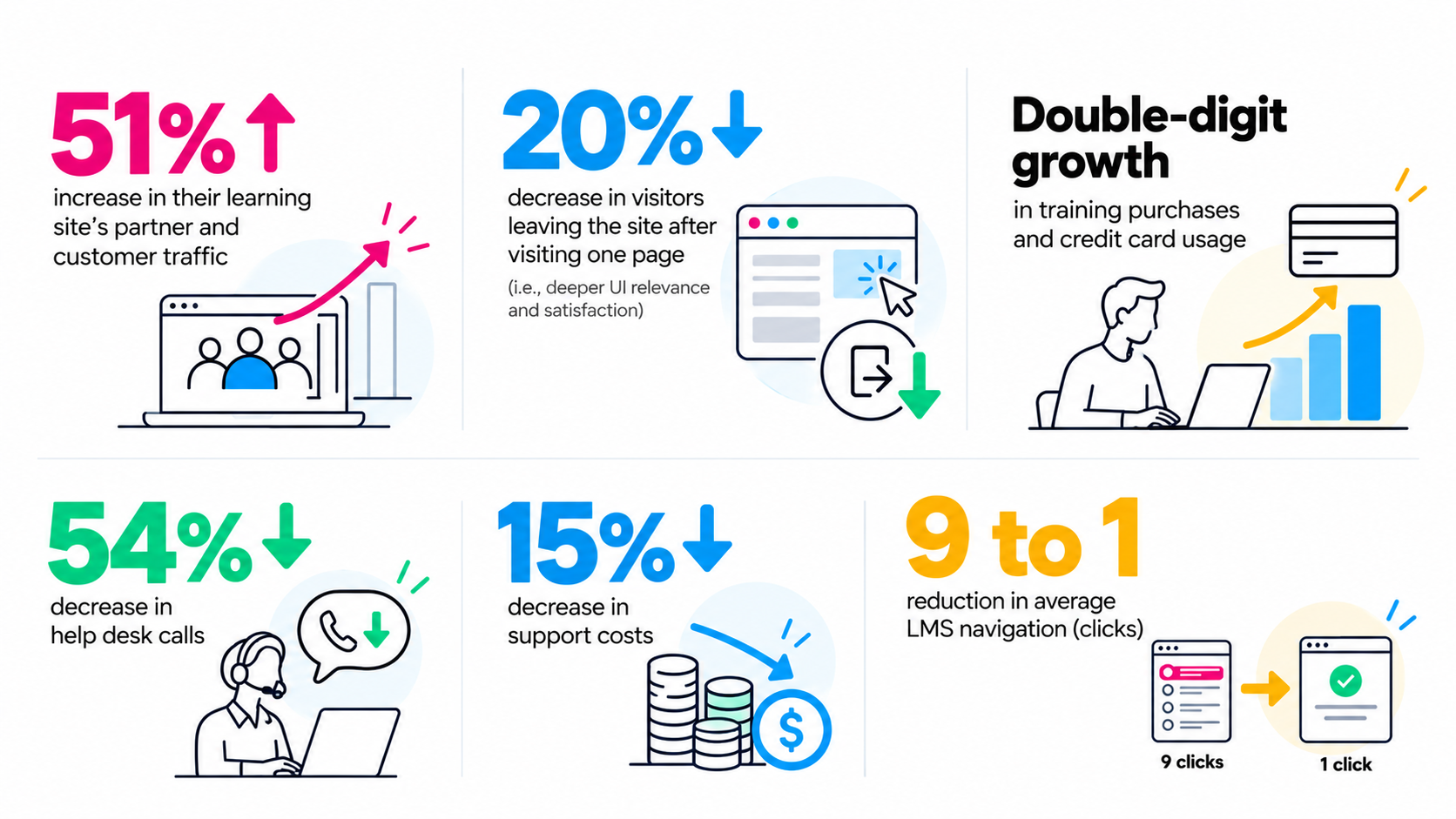
Case study: One of the world’s leading IT infrastructure companies used ExpertusONE to replace a cumbersome legacy LMS with a more intuitive partner and customer training experience across 400 offices in 60 countries. The company increased partner and customer learning-site traffic by 51%, reduced help desk calls by 54%, cut support costs by 15%, and reduced average LMS navigation from nine clicks to one.
Sales enablement is ultimately about readiness. Sellers need the right knowledge, at the right moment, in the right workflow. Leaders need visibility into what is working. Managers need better ways to coach. Partners need consistent training and resources. Buyers need sellers who can help them make sense of complex decisions.
That is the work a modern sales enablement strategy should support.
Key Takeaways
- Sales enablement helps sellers access the training, content, coaching, tools, and data they need to sell more effectively.
- A strong strategy starts with business goals, not training requests, and should focus on ramp time, consistency, readiness, and buyer conversations.
- Sales training works best when it is continuous, role-specific, easy to access, and reinforced through coaching and practice.
- An LMS can provide the operational foundation for sales enablement by centralizing learning, content, certifications, analytics, and partner training.
- The right sales enablement software should integrate with sales workflows, support mobile learning, provide strong analytics, and scale across teams, regions, and external audiences.
- Success should be measured through readiness and business impact, not just course completion. Key metrics may include ramp time, certification rates, content engagement, coaching activity, partner adoption, and sales performance.
FAQs
An LMS supports sales enablement by centralizing training, content, certifications, reporting, and learner management. A modern LMS can deliver role-based learning, mobile access, coaching support, analytics, and integrations with systems such as Salesforce, Slack, and Microsoft Teams.
Look for sales enablement software that supports CRM integration, personalized learning paths, content governance, mobile access, reporting, coaching, collaboration, and enterprise scalability. The right platform should make enablement easier for sellers to use and easier for leaders to measure.
Yes. Sales enablement can support partners, resellers, distributors, franchises, and other external sales channels. These audiences often need product training, certification, compliance tracking, brand messaging, and easy access to current resources.
Sales coaching helps turn learning into behavior. It gives managers a way to reinforce training, provide feedback, identify skill gaps, and help sellers improve in real sales situations. Coaching works best when it is supported by data, structured feedback, and ongoing learning paths.
Sales enablement is all about giving sales teams the training, content, coaching, tools, and data they need to sell more. As buying journeys become more digital and complex, sellers need support that is timely, relevant, and easy to access. A strong sales enablement strategy helps teams ramp faster, stay current on products and messaging, improve buyer conversations, and connect learning to business outcomes.
This guide explains how to build a scalable sales enablement program, use an LMS to support training and performance, choose the right technology, coach sellers more consistently, and measure enablement success.
Key Terms:
- Sales Enablement
- Sales Enablement Strategy
- Sales Enablement Training
- Sales Training
- Sales Coaching
- Sales Readiness
- Sales Enablement Software
- LMS for Sales Enablement
What is Sales Enablement?
Sales enablement is the process of equipping sales teams with the information, content, training, coaching, tools, and support they need to sell more effectively.
Gartner defines sales enablement as providing the sales organization with the information, content, and tools that help sellers sell more effectively. In practice, that work often includes:
- Sales onboarding
- Product training
- Messaging and positioning support
- Buyer education
- Competitive readiness
- Sales process training
- Coaching and role-play
- Content management
- CRM and workflow integration
- Analytics and performance reporting
Sales enablement is broader than sales training. Training helps sellers learn. Enablement helps sellers perform.
That distinction matters. A sales rep may complete a product course and still struggle to explain the product in the context of a buyer’s industry, pain points, objections, or buying stage. Effective enablement closes that gap. It connects knowledge to action.
Why Does Sales Enablement Matter Now?
Sales has become more complex. Buyers do more independent research. Buying committees are larger. Sales cycles include more digital touchpoints. Sales teams often work across regions, channels, and hybrid environments. New products, messaging updates, market changes, and competitive shifts can quickly make yesterday’s training outdated.
At the same time, sales teams are under pressure to do more with less. Salesforce reports that non-selling tasks, including administrative work and meeting preparation, consume 70% of reps’ time. When sellers spend most of their day outside active selling, enablement has to reduce friction instead of adding to it.
Sales leaders see the opportunity. Salesforce’s State of Sales report found that the number-one growth tactic for sales leaders is improving sales enablement and training. The goal is not to create more content, more courses, or more tools. The goal is to help salespeople answer the buyer’s next question with confidence.
That requires enablement that is:
- Easy to access
- Relevant to the seller’s role
- Aligned with the sales process
- Connected to real performance data
- Available in the systems sellers already use
- Flexible enough to support ongoing change
How to Build a Sales Enablement Strategy?
A sales enablement strategy should start with the business problem, not the training calendar.
Too often, enablement begins with a familiar request: “We need a course.” But a course is only useful when it solves a real performance problem. Before building content, sales and enablement leaders should define what needs to improve.
Common goals include:
- Reducing sales ramp time
- Improving product knowledge
- Increasing win rates
- Standardizing messaging
- Supporting new product launches
- Improving partner or channel readiness
- Strengthening manager coaching
- Reducing time spent searching for content
- Connecting learning activity to sales outcomes
Align Enablement With the Sales Process
Sales enablement should follow the way sellers actually sell. That means training and content should be mapped to stages of the sales process. A rep preparing for a discovery call needs different support than a rep handling pricing objections, building a proposal, or renewing an enterprise account.
A practical sales enablement strategy should answer:
- What does the seller need to know at each stage?
- What content helps the buyer move forward?
- What skills are required for each sales motion?
- Where do sellers most often get stuck?
- What can managers coach in the moment?
- What data shows whether enablement is working?
This is also where CRM integration matters. If learning and sales systems are disconnected, enablement becomes harder to measure and harder for sellers to use. When enablement is connected to the sales workflow, sellers can access training, content, and reminders without leaving the tools they already rely on.
ExpertusONE, for example, supports learning inside familiar sales workflows through Salesforce, Slack, and Microsoft Teams integrations. Its sales enablement solution connects content creation, management, and tracking in one system, with Salesforce integration designed to link learning activity and training completion with sales performance metrics.
Prioritize Relevance
Sales teams do not need more generic content. They need content that fits their role, region, product line, customer segment, and sales motion.
A new enterprise account executive may need deep product and discovery training. A partner seller may need certification, brand messaging, and co-selling guidance. A field rep may need mobile access to short refreshers before a customer meeting.
The more specific enablement becomes, the more useful it is.
That does not mean every learner needs a fully custom program. It means enablement should be structured so the right learners receive the right materials at the right time.
Sales Enablement Training Best Practices
Sales enablement training should not end after onboarding.
Onboarding matters. New sellers need to understand the company, product, messaging, market, sales process, tools, and expectations. But the most effective sales enablement programs continue long after ramp.
Gartner notes that nearly half of sellers believe the skills in their current role will be outdated within two to three years. That makes continuous training essential.
Start With Onboarding, Then Reinforce Over Time
Sales onboarding should help reps become productive faster. But one-time training rarely sticks on its own.
A stronger approach combines:
- Structured onboarding paths
- Product and messaging certifications
- Short refreshers after launch updates
- Scenario-based practice
- Manager coaching checkpoints
- Role-specific learning paths
- Content that sellers can revisit when needed
The goal is to move from “event-based training” to continuous readiness.
Use Microlearning for Moments of Need
Salespeople rarely have time to stop and search through long training modules during the workday. Microlearning helps by breaking information into shorter, easier-to-use formats.
Microlearning works especially well for:
- Product updates
- Competitive talking points
- Objection handling
- Compliance refreshers
- Short demos
- Messaging reminders
- New feature releases
- Deal-stage guidance
This is not about making training shorter for the sake of it. It is about making training usable when the seller needs it.
Personalize Training by Role and Need
Sales teams are not one audience.
Different sellers may need different enablement based on:
- Territory
- Product line
- Experience level
- Sales motion
- Customer segment
- Partner type
- Performance gaps
- Compliance requirements
Personalization helps sellers avoid irrelevant training and focus on the knowledge or skills most likely to improve performance.
AI can support this work by recommending learning paths, surfacing relevant content, and helping administrators match training to learner needs. The best use of AI in sales enablement is not hype. It is reducing manual work, improving relevance, and helping sellers find what they need faster.
Why Use an LMS for Sales Enablement?
Sales enablement becomes difficult to manage when training, content, coaching, data, and certifications live in separate systems.
An LMS can serve as the operational foundation for sales enablement by centralizing learning delivery, content access, tracking, reporting, compliance, and learner management. For large organizations, this matters because sales enablement often needs to support multiple teams, regions, products, and audiences at once.
A modern LMS can help organizations:
- Assign role-based training
- Manage onboarding paths
- Deliver mobile learning
- Track certifications
- Host product and messaging content
- Support live and virtual sessions
- Connect training to sales systems
- Report on learning progress
- Serve internal teams, partners, and external audiences
Make Training Accessible Anywhere
Salespeople are often on the move. They may be traveling, working remotely, preparing for a customer call, or supporting a partner conversation. Enablement needs to be available in those moments.
ExpertusONE’s sales enablement solution includes mobile access so salespeople can pull up critical content during calls, download videos for offline viewing, and launch classes from a mobile device.
That kind of access matters because enablement should not depend on where the seller happens to be working.
Centralize Sales Content
Sales content often becomes scattered. Product decks live in one folder. Competitive notes live somewhere else. Training courses sit in an LMS. Messaging updates live in a slide deck. Coaching notes stay with managers. Reps create their own versions when they cannot find what they need.
That creates risk. Sellers may use outdated messaging, miss important compliance updates, or lose time searching for basic information.
A centralized learning and content environment helps teams manage:
- Course content
- Product resources
- Sales playbooks
- Messaging updates
- Certification materials
- Coaching assets
- Compliance requirements
- Analytics and reporting
The result is not just easier administration. It is a more consistent buyer experience.
Connect Enablement to Data
Sales enablement leaders need to know what is working.
Gartner expects 65% of B2B sales organizations to move from intuition-based to data-driven decision-making by 2026, using technology that connects workflow, data, and analytics. Yet Gartner also notes that, on average, only 22% of the sales enablement budget is allocated to technology.
Without connected data, sales enablement teams may know who completed training, but not whether training changed behavior or improved outcomes.
A stronger system connects learning data with business questions:
- Are new reps ramping faster?
- Which teams are completing required training?
- Which content is being used?
- Where are sellers struggling?
- Which certifications correlate with performance?
- Which managers need more coaching visibility?
- Which regions need additional support?
Sales Coaching, Collaboration, and Performance Support
Training gives sellers knowledge. Coaching helps turn that knowledge into behavior.
Sales coaching is where managers help reps improve through feedback, practice, observation, and reinforcement. It may include call reviews, role-play, deal strategy, objection handling, pipeline inspection, or skill development.
The challenge is consistency. In many organizations, coaching depends heavily on the manager. Some teams get frequent, structured support. Others get occasional feedback when a deal is at risk.
A better approach makes coaching part of the enablement system.
Use Data to Guide Coaching
Managers should not have to guess where sellers need help.
Learning data, performance data, assessment results, and certification progress can help managers identify coaching opportunities. For example, a manager may see that a rep has completed product training but is struggling with discovery questions. Another rep may be strong in early-stage conversations but need help with negotiation.
Data does not replace manager judgment. It gives managers a clearer place to start.
Support Coaching in Hybrid Environments
Sales coaching no longer happens only in conference rooms or ride-alongs. Hybrid and remote teams need coaching that works across locations.
A learning platform can support:
- Virtual coaching sessions
- Recorded sessions
- Role-play activities
- Manager feedback
- Observation checklists
- Coaching assignments
- Peer collaboration
- Follow-up learning paths
ExpertusONE includes features such as Observation Checklist, data-driven insights, a Digital Content Player, and integrations that can support coaching, assessments, content delivery, and learning in the flow of work.
Encourage Peer Learning
Sales teams learn from each other.
High-performing reps often know which examples resonate, which objections are becoming common, and which messages are working in the field. Enablement programs should make that knowledge easier to share.
Collaborative learning can include discussion forums, shared resource libraries, manager-led sessions, group practice, feedback loops, and recognition for sellers who contribute useful examples.
This helps move enablement from a top-down program to a shared operating rhythm.
How to Choose Sales Enablement Software?
Sales enablement software should make it easier for sellers to learn, prepare, engage buyers, and improve performance. It should not become another disconnected tool.
When evaluating sales enablement platforms, look for technology that supports the full enablement lifecycle: onboarding, content, training, coaching, analytics, integrations, and continuous improvement.
Key Capabilities to Look For
A strong sales enablement platform should support:
- CRM integration: Sellers should be able to access enablement resources in the systems where they already work.
- Role-based learning paths: Training should reflect the needs of different teams, regions, roles, and sales motions.
- Mobile access: Sellers should be able to learn, review, and access content on the go.
- Content governance: Teams should be able to manage versions, update materials, and reduce outdated content.
- Reporting and analytics: Leaders should be able to track completion, engagement, readiness, certifications, and performance trends.
- Coaching support: Managers need tools to observe, guide, assess, and reinforce learning.
- Scalability: Enterprise sales enablement often includes global teams, partners, channels, compliance requirements, and multiple learner audiences.
- Ease of administration: Enablement teams should be able to assign training, update content, and generate reports without excessive manual work.
Avoid Tool Sprawl
Many sales teams already have too many systems. Adding another platform only helps if it reduces friction.
The question is not simply, “Does this tool have the right features?” The better question is, “Will this tool make sales enablement easier to use, easier to manage, and easier to measure?”
For sales organizations, that usually means choosing tools that integrate with CRM, communication platforms, content systems, and learning workflows.
Measuring Sales Enablement Success
Sales enablement should be measured by more than course completion.
Completion matters, especially for required training and certifications. But sales leaders also need to know whether enablement is improving readiness, productivity, and outcomes.
Useful sales enablement metrics include:
- Ramp time
- Training completion
- Certification rates
- Content engagement
- Coaching participation
- Assessment results
- Sales readiness scores
- Time spent selling
- Win rates
- Deal velocity
- Pipeline contribution
- Partner training adoption
- Compliance completion
- Manager coaching activity
Not every organization will track every metric. The best measurement strategy depends on the business goal.
If the goal is faster onboarding, ramp time and early productivity matter. If the goal is stronger messaging, assessment results and manager observation may matter more. If the goal is partner growth, certification completion and partner engagement may be more relevant.
Extend Enablement to Partners and Channel Teams
Sales enablement is not limited to internal sellers.
Many organizations rely on partners, resellers, franchisees, distributors, or external sales channels. These teams also need product knowledge, brand consistency, certification, messaging, and access to current resources.
Partner enablement creates a different set of challenges. External teams may not share the same systems, locations, languages, or workflows. They may need training that is structured, trackable, and easy to access without creating unnecessary administrative burden.
ExpertusONE’s partner training solution supports channel partners with interactive content, mobile access, distributed learning management, automated compliance tracking, and partner-specific portals. A Director of Operations at a cloud computing development organization said ExpertusONE played a significant role in the successful delivery and adoption of their partner certification program.
That is the larger value of a scalable learning platform: it can support internal sellers and external audiences without forcing every group into the same experience.
How Does ExpertusONE Support Sales Enablement?
ExpertusONE helps organizations deliver sales enablement through a learning platform designed for complex training environments.
For sales teams, ExpertusONE brings together content creation, learning management, mobile access, analytics, integrations, and workflow-based learning. Sellers can access training inside Salesforce, learn on mobile devices, receive reminders, complete required training, and connect learning activity with sales performance metrics.
For administrators and enablement leaders, ExpertusONE supports role-based assignments, tracking, content delivery, reporting, and multi-audience learning management. For extended enterprise teams, it can support partners, customers, distributors, and other external learners from a single learning environment.
Case study: One of the world’s leading IT infrastructure companies used ExpertusONE to replace a cumbersome legacy LMS with a more intuitive partner and customer training experience across 400 offices in 60 countries. The company increased partner and customer learning-site traffic by 51%, reduced help desk calls by 54%, cut support costs by 15%, and reduced average LMS navigation from nine clicks to one.
Sales enablement is ultimately about readiness. Sellers need the right knowledge, at the right moment, in the right workflow. Leaders need visibility into what is working. Managers need better ways to coach. Partners need consistent training and resources. Buyers need sellers who can help them make sense of complex decisions.
That is the work a modern sales enablement strategy should support.
Key Takeaways
- Sales enablement helps sellers access the training, content, coaching, tools, and data they need to sell more effectively.
- A strong strategy starts with business goals, not training requests, and should focus on ramp time, consistency, readiness, and buyer conversations.
- Sales training works best when it is continuous, role-specific, easy to access, and reinforced through coaching and practice.
- An LMS can provide the operational foundation for sales enablement by centralizing learning, content, certifications, analytics, and partner training.
- The right sales enablement software should integrate with sales workflows, support mobile learning, provide strong analytics, and scale across teams, regions, and external audiences.
- Success should be measured through readiness and business impact, not just course completion. Key metrics may include ramp time, certification rates, content engagement, coaching activity, partner adoption, and sales performance.
FAQs
An LMS supports sales enablement by centralizing training, content, certifications, reporting, and learner management. A modern LMS can deliver role-based learning, mobile access, coaching support, analytics, and integrations with systems such as Salesforce, Slack, and Microsoft Teams.
Look for sales enablement software that supports CRM integration, personalized learning paths, content governance, mobile access, reporting, coaching, collaboration, and enterprise scalability. The right platform should make enablement easier for sellers to use and easier for leaders to measure.
Yes. Sales enablement can support partners, resellers, distributors, franchises, and other external sales channels. These audiences often need product training, certification, compliance tracking, brand messaging, and easy access to current resources.
Sales coaching helps turn learning into behavior. It gives managers a way to reinforce training, provide feedback, identify skill gaps, and help sellers improve in real sales situations. Coaching works best when it is supported by data, structured feedback, and ongoing learning paths.


