
BLOG
What Fosway’s Research Reveals About Enterprise Learning: Five Uncomfortable Truths
By David Wilson and Ramesh Ramani
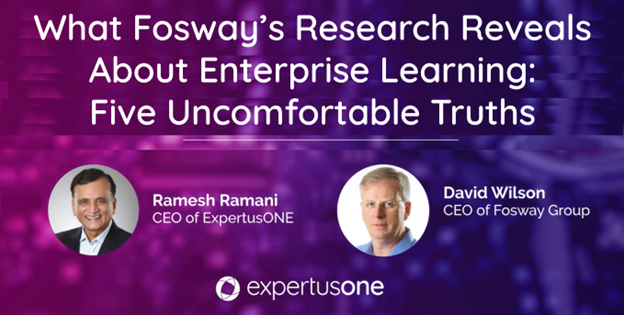
Watch the full conversation. If you’d like to hear the full discussion between David Wilson (Fosway Group) and Ramesh Ramani (ExpertusONE), you can watch the webinar here.
BLOG
What Fosway’s Research Reveals About Enterprise Learning: Five Uncomfortable Truths
By David Wilson and Ramesh Ramani
Watch the full conversation. If you’d like to hear the full discussion between David Wilson (Fosway Group) and Ramesh Ramani (ExpertusONE), you can watch the webinar here.
Summary:
Fosway’s research paints a clear picture of the state of enterprise learning: progress is real, but uneven. AI is reshaping how learning is created and delivered, and skills are becoming the language of workforce development. Yet beneath these advances, most organizations are still grappling with complexity, fragmented systems, and the need to deliver core training effectively. The result is a growing gap between ambition and execution. For learning leaders, the path forward isn’t about chasing trends, but about building a cohesive strategy that connects systems, supports diverse learners, and uses AI to enhance, not replace, the fundamentals.
The Quiet Crisis in Enterprise Learning (And Why AI Isn’t the Whole Story)
There’s a moment in almost every industry when the conversation gets ahead of reality. Right now, in corporate learning, that moment is called AI.
If you listen closely, the headlines suggest a kind of inevitability. AI will transform learning. Skills will finally be measurable. Systems will become intelligent. Everything will get faster, better, and more personalized.
A quieter one.
A more complicated one.
One where, despite all the talk of transformation, most learning leaders are still trying to solve something much more fundamental.
How do we make learning actually work at scale?
That tension was at the heart of a recent conversation between David Wilson, CEO of Fosway Group, and Ramesh Ramani, CEO of ExpertusONE. And what they revealed is less about hype and more about reality.
The First Truth: The Old Problems Never Went Away
If you were expecting AI to have replaced compliance training, think again. According to Fosway’s research, the top priority for most organizations is still the same as it was a decade ago:
- Deliver compliance and mandatory training effectively
- Ensure operational readiness
- Keep the business running without friction
That may sound unremarkable. But it matters. Because while the industry loves to talk about upskilling, reskilling, and personalization, those are layered on top of a foundation that cannot break.
You can’t become “more innovative” at the expense of being less compliant.
You can’t create a better experience if the basics fail.
And so learning leaders are caught in a balancing act: Run the old system flawlessly while building the new one at the same time.
The Second Truth: Complexity Is the Real Problem
We tend to describe enterprise learning in terms of scale. Big companies. Thousands of employees. Global reach.
But scale isn’t the hard part. Complexity is.
Large organizations aren’t just bigger. They are fundamentally more fragmented:
- Multiple geographies with different regulations
- Federated teams with local control
- Diverse roles, from desk-based workers to frontline staff
- Different audiences with completely different learning needs
And that complexity shows up most clearly in technology. Only a minority of organizations operate on a single, unified learning platform. Many are juggling multiple systems, stitched together over time.
The result? A learning ecosystem that looks less like a system and more like a patchwork.
The Third Truth: “Learning Experience” Means Different Things to Different People
For years, the industry has rallied around the idea of “learning experience.” Better interfaces. Personalized recommendations. Netflix-like discovery.
But here’s the catch. That vision assumes a certain type of learner.
Someone with time.
Access.
And motivation to explore.
That’s not most employees. For frontline workers, especially, learning is not about discovery. It’s about utility.
- “What do I need to know right now?”
- “How do I do my job correctly?”
- “How do I stay compliant?”
In that context, the best experience isn’t the most engaging one. It’s the most efficient one.
And this is where many learning strategies quietly fall apart. They optimize for a small segment of learners while missing the reality of the majority.
The Fourth Truth: Skills Are Still Unsolved
If AI is the headline, skills are the subplot that refuses to resolve. Organizations have been trying to operationalize skills for years. Maybe decades.
And yet, according to Fosway’s data, only a small percentage of companies consider themselves effective at it.
Why? Because skills are deceptively complex:
- They require a shared language across HR, L&D, and recruiting
- They demand constant updates as roles evolve
- They depend on accurate assessment and validation
In the past, this was nearly impossible to manage manually. Now, AI offers a way forward. It can:
- Build and maintain skills taxonomies
- Map skills to content
- Identify gaps and recommend learning paths
But even with AI, the challenge hasn’t disappeared. It’s just become more achievable. The jury, as Wilson puts it, is still out.
The Fifth Truth: AI Is a Multiplier, Not a Solution
This is where the conversation gets interesting. Because AI is not just another feature. It’s a force that touches everything:
- Content creation (faster, cheaper, scalable)
- Personalization (more precise recommendations)
- Skills mapping (automated and dynamic)
- Administration (reduced manual effort)
In some cases, it’s delivering 10x improvements in speed and efficiency. But here’s the nuance that often gets lost:
AI doesn’t remove complexity. It amplifies your ability to deal with it.
If your systems are fragmented, AI operates across fragmentation.
If your data is inconsistent, AI reflects that inconsistency.
If your strategy is unclear, AI accelerates the wrong things faster.
Which leads to a subtle but important shift in thinking: The question is no longer “Do we have AI?” It’s “Is our foundation ready for AI to matter?”
The Final Insight: Most Learning Systems Still Aren’t Fit for Purpose
Perhaps the most striking finding from the research is this: More organizations say their learning platforms are not fit for the modern workforce than those who say they are.
Even after years of investment. Even after waves of innovation. That’s not a technology problem alone. It’s a strategy problem.
Organizations that adopt a more cohesive, best-of-breed approach are significantly more likely to feel confident in their systems. But many are still navigating fragmented landscapes, trying to modernize without fully rebuilding.
So, Where Does This Leave Learning Leaders?
If there’s a single takeaway from this conversation, it’s this: Modern learning isn’t about choosing between old and new. It’s about making them work together.
- Compliance and innovation
- Efficiency and experience
- Structure and personalization
- Systems and AI
The organizations that succeed won’t be the ones chasing every new trend. They’ll be the ones that:
- Understand their complexity
- Build for their actual audiences
- And use AI as an enabler, not a shortcut
Because in the end, the goal hasn’t changed. Help people do their jobs better. At scale. Without friction.
Everything else is just a means to that end.
Watch the full conversation. If you’d like to hear the full discussion between David Wilson (Fosway Group) and Ramesh Ramani (ExpertusONE), you can watch the webinar here.
FAQs
Not fully. Many organizations are still early in their journey and find it difficult to align skills across HR, learning, and business functions.
They should focus on balancing foundational needs like compliance with newer priorities like skills and AI, while simplifying their technology ecosystem.
Key Takeaways
AI is accelerating change, but not solving the core problem
Compliance and operational training still come first
Complexity, not scale, defines enterprise learning challenges
Skills strategies are still a work in progress
Most learning systems are not meeting modern needs
About the Authors:
David Wilson, Fosway Group
A major commentator on the HR, talent, and learning industries for over 20 years, David is a strategic advisor to many major corporate and supplier organizations in the UK and Europe. David personally leads Fosway’s research and corporate advisory agenda. He is the author of over 150 research papers and articles and a leading speaker at major conferences and events around the world. Recognized in 2020 with the Colin Corder award for his outstanding services to the industry, David’s extensive market knowledge and detailed insight into corporate projects and experiences mean he continues to influence the thinking of many of the leading companies and vendors operating in the market today.
Ramesh Ramani, ExpertusONE
Ramesh Ramani is the co-founder, CEO, and President of ExpertusONE, where he sets the company’s strategic direction and guides the development of an enterprise learning platform used by large, complex organizations. A seasoned software entrepreneur, he has spent more than two decades building and scaling technology companies, with a focus on bringing powerful yet practical innovations to the learning and talent development market.
Summary:
Fosway’s research paints a clear picture of the state of enterprise learning: progress is real, but uneven. AI is reshaping how learning is created and delivered, and skills are becoming the language of workforce development. Yet beneath these advances, most organizations are still grappling with complexity, fragmented systems, and the need to deliver core training effectively. The result is a growing gap between ambition and execution. For learning leaders, the path forward isn’t about chasing trends, but about building a cohesive strategy that connects systems, supports diverse learners, and uses AI to enhance, not replace, the fundamentals.
The Quiet Crisis in Enterprise Learning (And Why AI Isn’t the Whole Story)
There’s a moment in almost every industry when the conversation gets ahead of reality. Right now, in corporate learning, that moment is called AI.
If you listen closely, the headlines suggest a kind of inevitability. AI will transform learning. Skills will finally be measurable. Systems will become intelligent. Everything will get faster, better, and more personalized.
A quieter one.
A more complicated one.
One where, despite all the talk of transformation, most learning leaders are still trying to solve something much more fundamental.
How do we make learning actually work at scale?
That tension was at the heart of a recent conversation between David Wilson, CEO of Fosway Group, and Ramesh Ramani, CEO of ExpertusONE. And what they revealed is less about hype and more about reality.
The First Truth: The Old Problems Never Went Away
If you were expecting AI to have replaced compliance training, think again. According to Fosway’s research, the top priority for most organizations is still the same as it was a decade ago:
- Deliver compliance and mandatory training effectively
- Ensure operational readiness
- Keep the business running without friction
That may sound unremarkable. But it matters. Because while the industry loves to talk about upskilling, reskilling, and personalization, those are layered on top of a foundation that cannot break.
You can’t become “more innovative” at the expense of being less compliant.
You can’t create a better experience if the basics fail.
And so learning leaders are caught in a balancing act: Run the old system flawlessly while building the new one at the same time.
The Second Truth: Complexity Is the Real Problem
We tend to describe enterprise learning in terms of scale. Big companies. Thousands of employees. Global reach.
But scale isn’t the hard part. Complexity is.
Large organizations aren’t just bigger. They are fundamentally more fragmented:
- Multiple geographies with different regulations
- Federated teams with local control
- Diverse roles, from desk-based workers to frontline staff
- Different audiences with completely different learning needs
And that complexity shows up most clearly in technology. Only a minority of organizations operate on a single, unified learning platform. Many are juggling multiple systems, stitched together over time.
The result? A learning ecosystem that looks less like a system and more like a patchwork.
The Third Truth: “Learning Experience” Means Different Things to Different People
For years, the industry has rallied around the idea of “learning experience.” Better interfaces. Personalized recommendations. Netflix-like discovery.
But here’s the catch. That vision assumes a certain type of learner.
Someone with time.
Access.
And motivation to explore.
That’s not most employees. For frontline workers, especially, learning is not about discovery. It’s about utility.
- “What do I need to know right now?”
- “How do I do my job correctly?”
- “How do I stay compliant?”
In that context, the best experience isn’t the most engaging one. It’s the most efficient one.
And this is where many learning strategies quietly fall apart. They optimize for a small segment of learners while missing the reality of the majority.
The Fourth Truth: Skills Are Still Unsolved
If AI is the headline, skills are the subplot that refuses to resolve. Organizations have been trying to operationalize skills for years. Maybe decades.
And yet, according to Fosway’s data, only a small percentage of companies consider themselves effective at it.
Why? Because skills are deceptively complex:
- They require a shared language across HR, L&D, and recruiting
- They demand constant updates as roles evolve
- They depend on accurate assessment and validation
In the past, this was nearly impossible to manage manually. Now, AI offers a way forward. It can:
- Build and maintain skills taxonomies
- Map skills to content
- Identify gaps and recommend learning paths
But even with AI, the challenge hasn’t disappeared. It’s just become more achievable. The jury, as Wilson puts it, is still out.
The Fifth Truth: AI Is a Multiplier, Not a Solution
This is where the conversation gets interesting. Because AI is not just another feature. It’s a force that touches everything:
- Content creation (faster, cheaper, scalable)
- Personalization (more precise recommendations)
- Skills mapping (automated and dynamic)
- Administration (reduced manual effort)
In some cases, it’s delivering 10x improvements in speed and efficiency. But here’s the nuance that often gets lost:
AI doesn’t remove complexity. It amplifies your ability to deal with it.
If your systems are fragmented, AI operates across fragmentation.
If your data is inconsistent, AI reflects that inconsistency.
If your strategy is unclear, AI accelerates the wrong things faster.
Which leads to a subtle but important shift in thinking: The question is no longer “Do we have AI?” It’s “Is our foundation ready for AI to matter?”
The Final Insight: Most Learning Systems Still Aren’t Fit for Purpose
Perhaps the most striking finding from the research is this: More organizations say their learning platforms are not fit for the modern workforce than those who say they are.
Even after years of investment. Even after waves of innovation. That’s not a technology problem alone. It’s a strategy problem.
Organizations that adopt a more cohesive, best-of-breed approach are significantly more likely to feel confident in their systems. But many are still navigating fragmented landscapes, trying to modernize without fully rebuilding.
So, Where Does This Leave Learning Leaders?
If there’s a single takeaway from this conversation, it’s this: Modern learning isn’t about choosing between old and new. It’s about making them work together.
- Compliance and innovation
- Efficiency and experience
- Structure and personalization
- Systems and AI
The organizations that succeed won’t be the ones chasing every new trend. They’ll be the ones that:
- Understand their complexity
- Build for their actual audiences
- And use AI as an enabler, not a shortcut
Because in the end, the goal hasn’t changed. Help people do their jobs better. At scale. Without friction.
Everything else is just a means to that end.
Watch the full conversation. If you’d like to hear the full discussion between David Wilson (Fosway Group) and Ramesh Ramani (ExpertusONE), you can watch the webinar here.
FAQs
Not fully. Many organizations are still early in their journey and find it difficult to align skills across HR, learning, and business functions.
They should focus on balancing foundational needs like compliance with newer priorities like skills and AI, while simplifying their technology ecosystem.
Key Takeaways
AI is accelerating change, but not solving the core problem
Compliance and operational training still come first
Complexity, not scale, defines enterprise learning challenges
Skills strategies are still a work in progress
Most learning systems are not meeting modern needs
About the Authors:
David Wilson, Fosway Group
A major commentator on the HR, talent, and learning industries for over 20 years, David is a strategic advisor to many major corporate and supplier organizations in the UK and Europe. David personally leads Fosway’s research and corporate advisory agenda. He is the author of over 150 research papers and articles and a leading speaker at major conferences and events around the world. Recognized in 2020 with the Colin Corder award for his outstanding services to the industry, David’s extensive market knowledge and detailed insight into corporate projects and experiences mean he continues to influence the thinking of many of the leading companies and vendors operating in the market today.
Ramesh Ramani, ExpertusONE
Ramesh Ramani is the co-founder, CEO, and President of ExpertusONE, where he sets the company’s strategic direction and guides the development of an enterprise learning platform used by large, complex organizations. A seasoned software entrepreneur, he has spent more than two decades building and scaling technology companies, with a focus on bringing powerful yet practical innovations to the learning and talent development market.


