
BLOG
From Dealership to Plant Floor: Solving the Hidden Complexity of Automotive Learning
Training isn’t the challenge. Orchestration is.
Author: Greg Bashar

BLOG
From Dealership to Plant Floor: Solving the Hidden Complexity of Automotive Learning
Training isn’t the challenge. Orchestration is.
Author: Greg Bashar
Overview
Auto companies face a learning challenge unlike almost any other industry. They must train corporate teams, plant workers, distributors, dealerships, technicians, and partners, often across dozens of countries and languages. At the same time, compliance requirements are rising, electrification is reshaping what’s needed, and dealers expect learning programs to improve sales.
This article explores the core challenges of automotive learning programs and outlines practical solutions modern learning platforms must deliver.
Why is Automotive Learning So Much More Complex Than Other Industries?
Imagine a vehicle launch as a relay race.
Engineering hands the baton to marketing. Marketing hands it to sales. Sales hands it to the dealership floor. Only then does the customer meet the product.
The difficulty is not in designing the car. It is in delivering a consistent experience through a distributed network where many representatives do not sit inside your org chart.
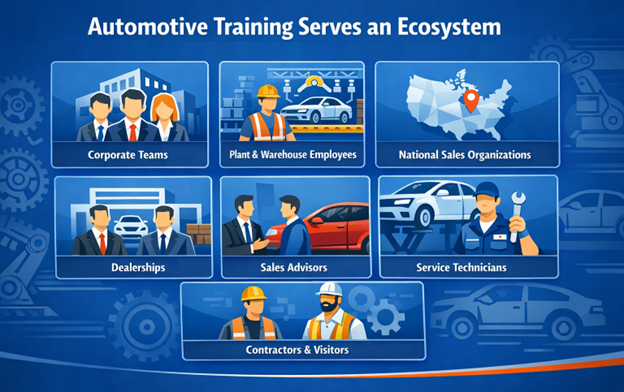
In Europe alone, some automotive manufacturers coordinate learning across nearly 30 independently held national sales companies operating in close to 50 countries, with content translated into 30 languages. In these environments, “one LMS” does not mean one experience. It means central governance with local flexibility.
The architecture must support:
- Central content reuse
- Role-based access controls
- Market segmentation
- Language localization
- Brand-specific customization
This is not a feature. It is the foundation.
Why is Dealer Training Adoption so Difficult?
Here is the uncomfortable truth: dealership participation is often not mandatory.
Dealers are businesses. Time spent training is time not spent selling or servicing vehicles. For technicians especially, training hours translate directly into lost billable time.
Automotive organizations that have modernized their technician learning programs have emphasized reducing time away from the workshop through modular, continuous learning. In some European programs, organizations reported shifting portions of multi-day classroom training into e-learning modules, significantly reducing time out of role.
Research supports this motivation dynamic. A study published in the Journal of Applied Psychology found that training effectiveness improves when learners perceive autonomy and relevance. When participation is voluntary, relevance becomes the curriculum.
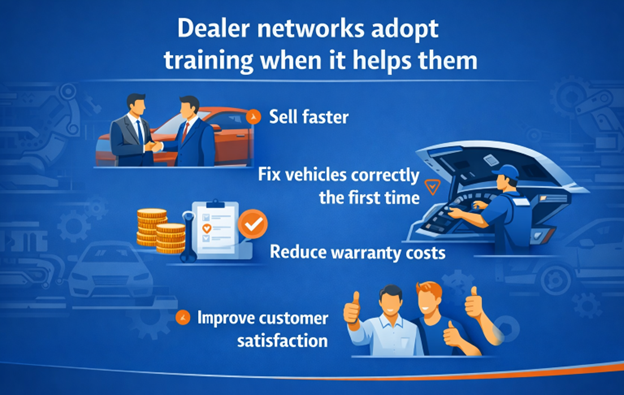
Learning that achieves those outcomes gets used. Learning that does not quietly disappear.
How Big is the EV Skills and Compliance Challenge?
Electrification has changed the stakes.
The Institute of the Motor Industry reported that approximately 26 percent of the UK technician workforce holds an EV qualification. They projected a shortfall of more than 29,000 EV-qualified technicians by 2035 if trends continue.
Meanwhile, ACEA and The Adecco Group jointly reported that electrification and digitalization are reshaping automotive workforce needs, increasing demand for higher-skilled digital and engineering roles.
Compliance adds another layer.
The EU Occupational Safety and Health Framework Directive requires employers to provide adequate safety training upon recruitment, job change, introduction of new equipment, and new technologies. That includes workers from outside undertakings operating on-site.
Compliance in automotive spans:
- Manufacturing safety
- Service bay procedures
- High-voltage EV systems
- Certification and accreditation
- Contractor site access
This is not periodic training. It is continuous readiness.
In this environment, learning systems become operational infrastructure.
Why is Search and Performance Support More Important Than Courses?
In many industries, learning is scheduled. In automotive retail and service, learning is situational.
A technician diagnosing a high-voltage issue does not need a curriculum. They need fast, reliable access to the right information.
The EU motor vehicle block exemption framework reinforces the importance of access to technical information for repair and maintenance services. Access to vehicle data has become a competitive necessity.
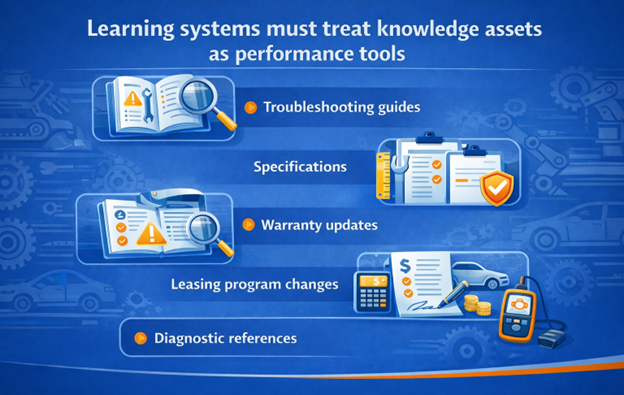
Search is not convenience. It is horsepower.
Does eLearning Work in Automotive?
Yes. But not alone.
A large-scale study of 583 automotive sales training instances in South Korea compared traditional instructor-led training, fully digital, and hybrid approaches. Effectiveness declined when shifting from traditional to fully digital, then recovered under hybrid models.
The key variable was instructor engagement.
Digital delivery solves the “when” and “where.” Hybrid models restore the “why” and “how.”
In automotive learning, mobile-first design must be paired with:
- Manager reinforcement
- Practice environments
- Certification pathways
- Clear performance expectations
Mobility enables. Blending activates.
Can Automotive Learning Actually Be Linked to Dealer Performance?
This is the question that matters.
A conference paper presented at the Joint Statistical Meetings analyzed dealership training records alongside vehicle registration data to examine sales performance before and after training interventions.
The researchers noted both measurable impact and the complexity of isolating training effects due to selection bias and data integrity challenges.
Correlation is difficult, but possible.
Automotive manufacturers increasingly want to measure learning against KPIs such as:
- Conversion rates
- First-time fix rates
- Warranty costs
- Technician productivity
- Customer satisfaction scores
To do this credibly, systems must support:
- Role segmentation
- Market-level reporting
- Curriculum version tracking
- Secure data partitioning
- Real-time analytics
Without segmentation, impact claims become fragile. With it, learning becomes a strategic lever.
In the end, automotive learning is not really about courses, platforms, or even “training” in the way most industries mean it. It’s about orchestration across a network that has to behave like one organization, even when it is anything but.
Here’s the twist.
The strongest automotive learning programs do not treat learning as an L&D initiative. They treat it the way manufacturing treats quality: as a system that quietly determines whether the brand experience is consistent or chaotic, profitable or leaky. The learning platform is not the point. It’s the mechanism that turns fast-changing products, dispersed people, and uneven readiness into one repeatable standard.
In a dealer network, that is not “support.” That is a strategy.
Key Takeaways
Automotive learning is an extended-enterprise orchestration challenge, not a single-audience problem.
Dealer adoption depends on business relevance and reduced time out of role.
Compliance requirements require continuous, structured training governance.
Search-driven performance support is as critical as formal coursework.
Hybrid learning models outperform purely digital programs in automotive sales contexts.
Segmented analytics are essential to correlate learning participation with dealership performance.
Modern automotive learning platforms must balance central control with local flexibility.
About the Author
Greg Bashar is the Senior Learning Advisor at ExpertusONE and has more than 18 years of experience helping enterprise organizations make smart, confident LMS and learning-technology decisions. He partners with L&D and business leaders to align learning platforms with real operational needs, long-term strategy, and measurable outcomes. Greg has advised global brands including Stanley Black & Decker, The Hartford, Estée Lauder, and Toyota, and is known for bringing clarity to complex, high-stakes learning initiatives.
FAQs
Automotive learning must support distributed dealer networks, multiple languages, compliance mandates, and rapidly evolving technical requirements such as EV systems.
Manufacturers must train independent dealerships and partners who are not direct employees, requiring segmented access and tailored portals.
The EU Occupational Safety and Health Framework Directive mandates adequate safety training upon recruitment, job changes, and new technology introduction.
Research suggests hybrid approaches combining digital and instructor engagement outperform fully digital training alone.
By correlating segmented learning data with KPIs such as sales rates, warranty costs, and technician productivity.
Search enables real-time access to troubleshooting guides, specifications, and updates during live service and sales interactions.
Endnotes
- Jason A. Colquitt, Jeffrey A. LePine, and Raymond A. Noe, “Toward an Integrative Theory of Training Motivation: A Meta-Analytic Path Analysis of 20 Years of Research,” Journal of Applied Psychology 85, no. 5 (October 2000): 678–707,
https://doi.org/10.1037/0021-9010.85.5.678. - Winfred Arthur Jr., Winston Bennett Jr., Pamela S. Edens, and Suzanne T. Bell, “Effectiveness of Training in Organizations: A Meta-Analysis of Design and Evaluation Features,” Journal of Applied Psychology 88, no. 2 (April 2003): 234–245,
https://doi.org/10.1037/0021-9010.88.2.234. - Council Directive 89/391/EEC of 12 June 1989 on the introduction of measures to encourage improvements in the safety and health of workers at work, Article 12 “Training of workers,” EUR-Lex, https://eur-lex.europa.eu (see consolidated directive text and Article 12).
- Institute of the Motor Industry (IMI), “EV TechSafe Technician Forecast – April 2025,” (webpage, accessed February 26, 2026), https://tide.theimi.org.uk/industry-latest/research/ev-techsafe-technician-forecast-april-2025.
- ACEA (European Automobile Manufacturers’ Association), “Accelerating the race to reskill Europe’s automotive workforce: ACEA and Adecco Group unveil landmark analysis,” press release, January 13, 2026,
https://www.acea.auto/press-release/accelerating-the-race-to-reskill-europes-automotive-workforce-acea-and-adecco-group-unveil-landmark-analysis/. - The Adecco Group, “Accelerating the race to reskill Europe’s automotive workforce: ACEA and the Adecco Group unveil landmark analysis,” press release, January 13, 2026,
https://www.adeccogroup.com/our-group/media/press-releases/accelerating-the-race-to-reskill. - Sehoon Kim, “Innovating workplace learning: Training methodology analysis based on content, instructional design, programmed learning, and recommendation framework,” Frontiers in Psychology 13 (July 22, 2022): 870574,
https://doi.org/10.3389/fpsyg.2022.870574. - Reuters, “Auto sector scrambles to retool workforce for electric and automated future,” November 19, 2024, https://www.reuters.com/sustainability/climate-energy/auto-sector-scrambles-retool-workforce-electric-automated-future-2024-11-19/.
- Commission Regulation (EU) No 461/2010 of 27 May 2010 on the application of Article 101(3) of the Treaty on the Functioning of the European Union to categories of vertical agreements and concerted practices in the motor vehicle sector (Motor Vehicle Block Exemption Regulation), consolidated version showing validity through 31 May 2028, EUR-Lex,
https://eur-lex.europa.eu/eli/reg/2010/461/2023-05-07/eng. - European Commission (Competition), “Antitrust: Commission prolongs Motor Vehicle Block Exemption Regulation and updates the Supplementary Guidelines,” press release, April 17, 2023 (summary coverage and key changes quoted in multiple reproductions), reproduced at Cyprus News Agency (CNA),
https://www.cna.org.cy/press-release/article/4825823/press-release-european-commission. - Joint Statistical Meetings (American Statistical Association), conference paper referenced in the article as examining dealership training records alongside automobile registration data to test association with sales-rate changes.
Overview
Auto companies face a learning challenge unlike almost any other industry. They must train corporate teams, plant workers, distributors, dealerships, technicians, and partners, often across dozens of countries and languages. At the same time, compliance requirements are rising, electrification is reshaping what’s needed, and dealers expect learning programs to improve sales.
This article explores the core challenges of automotive learning programs and outlines practical solutions modern learning platforms must deliver.
Why is Automotive Learning So Much More Complex Than Other Industries?
Imagine a vehicle launch as a relay race.
Engineering hands the baton to marketing. Marketing hands it to sales. Sales hands it to the dealership floor. Only then does the customer meet the product.
The difficulty is not in designing the car. It is in delivering a consistent experience through a distributed network where many representatives do not sit inside your org chart.
In Europe alone, some automotive manufacturers coordinate learning across nearly 30 independently held national sales companies operating in close to 50 countries, with content translated into 30 languages. In these environments, “one LMS” does not mean one experience. It means central governance with local flexibility.
The architecture must support:
- Central content reuse
- Role-based access controls
- Market segmentation
- Language localization
- Brand-specific customization
This is not a feature. It is the foundation.
Why is Dealer Training Adoption so Difficult?
Here is the uncomfortable truth: dealership participation is often not mandatory.
Dealers are businesses. Time spent training is time not spent selling or servicing vehicles. For technicians especially, training hours translate directly into lost billable time.
Automotive organizations that have modernized their technician learning programs have emphasized reducing time away from the workshop through modular, continuous learning. In some European programs, organizations reported shifting portions of multi-day classroom training into e-learning modules, significantly reducing time out of role.
Research supports this motivation dynamic. A study published in the Journal of Applied Psychology found that training effectiveness improves when learners perceive autonomy and relevance. When participation is voluntary, relevance becomes the curriculum.
Learning that achieves those outcomes gets used. Learning that does not quietly disappear.
How Big is the EV Skills and Compliance Challenge?
Electrification has changed the stakes.
The Institute of the Motor Industry reported that approximately 26 percent of the UK technician workforce holds an EV qualification. They projected a shortfall of more than 29,000 EV-qualified technicians by 2035 if trends continue.
Meanwhile, ACEA and The Adecco Group jointly reported that electrification and digitalization are reshaping automotive workforce needs, increasing demand for higher-skilled digital and engineering roles.
Compliance adds another layer.
The EU Occupational Safety and Health Framework Directive requires employers to provide adequate safety training upon recruitment, job change, introduction of new equipment, and new technologies. That includes workers from outside undertakings operating on-site.
Compliance in automotive spans:
- Manufacturing safety
- Service bay procedures
- High-voltage EV systems
- Certification and accreditation
- Contractor site access
This is not periodic training. It is continuous readiness.
In this environment, learning systems become operational infrastructure.
Why is Search and Performance Support More Important Than Courses?
In many industries, learning is scheduled. In automotive retail and service, learning is situational.
A technician diagnosing a high-voltage issue does not need a curriculum. They need fast, reliable access to the right information.
The EU motor vehicle block exemption framework reinforces the importance of access to technical information for repair and maintenance services. Access to vehicle data has become a competitive necessity.
Search is not convenience. It is horsepower.
Does eLearning Work in Automotive?
Yes. But not alone.
A large-scale study of 583 automotive sales training instances in South Korea compared traditional instructor-led training, fully digital, and hybrid approaches. Effectiveness declined when shifting from traditional to fully digital, then recovered under hybrid models.
The key variable was instructor engagement.
Digital delivery solves the “when” and “where.” Hybrid models restore the “why” and “how.”
In automotive learning, mobile-first design must be paired with:
- Manager reinforcement
- Practice environments
- Certification pathways
- Clear performance expectations
Mobility enables. Blending activates.
Can Automotive Learning Actually Be Linked to Dealer Performance?
This is the question that matters.
A conference paper presented at the Joint Statistical Meetings analyzed dealership training records alongside vehicle registration data to examine sales performance before and after training interventions.
The researchers noted both measurable impact and the complexity of isolating training effects due to selection bias and data integrity challenges.
Correlation is difficult, but possible.
Automotive manufacturers increasingly want to measure learning against KPIs such as:
- Conversion rates
- First-time fix rates
- Warranty costs
- Technician productivity
- Customer satisfaction scores
To do this credibly, systems must support:
- Role segmentation
- Market-level reporting
- Curriculum version tracking
- Secure data partitioning
- Real-time analytics
Without segmentation, impact claims become fragile. With it, learning becomes a strategic lever.
In the end, automotive learning is not really about courses, platforms, or even “training” in the way most industries mean it. It’s about orchestration across a network that has to behave like one organization, even when it is anything but.
Here’s the twist.
The strongest automotive learning programs do not treat learning as an L&D initiative. They treat it the way manufacturing treats quality: as a system that quietly determines whether the brand experience is consistent or chaotic, profitable or leaky. The learning platform is not the point. It’s the mechanism that turns fast-changing products, dispersed people, and uneven readiness into one repeatable standard.
In a dealer network, that is not “support.” That is a strategy.
Key Takeaways
Automotive learning is an extended-enterprise orchestration challenge, not a single-audience problem.
Dealer adoption depends on business relevance and reduced time out of role.
Compliance requirements require continuous, structured training governance.
Search-driven performance support is as critical as formal coursework.
Hybrid learning models outperform purely digital programs in automotive sales contexts.
Segmented analytics are essential to correlate learning participation with dealership performance.
Modern automotive learning platforms must balance central control with local flexibility.
About the Author
Greg Bashar is the Senior Learning Advisor at ExpertusONE and has more than 18 years of experience helping enterprise organizations make smart, confident LMS and learning-technology decisions. He partners with L&D and business leaders to align learning platforms with real operational needs, long-term strategy, and measurable outcomes. Greg has advised global brands including Stanley Black & Decker, The Hartford, Estée Lauder, and Toyota, and is known for bringing clarity to complex, high-stakes learning initiatives.
FAQs
Automotive learning must support distributed dealer networks, multiple languages, compliance mandates, and rapidly evolving technical requirements such as EV systems.
Manufacturers must train independent dealerships and partners who are not direct employees, requiring segmented access and tailored portals.
The EU Occupational Safety and Health Framework Directive mandates adequate safety training upon recruitment, job changes, and new technology introduction.
Research suggests hybrid approaches combining digital and instructor engagement outperform fully digital training alone.
By correlating segmented learning data with KPIs such as sales rates, warranty costs, and technician productivity.
Search enables real-time access to troubleshooting guides, specifications, and updates during live service and sales interactions.
Endnotes
- Jason A. Colquitt, Jeffrey A. LePine, and Raymond A. Noe, “Toward an Integrative Theory of Training Motivation: A Meta-Analytic Path Analysis of 20 Years of Research,” Journal of Applied Psychology 85, no. 5 (October 2000): 678–707,
https://doi.org/10.1037/0021-9010.85.5.678. - Winfred Arthur Jr., Winston Bennett Jr., Pamela S. Edens, and Suzanne T. Bell, “Effectiveness of Training in Organizations: A Meta-Analysis of Design and Evaluation Features,” Journal of Applied Psychology 88, no. 2 (April 2003): 234–245,
https://doi.org/10.1037/0021-9010.88.2.234. - Council Directive 89/391/EEC of 12 June 1989 on the introduction of measures to encourage improvements in the safety and health of workers at work, Article 12 “Training of workers,” EUR-Lex, https://eur-lex.europa.eu (see consolidated directive text and Article 12).
- Institute of the Motor Industry (IMI), “EV TechSafe Technician Forecast – April 2025,” (webpage, accessed February 26, 2026), https://tide.theimi.org.uk/industry-latest/research/ev-techsafe-technician-forecast-april-2025.
- ACEA (European Automobile Manufacturers’ Association), “Accelerating the race to reskill Europe’s automotive workforce: ACEA and Adecco Group unveil landmark analysis,” press release, January 13, 2026,
https://www.acea.auto/press-release/accelerating-the-race-to-reskill-europes-automotive-workforce-acea-and-adecco-group-unveil-landmark-analysis/. - The Adecco Group, “Accelerating the race to reskill Europe’s automotive workforce: ACEA and the Adecco Group unveil landmark analysis,” press release, January 13, 2026,
https://www.adeccogroup.com/our-group/media/press-releases/accelerating-the-race-to-reskill. - Sehoon Kim, “Innovating workplace learning: Training methodology analysis based on content, instructional design, programmed learning, and recommendation framework,” Frontiers in Psychology 13 (July 22, 2022): 870574,
https://doi.org/10.3389/fpsyg.2022.870574. - Reuters, “Auto sector scrambles to retool workforce for electric and automated future,” November 19, 2024, https://www.reuters.com/sustainability/climate-energy/auto-sector-scrambles-retool-workforce-electric-automated-future-2024-11-19/.
- Commission Regulation (EU) No 461/2010 of 27 May 2010 on the application of Article 101(3) of the Treaty on the Functioning of the European Union to categories of vertical agreements and concerted practices in the motor vehicle sector (Motor Vehicle Block Exemption Regulation), consolidated version showing validity through 31 May 2028, EUR-Lex,
https://eur-lex.europa.eu/eli/reg/2010/461/2023-05-07/eng. - European Commission (Competition), “Antitrust: Commission prolongs Motor Vehicle Block Exemption Regulation and updates the Supplementary Guidelines,” press release, April 17, 2023 (summary coverage and key changes quoted in multiple reproductions), reproduced at Cyprus News Agency (CNA),
https://www.cna.org.cy/press-release/article/4825823/press-release-european-commission. - Joint Statistical Meetings (American Statistical Association), conference paper referenced in the article as examining dealership training records alongside automobile registration data to test association with sales-rate changes.


