
BLOG
 Want to Keep Top Talent? Start With Upskilling.
Author: Ramesh Ramani
BLOG
Want to Keep Top Talent? Start With Upskilling.
Author: Ramesh Ramani
Summary:
Upskilling is no longer optional—it’s essential. Employees want opportunities to grow, and organizations need agile, skilled teams to stay competitive. This guide outlines three keys to designing a successful upskilling initiative: using the right technology, identifying key skill gaps, and creating flexible, self-directed learning paths that engage employees long-term.
Why Does Upskilling Matter Now?
Today’s employees aren’t just looking for a paycheck—they’re looking for progress. Research shows that one of the most effective ways to attract and retain top talent is by offering meaningful upskilling and reskilling opportunities.
According to McKinsey, 87% of executives say they are experiencing skill gaps—or expect them within a few years—and 53% of employees say they’ll need to learn new skills to remain employable.
Whether employees stay for years or take their enhanced skills elsewhere, investing in learning signals that your company values growth and long-term potential.
As industries evolve at lightning speed, upskilling has shifted from a “nice-to-have” to a business necessity. Organizations that prioritize continuous learning are better equipped to adapt, innovate, and close the gap between current capabilities and future needs.
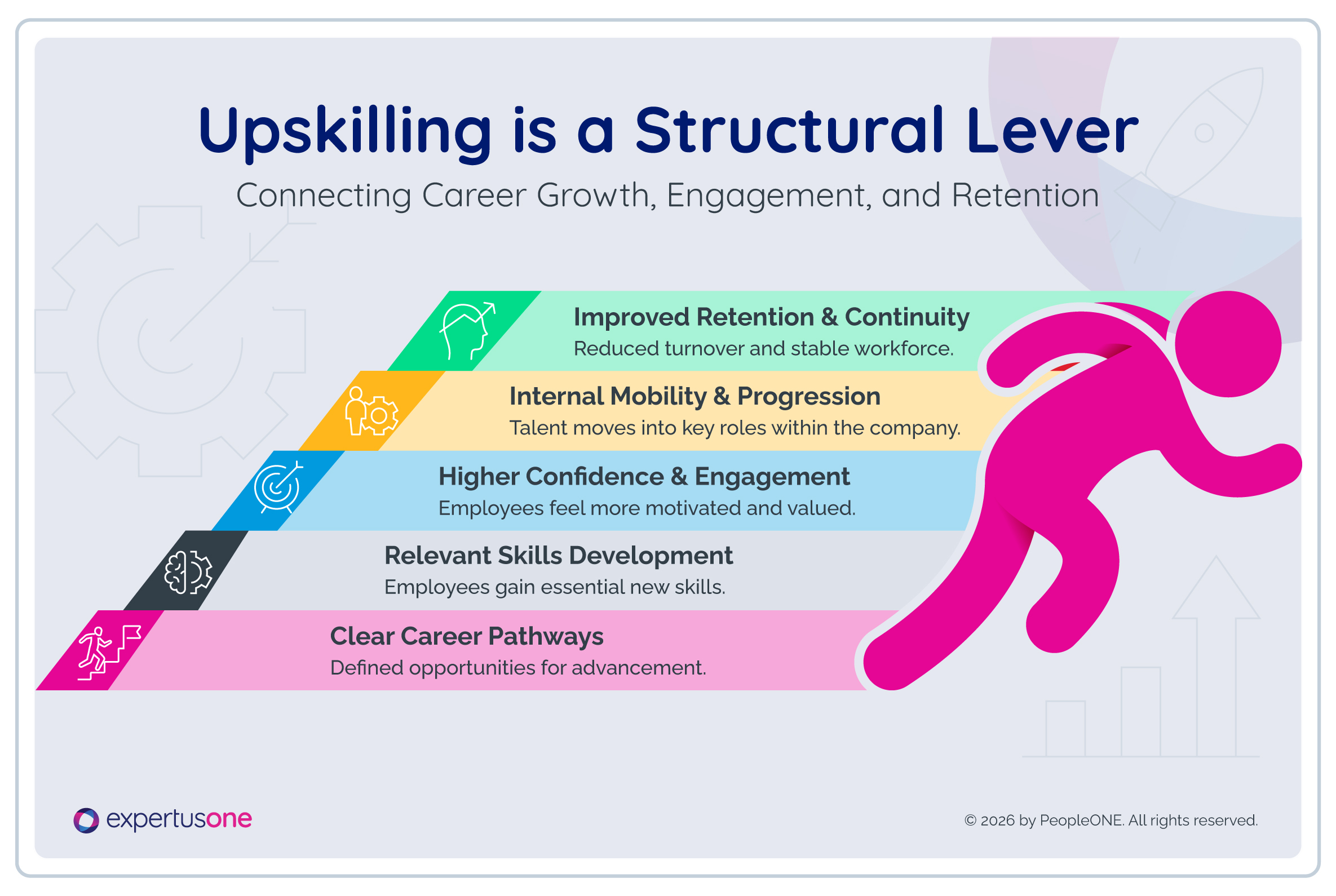
Upskilling delivers value on both sides. Employees gain confidence, career mobility, and engagement. Companies benefit from greater productivity, retention, and agility. A workforce that learns continuously is a workforce ready for change.
So, how can you design an upskilling program that delivers lasting impact? Here are three essential steps to build a truly effective initiative.
1. Start with the Right Tools
Every successful upskilling initiative begins with the right foundation—your learning technology. Without a strong digital infrastructure, even the best programs lose momentum.
A modern Learning Management System (LMS) is the backbone of effective upskilling. It centralizes learning resources, streamlines delivery, and ensures that every employee—no matter where they work—can access opportunities for growth.
Platforms like ExpertusONE make this seamless by integrating directly into the tools employees already use—such as Microsoft Teams, Salesforce, and Slack—keeping learning within the flow of work.
But convenience is only part of the equation. The most powerful LMS platforms also use AI to personalize the learning journey, recommending courses that align with each employee’s role, goals, and past behavior.
When choosing an LMS, look for features that support long-term engagement and scalability:
- AI-driven personalization and recommendations
- Interactive modules (videos, simulations, quizzes)
- Gamification and progress tracking
- Mobile compatibility for hybrid teams
- Analytics dashboards to measure outcomes
By investing in the right platform, you’re not just implementing technology—you’re building the foundation for a learning culture that grows with your business.
2. Identify Missing Skill Sets and Set Clear Objectives
An impactful upskilling program begins with knowing where you are—and where you need to go.
Most organizations already offer compliance or onboarding training. But true upskilling means anticipating the future and preparing your people to meet it.
Start with a skills gap analysis to determine what’s missing today and what will be vital tomorrow. Include both technical and soft skills—because adaptability, collaboration, and communication are just as crucial as technical expertise.
Gartner reports that organizations identifying “skill adjacencies”—skills closely related to existing competencies—can fill roles faster and improve retention rates. For instance, a data analyst could evolve into a data visualization or business intelligence role with focused upskilling.
To create a strong foundation:
- Map current skills across departments
- Forecast future skill needs tied to strategic goals
- Define measurable objectives for training success
- Align content with real-world performance outcomes
This clarity ensures that your upskilling strategy directly supports business growth.
And the return is tangible. A LinkedIn Learning survey found that 94% of employees would stay longer at a company that invests in their career development. That’s not just retention—it’s a cultural advantage.
3. Create Flexible Learning Pathways
Upskilling is most effective when it’s flexible, self-directed, and continuous. The days of one-size-fits-all corporate training are long gone.
Instead, give employees the autonomy to choose how—and when—they learn. Offer multiple pathways that allow learners to explore new topics, deepen existing skills, and move at their own pace. This autonomy fosters curiosity, engagement, and accountability.
Design your learning ecosystem around these principles:
- Diverse formats: Combine microlearning, podcasts, live sessions, and simulations.
- Self-paced learning: Let employees train when it fits their schedule.
- Social collaboration: Encourage team learning through discussions or peer mentoring.
- Gamification: Motivate learners with points, badges, and leaderboards.
Platforms like ExpertusONE support all these methods—across desktop, mobile, and even offline access. This flexibility is critical for hybrid workers, remote teams, and busy professionals alike.
Flexibility also drives results. When learning fits seamlessly into daily life, participation and knowledge retention soar.
Building a Culture of Continuous Learning
Upskilling isn’t just a project—it’s a mindset. The goal is to embed learning into your culture so that growth becomes a shared habit.
Encourage managers to set learning goals during performance reviews, celebrate completion milestones, and connect training outcomes directly to career progression. Recognition reinforces motivation and builds momentum.
When employees feel that learning fuels advancement—and leaders actively participate—continuous improvement becomes part of the company DNA.
Upskilling isn’t just good for people; it’s good for business. A workforce that learns consistently is better equipped to innovate, adapt, and lead. The organizations that embrace this culture of growth will be the ones defining the future of work.
FAQs
Yes, LinkedIn’s research shows that companies with strong learning cultures achieve higher retention and internal mobility, and L&D professionals increasingly measure retention as a core outcome of upskilling.
Yes, surveys indicate that employees overwhelmingly value career growth. 94% of workers say they’d stay longer at a company that invests in learning and development.
By modeling continuous learning themselves. When leaders participate in training, share insights, and recognize progress, they set a powerful example for their teams.
Key Takeaways
Upskilling is now a core retention and growth strategy.
A digital LMS is the foundation of a scalable upskilling ecosystem.
Personalization, interactivity, and flexibility fuel engagement.
Regularly assess skills to align learning with business goals.
A culture of continuous learning builds long-term competitive advantage.
Summary:
Upskilling is no longer optional—it’s essential. Employees want opportunities to grow, and organizations need agile, skilled teams to stay competitive. This guide outlines three keys to designing a successful upskilling initiative: using the right technology, identifying key skill gaps, and creating flexible, self-directed learning paths that engage employees long-term.
Why Does Upskilling Matter Now?
Today’s employees aren’t just looking for a paycheck—they’re looking for progress. Research shows that one of the most effective ways to attract and retain top talent is by offering meaningful upskilling and reskilling opportunities.
According to McKinsey, 87% of executives say they are experiencing skill gaps—or expect them within a few years—and 53% of employees say they’ll need to learn new skills to remain employable.
Whether employees stay for years or take their enhanced skills elsewhere, investing in learning signals that your company values growth and long-term potential.
As industries evolve at lightning speed, upskilling has shifted from a “nice-to-have” to a business necessity. Organizations that prioritize continuous learning are better equipped to adapt, innovate, and close the gap between current capabilities and future needs.
Upskilling delivers value on both sides. Employees gain confidence, career mobility, and engagement. Companies benefit from greater productivity, retention, and agility. A workforce that learns continuously is a workforce ready for change.
So, how can you design an upskilling program that delivers lasting impact? Here are three essential steps to build a truly effective initiative.
1. Start with the Right Tools
Every successful upskilling initiative begins with the right foundation—your learning technology. Without a strong digital infrastructure, even the best programs lose momentum.
A modern Learning Management System (LMS) is the backbone of effective upskilling. It centralizes learning resources, streamlines delivery, and ensures that every employee—no matter where they work—can access opportunities for growth.
Platforms like ExpertusONE make this seamless by integrating directly into the tools employees already use—such as Microsoft Teams, Salesforce, and Slack—keeping learning within the flow of work.
But convenience is only part of the equation. The most powerful LMS platforms also use AI to personalize the learning journey, recommending courses that align with each employee’s role, goals, and past behavior.
When choosing an LMS, look for features that support long-term engagement and scalability:
- AI-driven personalization and recommendations
- Interactive modules (videos, simulations, quizzes)
- Gamification and progress tracking
- Mobile compatibility for hybrid teams
- Analytics dashboards to measure outcomes
By investing in the right platform, you’re not just implementing technology—you’re building the foundation for a learning culture that grows with your business.
2. Identify Missing Skill Sets and Set Clear Objectives
An impactful upskilling program begins with knowing where you are—and where you need to go.
Most organizations already offer compliance or onboarding training. But true upskilling means anticipating the future and preparing your people to meet it.
Start with a skills gap analysis to determine what’s missing today and what will be vital tomorrow. Include both technical and soft skills—because adaptability, collaboration, and communication are just as crucial as technical expertise.
Gartner reports that organizations identifying “skill adjacencies”—skills closely related to existing competencies—can fill roles faster and improve retention rates. For instance, a data analyst could evolve into a data visualization or business intelligence role with focused upskilling.
To create a strong foundation:
- Map current skills across departments
- Forecast future skill needs tied to strategic goals
- Define measurable objectives for training success
- Align content with real-world performance outcomes
This clarity ensures that your upskilling strategy directly supports business growth.
And the return is tangible. A LinkedIn Learning survey found that 94% of employees would stay longer at a company that invests in their career development. That’s not just retention—it’s a cultural advantage.
3. Create Flexible Learning Pathways
Upskilling is most effective when it’s flexible, self-directed, and continuous. The days of one-size-fits-all corporate training are long gone.
Instead, give employees the autonomy to choose how—and when—they learn. Offer multiple pathways that allow learners to explore new topics, deepen existing skills, and move at their own pace. This autonomy fosters curiosity, engagement, and accountability.
Design your learning ecosystem around these principles:
- Diverse formats: Combine microlearning, podcasts, live sessions, and simulations.
- Self-paced learning: Let employees train when it fits their schedule.
- Social collaboration: Encourage team learning through discussions or peer mentoring.
- Gamification: Motivate learners with points, badges, and leaderboards.
Platforms like ExpertusONE support all these methods—across desktop, mobile, and even offline access. This flexibility is critical for hybrid workers, remote teams, and busy professionals alike.
Flexibility also drives results. When learning fits seamlessly into daily life, participation and knowledge retention soar.
Building a Culture of Continuous Learning
Upskilling isn’t just a project—it’s a mindset. The goal is to embed learning into your culture so that growth becomes a shared habit.
Encourage managers to set learning goals during performance reviews, celebrate completion milestones, and connect training outcomes directly to career progression. Recognition reinforces motivation and builds momentum.
When employees feel that learning fuels advancement—and leaders actively participate—continuous improvement becomes part of the company DNA.
Upskilling isn’t just good for people; it’s good for business. A workforce that learns consistently is better equipped to innovate, adapt, and lead. The organizations that embrace this culture of growth will be the ones defining the future of work.
FAQs
Yes, LinkedIn’s research shows that companies with strong learning cultures achieve higher retention and internal mobility, and L&D professionals increasingly measure retention as a core outcome of upskilling.
Yes, surveys indicate that employees overwhelmingly value career growth. 94% of workers say they’d stay longer at a company that invests in learning and development.
By modeling continuous learning themselves. When leaders participate in training, share insights, and recognize progress, they set a powerful example for their teams.
Key Takeaways
Upskilling is now a core retention and growth strategy.
A digital LMS is the foundation of a scalable upskilling ecosystem.
Personalization, interactivity, and flexibility fuel engagement.
Regularly assess skills to align learning with business goals.
A culture of continuous learning builds long-term competitive advantage.


