
BLOG
The Complete Guide to LMS Features: What to Look for Before You Buy
Author: Greg Bashar

BLOG
The Complete Guide to LMS Features: What to Look for Before You Buy
Author: Greg Basher
Summary
LMS features matter most when they help organizations automate and scale learning without adding complexity. The right platform does more than house and distribute courses. It supports onboarding, compliance, skills development, reporting, and learning across multiple audiences. For enterprise buyers, the key question is not how many features an LMS includes, but whether those capabilities improve access, reduce administrative work, strengthen governance, and connect learning to business outcomes.
Key Terms:
- LMS Features
- Learning Management System
- Enterprise LMS
- LMS Platform
- LMS Integrations
- Mobile Learning
- Learning Analytics
- Personalized Learning
What is a Learning Management System (LMS)?
A learning management system, or LMS, is a platform used to deliver, manage, track, and report on learning. At a basic level, it helps organizations assign training, organize content, monitor completion, and maintain records of learner activity.
For enterprise organizations, that definition needs to go further. An LMS is not just a course library or a place to upload learning content. It is the system that helps learning teams run structured programs across different audiences, locations, business units, compliance environments, and use cases. It supports the administrative side of learning as much as the learner experience itself.
That distinction matters because enterprise learning is rarely limited to one audience or one type of program. The LMS may be used for employee onboarding, compliance, field readiness, sales enablement, customer education, partner learning, and ongoing development at the same time. In that environment, the platform becomes an operational system, not just a content destination.
What does an LMS do?
An LMS gives organizations a central system for managing learning from end to end. That often includes content delivery, learner enrollment, assignments, completion tracking, certifications, reminders, reporting, and administrative workflows.
In practice, an LMS may be used to:
- Deliver onboarding and role-based training
- Assign required and recurring learning
- Support certifications and continuing education
- Provide self-paced development opportunities
- Enable customer and partner education
- Give managers and administrators visibility into progress and gaps
The real value is coordination. Instead of managing learning through spreadsheets, email reminders, separate portals, and disconnected reports, the LMS creates a more consistent way to deliver and monitor training across the organization.
That consistency becomes more important as learning expands. A small business might be able to manage parts of training manually. A large enterprise usually cannot. Once the number of learners, requirements, audiences, and stakeholders increases, the organization needs a system that can keep learning operations organized without constant manual intervention.
How Businesses Use an LMS
Most organizations do not use an LMS for a single purpose. They use it across a mix of operational and strategic needs.
In some cases, the LMS starts as a tool for employee training or compliance. Over time, it expands into leadership development, sales enablement, product training, customer education, partner learning, and internal mobility programs. In larger organizations, it may also need to support multiple brands, regions, languages, and audiences at once.
That is why LMS evaluation cannot stop at course delivery. Buyers need to ask how the platform will perform under real operating conditions:
- Can it support different learner groups with different permissions and content needs?
- Can it handle reporting across distributed teams?
- Can it fit into the wider business systems already in place?
- Can it scale without forcing administrators into more manual work as the organization grows?
Those are the questions that separate a basic LMS from a platform built for enterprise complexity.
Building the Business Case for an LMS
Organizations usually take a closer look at LMS features when the current approach stops working. Training becomes harder to coordinate. Reporting becomes less reliable. Learners struggle to find what they need. Manual follow-up increases. Administrators spend more time maintaining the system than improving the learning strategy.
Learning technology decisions carry real weight because enterprise training is a major investment. A recent Training Industry Report put U.S. training expenditures at about $98 billion, underscoring why organizations need platforms that improve visibility, consistency, and efficiency rather than adding more operational friction.
An LMS is not just a publishing tool. It is a system for reducing friction in how learning is delivered, tracked, and improved. For enterprise teams, that matters because learning is rarely isolated. It affects compliance, onboarding, productivity, role readiness, workforce development, customer experience, and change management.
The strongest business case is not that an LMS stores content, as most systems can do that. The stronger argument is that the right LMS helps the organization operate more effectively by creating consistency, visibility, and control across learning processes that would otherwise remain fragmented.
The Limits of Manual Training Management
Manual learning administration can work for small training programs, but it usually breaks down as organizations grow. When training is spread across multiple systems, spreadsheets, inbox reminders, shared drives, and separate reporting tools, a number of problems arise:
- Teams lose visibility
- Completion status becomes harder to verify
- Follow-up becomes inconsistent
- Reporting turns into reconciliation work
- Administrative effort grows faster than the learning program itself
It creates more than inefficiency; it also increases risk. When assignments are inconsistent, records are hard to trust, or reporting definitions vary across teams, it becomes harder to show the business that learning is being managed well. The problem gets worse in environments where timing, completion evidence, or recurring training requirements matter.
This is one of the main reasons organizations outgrow lightweight systems. The issue is not usually a lack of content. It is the burden of coordinating learning operations in a way that remains reliable as complexity increases.
Why Scale, Consistency, and Reporting Matter
As organizations become more distributed, learning operations become more demanding. There are more learners, more roles, more requirements, more stakeholders, and more pressure to show that training is effective.
That changes what matters in an LMS. The platform has to do more than deliver courses. It has to support repeatable processes, role-based assignments, timely reporting, and stronger control over how learning is delivered and tracked.
Consistency matters because enterprise learning is often tied to business-critical outcomes. Onboarding affects time to productivity. Compliance affects risk. Product training affects customer experience and readiness. Partner education affects external performance. When learning operations are inconsistent, those outcomes become harder to manage.
Reporting matters for the same reason. Managers need visibility into their teams. Learning teams need to know where progress is falling off. Leaders need evidence that learning investments are producing results. Without that visibility, learning becomes harder to improve and harder to defend.
How Does an LMS Support Business Goals?
A well-chosen LMS can reduce manual effort, improve training consistency, strengthen compliance oversight, and make learning more accessible across the organization. It can also support broader business priorities such as faster onboarding, workforce development, customer readiness, partner enablement, and more consistent knowledge transfer.
This becomes especially important when learning extends beyond employees. Many enterprise organizations also need to educate customers, partners, dealers, contractors, or franchise networks. In those environments, the LMS is not just an internal HR or L&D system. It becomes part of the wider business infrastructure.
That is why the business case for an LMS is often broader than it first appears. It is not only about the learning experience. It is about how the organization manages growth, change, governance, and performance through a more structured learning system.
What are the LMS Features That Matter Most?
There is no shortage of LMS feature lists. The problem is that many of them flatten everything into one long inventory. In practice, some capabilities are foundational, while others matter most because they improve adoption, reduce manual work, or strengthen visibility and control.
The most important LMS features are the ones that help organizations manage learning effectively as complexity increases. They support the learner experience, but they also support the operating model behind it.
Content Creation and Delivery
At the center of any LMS is content delivery. The platform should make it easy to organize, assign, launch, and complete learning across different formats and audiences.
That includes standard course management, but modern organizations usually need more than that. They may need video, knowledge resources, assessments, instructor-led components, reference documents, interactive learning elements, and structured learning paths. Some teams need short modules that fit naturally into the workday. Others need more formal programs tied to certification or role readiness. It also helps when the platform includes built-in content creation tools (such as ExpertusONE’s Interaction Studio), so learning teams can develop and update training without relying entirely on external authoring workflows.
Content delivery matters because it shapes the learner experience immediately. If content is hard to find, hard to launch, or hard to complete, adoption suffers. If the platform supports a wider range of content types and learning models, teams gain more flexibility in how they design programs.
This also affects how future-ready the system feels. A platform that only works well for one format often pushes teams into workarounds. A stronger LMS allows learning teams to support different business needs without creating separate systems for each one.
Learner Experience and Accessibility
A good LMS should make learning easier to access, not harder. Learners should be able to find relevant training quickly, understand what is expected of them, and move through learning without unnecessary friction. For enterprise teams, that often includes self-paced learning, clear progress visibility, intuitive navigation, and mobile-friendly access for remote, hybrid, field-based, and deskless users.
This is one of the clearest shifts in LMS buying. Administrative capabilities still matter, but adoption depends heavily on usability. A system may look strong in a demo and still underperform if learners only visit it when training is mandatory.
Accessibility is part of this conversation, too. Large organizations serve employees and external audiences in very different working conditions. Some learners sit at a desk all day. Others are in the field, on a shop floor, in healthcare settings, or moving between locations. The LMS has to work across those realities.
The goal is not just convenience; it is consistency. If the platform makes learning easier to access and easier to understand, more learners are likely to complete it on time and return to it when they need it.
Automation and Administration
One of the clearest signs of LMS value is what it removes from the administrative workload.
Automation features help reduce manual effort in assigning training, sending reminders, tracking completions, managing recurring requirements, and supporting manager follow-up. These capabilities can seem secondary during evaluation, but they become much more important once learning programs scale across teams, regions, and audiences.
For enterprise organizations, administration is not just about efficiency. It is also about control. The right LMS should make it easier to manage role-based learning, recurring requirements, exceptions, and governance rules without building a system that is rigid or difficult to maintain.
This is where many older systems start to feel limited. They may support content delivery, but they leave too much of the operational burden in the hands of administrators. That often leads to manual assignments, spreadsheet-based oversight, inconsistent reminders, and weak visibility into what has or has not happened.
A stronger LMS reduces that friction. It helps learning teams spend less time chasing status and more time improving the quality, relevance, and impact of what they are delivering.
Reporting and Analytics
Reporting is one of the most important LMS feature areas because it affects both day-to-day management and long-term credibility.
Learning teams need to know who completed training, where participation is falling off, which programs are working, and where follow-up is needed. Managers need a clearer view of team progress. Leaders need evidence that learning investments are producing business value rather than simply generating activity.
A strong LMS should support more than static completion reports. It should help organizations monitor trends, identify risks, understand engagement, and act on the data. That is what moves analytics from a reporting function to a decision-making capability.
This is also where the platform starts to support stronger business conversations. Better reporting helps learning teams show how onboarding is progressing, where compliance risk is concentrated, which populations need support, and whether strategic programs are gaining traction.
When analytics are useful and accessible, they do more than document the past. They help teams improve participation, strengthen follow-up, and make learning investments easier to evaluate over time.
Compliance and Certification Management
For many enterprise buyers, compliance is one of the clearest tests of LMS effectiveness.
Required learning often involves deadlines, recurring assignments, certification cycles, reminders, audit-ready records, and clear proof that the right people completed the right training at the right time. In some environments, managers may also need to verify observed readiness or practical competency, not just course completion.
That makes compliance-related features especially important. The LMS should help organizations assign required learning accurately, track status consistently, maintain evidence, and support confidence that records are complete and usable.
Even where compliance is not the main buying driver, the same capabilities often support broader governance. The ability to manage recurring requirements, document completions, and maintain consistent records helps bring more discipline to enterprise learning as a whole.
The strongest platforms treat compliance as an operational process, not just a content issue. That means supporting the assignments, deadlines, reminders, records, and reporting needed to manage requirements with confidence.
Social, Collaborative, and Interactive Learning
Not every valuable LMS feature is administrative. Interactive and collaborative capabilities can make learning easier to sustain over time. Depending on the organization, that may include discussions, live sessions, polls, quizzes, gamification, recognition, peer learning, or shared learning experiences that go beyond passive course consumption.
These features matter most when they support a clear goal. Gamification alone will not fix weak learning design. But when the content is relevant and the system is easy to use, interactive elements can improve participation, reinforce progress, and make learning feel more connected to everyday work.
This is also where the LMS can move beyond compliance or one-time delivery and support a more active learning culture. Interaction helps create momentum. Collaboration helps learners see value in returning. Live learning features can strengthen communication and alignment across distributed teams.
For organizations trying to keep learning visible and engaging over time, these capabilities are often more meaningful than they first appear.
Modern LMS Requirements for Enterprise Organizations
There is a difference between standard LMS functionality and the capabilities enterprise buyers should prioritize now.
Most platforms can deliver content and track completions. The larger question is whether the system supports modern learning operations: distributed teams, multiple audiences, tighter reporting expectations, more complex technology environments, and greater pressure to show business value.
This is where enterprise evaluation becomes more selective. The goal is not to collect features. It is to identify the capabilities that help the organization operate with more flexibility, control, and relevance over time.
Personalization and AI
One of the biggest shifts in LMS expectations is the move toward more relevant learning experiences.
Learners no longer expect to search through broad catalogs with little guidance. They expect the system to surface content that reflects their role, goals, skills, interests, or previous activity. That makes personalization and AI-supported recommendations more important than they used to be.
The most useful AI in an LMS is rarely flashy. It works in the background to reduce noise, improve discovery, support administration, and make learning feel more relevant at scale.
Personalization also helps address one of the most common learner frustrations: too much content with too little guidance. When the platform makes it easier to find what matters, learning feels more practical and less overwhelming.
Mobile and Flexible Learning
Enterprise learning no longer happens in one place or one format. Teams may be hybrid, remote, field-based, or constantly moving between systems and responsibilities. In that environment, mobile access and flexible delivery are not optional extras. They are part of the baseline expectation.
A modern LMS should support learning that fits around work rather than requiring work to stop completely. That includes mobile-friendly access, shorter learning experiences, self-paced pathways, and delivery models that can serve different learner contexts without creating separate systems.
This matters for adoption as much as convenience. If employees cannot access learning easily in the environments where they actually work, completion rates and engagement are likely to suffer.
Skills Development and Continuous Learning
Many organizations are no longer evaluating LMS platforms only for course delivery. They are also evaluating whether the platform can support longer-term workforce development. That matters because the skills landscape is shifting quickly. McKinsey, citing the World Economic Forum, notes that 39% of existing skill sets are expected to be transformed or become outdated over the current five-year period, which raises the importance of platforms that support ongoing learning instead of one-time training events.
That means helping employees discover certifications, development programs, role-based pathways, and cross-functional learning opportunities. It also means making upskilling and reskilling feel structured instead of scattered.
This is where an LMS starts to play a broader role. It becomes part of how the organization supports internal mobility, career visibility, and continuous development rather than only mandatory training.
That shift matters because learners engage differently when the platform supports growth as well as obligation. A system that only delivers assigned courses may meet a short-term need. A system that supports development can contribute to retention, readiness, and a stronger learning culture over time.
Support for Multiple Audiences
One of the clearest markers of an enterprise-ready LMS is whether it can support more than one audience well.
Many organizations need to train employees, but they may also need to educate customers, partners, contractors, dealers, franchisees, or other external groups. Those audiences often need different content, permissions, workflows, reporting views, and learning environments.
A platform that only works well for internal employee learning may create new fragmentation as learning expands. A stronger enterprise LMS supports multiple audiences without forcing teams to stitch together separate systems or duplicate administrative effort.
This is also where strategic value becomes more visible. Multi-audience support allows the LMS to contribute to broader business goals such as customer adoption, partner readiness, external consistency, and extended enterprise performance.
| Capability | Basic LMS | Modern enterprise LMS |
|---|---|---|
| Personalization | Standard course catalog with manual search and limited guidance | Personalized recommendations based on role, goals, skills, or learner activity |
| Mobile learning | Limited mobile access or a desktop-first experience | Mobile-friendly, flexible learning that supports hybrid, remote, and field-based teams |
| Multi-audience support | Primarily designed for internal employee training | Supports employees, customers, partners, contractors, and other learner audiences |
| Integrations | Standalone system with limited connections to other tools | Connects with HR systems, CRM platforms, collaboration tools, identity systems, and other business applications |
| Analytics | Basic completion tracking and standard dashboards | Deeper insights into engagement, progress, knowledge gaps, and learning trends |
| Governance | Basic administration and recordkeeping | Stronger controls for assignments, compliance, permissions, records, and reporting consistency |
| Skills development | Focused mainly on course delivery and completions | Supports continuous learning, skills development, career pathways, and internal mobility |
LMS Integration Capabilities
Integration deserves its own section because it has become one of the most important LMS evaluation criteria.
The question is no longer whether the LMS can connect to other systems at all. The more important question is whether those connections reduce friction, improve access, strengthen data quality, and help learning fit into the way people already work.
Why Do Integrations Matter?
A learning platform that sits apart from the rest of the business creates friction. When employees already move between messages, workflows, meetings, and operational systems all day, one more disconnected destination makes adoption harder.
Integrations help reduce that friction by making learning easier to access and easier to manage. They also help reduce the administrative burden that comes from maintaining data and workflows across multiple platforms.
The easier it is to access learning within familiar systems, the more likely people are to use it consistently. That is one reason integrations matter so much in enterprise learning environments.
Learning in the Flow of Work
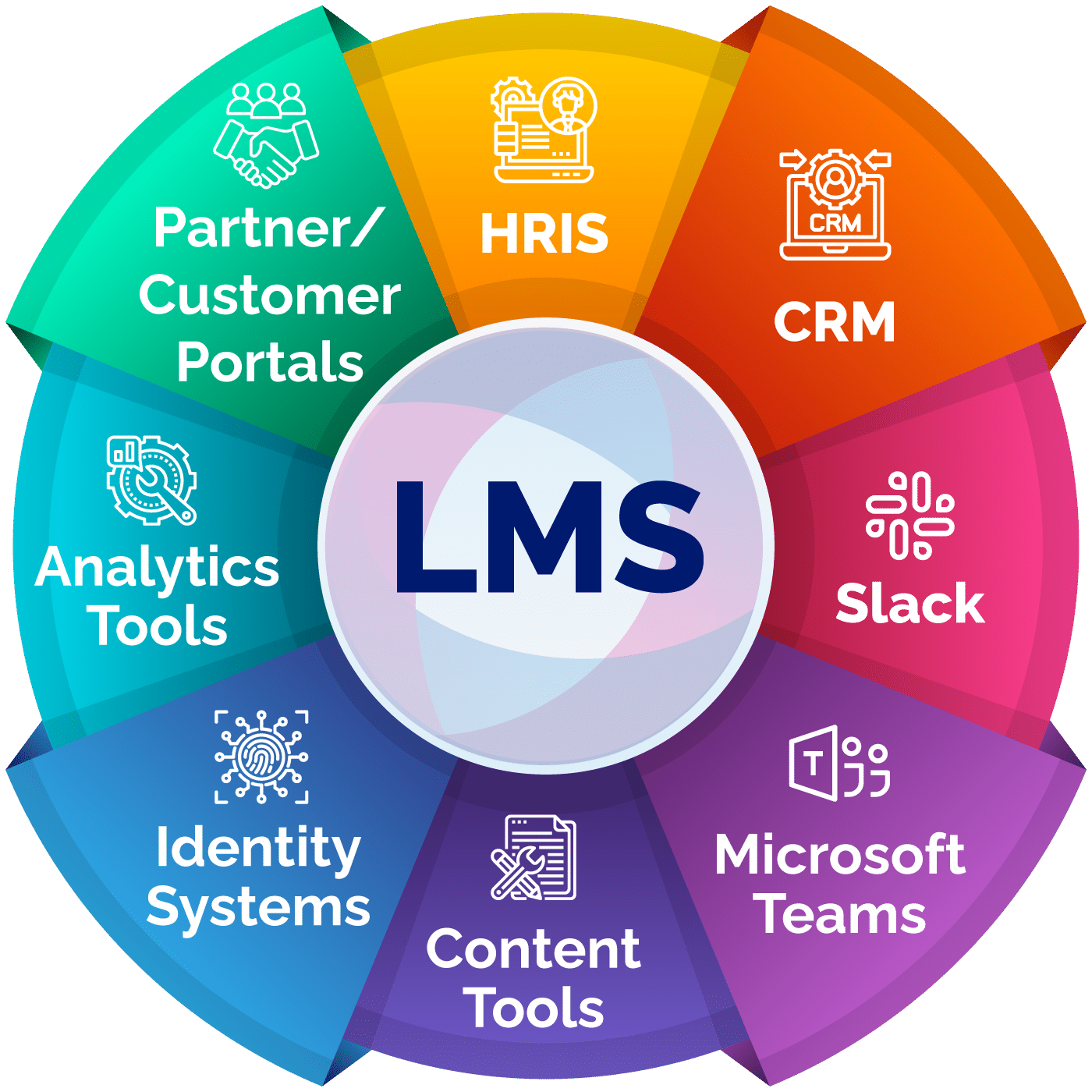
One of the strongest use cases for integration is learning in the flow of work. When an LMS connects with tools such as Slack, Microsoft Teams, Salesforce, HR systems, and other business platforms, learning can happen closer to where work already happens. That reduces friction for learners and makes training feel more practical instead of separate.
Learning in the flow of work does not mean every training experience should disappear into another system. It means the LMS should be flexible enough to support access, nudges, and visibility within the systems employees already rely on.
Connecting Your LMS With Business Systems
Enterprise buyers should also think about integration more broadly. The LMS often needs to connect with systems of record, identity systems, communication tools, reporting environments, and customer or partner platforms.
That matters for both usability and control. Strong integrations can improve data consistency, reduce manual administration, support better assignment logic, and make reporting more reliable. Weak integrations tend to push work back into spreadsheets, manual imports, and workaround processes.
This is one of the reasons modern enterprise LMS evaluation often overlaps with broader technology strategy. Buyers are not just choosing a content platform. They are choosing how learning will fit into the wider operating environment of the business.
How LMS Features Improve Engagement and Employee Empowerment
A purely technical discussion of LMS features misses something important. The platform also shapes how employees experience learning.
When the LMS is hard to use, generic, or disconnected from growth, learning feels like a task to get through. When it is accessible, relevant, and visibly connected to development, learning feels more worthwhile.
That does not mean engagement comes from novelty. It usually comes from clarity, relevance, ease of access, and a sense that the time spent learning leads somewhere.
Giving Learners More Control
Employees are more likely to engage with learning when they can see what matters, access it easily, and move through it at their own pace.
That is why self-paced pathways, progress visibility, mobile access, flexible formats, and intuitive navigation matter. These features make learning easier to fit into real work schedules and give learners more ownership over how they develop.
Control also affects motivation. A system that constantly feels confusing or rigid makes learning feel imposed. A system that makes expectations clear and progress visible gives learners a stronger sense of momentum.
Supporting Career Growth and Development
A modern LMS can support growth by making certifications, development programs, learning pathways, and cross-functional opportunities easier to discover.
That matters because employees engage differently when learning feels connected to opportunity rather than only to compliance. Growth-oriented learning helps shift the platform from a requirement engine to a development environment.
For organizations trying to build stronger internal mobility and workforce resilience, this is a meaningful feature area. The LMS can help make growth pathways more visible and more attainable across the business.
When learners can see how training connects to advancement, development becomes easier to sustain over time.
Increasing Participation and Completion
Engagement improves when learning is not only accessible, but relevant and interactive.
Better recommendations, stronger analytics, collaborative tools, live learning experiences, and well-used gamification features can all help increase participation over time. These capabilities are most effective when they are built on a platform that already makes access and relevance easier.
For distributed teams, these features can also reinforce communication and shared expectations. Learning becomes more than a task list. It becomes part of how the organization supports alignment, readiness, and continuous development across locations and roles.
This is one of the reasons learner experience and operational design cannot really be separated. Participation is shaped by both. If the system creates friction, engagement drops. If it improves relevance, access, and clarity, participation tends to rise.
How to Evaluate LMS Features Without Getting Lost in the Checklist
A long feature list can be useful, but it is not a strategy. The better approach is to evaluate features through a smaller set of business questions:
- Will this feature reduce friction for learners?
- Will it reduce manual work for administrators?
- Will it improve visibility for managers and leaders?
- Will it support governance and consistency at scale?
- Will it still be useful as our audiences, systems, and learning needs become more complex?
These questions keep evaluation grounded in operational value rather than volume.
In most enterprise buying conversations, the strongest platform is not the one with the longest checklist. It is the one that solves the most important problems clearly, consistently, and at scale. That is especially true for organizations that have already outgrown a legacy LMS, a fragmented stack, or manual learning processes.
Where Does ExpertusONE Fit?
For enterprise organizations that need to support learning across employees, customers, partners, and other audiences, ExpertusONE brings key LMS capabilities together in one platform. That includes structured training delivery, governance controls, reporting, integrations, and support for more flexible, personalized learning experiences.
This matters when learning operations have outgrown manual processes, disconnected systems, or basic LMS functionality. Instead of adding more tools to manage more complexity, organizations can use a platform designed to support scale, visibility, and consistency across a wider learning ecosystem.
ExpertusONE is especially relevant for teams that need to manage multiple audiences, strengthen administrative control, improve reporting, and connect learning to the systems employees and external users already rely on. For organizations balancing learner experience with governance and operational demands, that combination can be a meaningful advantage.
Key Takeaways
An LMS is no longer just a course delivery system. For enterprise organizations, it is part of the operating infrastructure for learning, compliance, and workforce development.
The strongest business case for an LMS is not content hosting. It is consistency, visibility, efficiency, and scale.
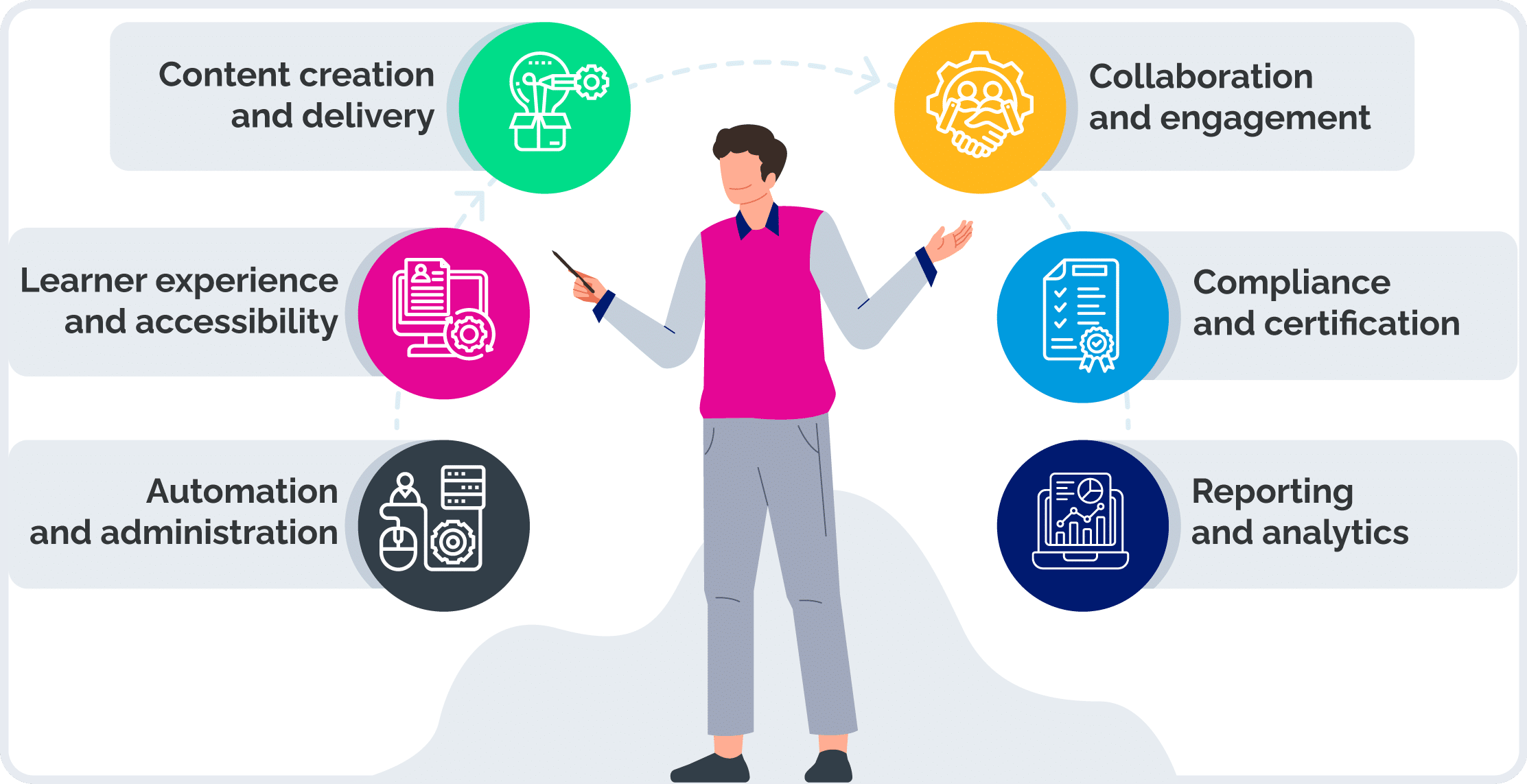
The most important LMS features usually fall into a few core areas: content delivery, learner experience, automation, analytics, compliance support, collaboration, integration, and personalization.
Modern enterprise LMS buyers should look beyond basic feature lists and prioritize flexibility, governance, mobile access, integrations, and support for multiple audiences.
Integrations matter because learning works better when it fits into everyday workflows instead of living in a disconnected system.
Engagement improves when learning is relevant, accessible, interactive, and connected to employee growth.
FAQs
Every LMS should support core functions such as content delivery, learner management, assignments, completion tracking, and reporting. For enterprise organizations, those basics are usually not enough on their own. Features such as automation, integrations, analytics, certification tracking, mobile access, and support for multiple audiences often become just as important.
The most important enterprise LMS features usually include automation, reporting, compliance support, integration capabilities, mobile learning, personalization, governance controls, and flexible content delivery. These features matter because they help organizations manage learning at scale with more consistency and less manual effort.
Integrations help reduce friction by connecting learning to the systems employees already use. That can improve access, reduce context switching, strengthen assignment logic, and make reporting more reliable. In practice, integrations help the LMS feel like part of the business instead of a disconnected destination.
Analytics improve training outcomes by helping teams see what is working, where participation is dropping, which learners need support, and how programs connect to wider business goals. Better visibility helps managers follow up more effectively and helps learning leaders make stronger decisions about what to improve.
Yes. Many enterprise LMS platforms are used for customer education, partner enablement, contractor learning, dealer training, and other extended enterprise use cases. The important question is whether the platform can support those audiences cleanly, with the right permissions, reporting, and learning environments.
About the Author:
Greg Bashar is the Senior Learning Advisor at ExpertusONE with more than 18 years of experience helping enterprise organizations make smart, confident LMS and learning-technology decisions. He partners with L&D and business leaders to align learning platforms with real operational needs, long-term strategy, and measurable outcomes. Greg has advised global brands including Stanley Black & Decker, The Hartford, Estée Lauder, and Toyota, and is known for bringing clarity to complex, high-stakes learning initiatives.
Summary
LMS features matter most when they help organizations automate and scale learning without adding complexity. The right platform does more than house and distribute courses. It supports onboarding, compliance, skills development, reporting, and learning across multiple audiences. For enterprise buyers, the key question is not how many features an LMS includes, but whether those capabilities improve access, reduce administrative work, strengthen governance, and connect learning to business outcomes.
Key Terms:
- LMS Features
- Learning Management System
- Enterprise LMS
- LMS Platform
- LMS Integrations
- Mobile Learning
- Learning Analytics
- Personalized Learning
What is a Learning Management System (LMS)?
A learning management system, or LMS, is a platform used to deliver, manage, track, and report on learning. At a basic level, it helps organizations assign training, organize content, monitor completion, and maintain records of learner activity.
For enterprise organizations, that definition needs to go further. An LMS is not just a course library or a place to upload learning content. It is the system that helps learning teams run structured programs across different audiences, locations, business units, compliance environments, and use cases. It supports the administrative side of learning as much as the learner experience itself.
That distinction matters because enterprise learning is rarely limited to one audience or one type of program. The LMS may be used for employee onboarding, compliance, field readiness, sales enablement, customer education, partner learning, and ongoing development at the same time. In that environment, the platform becomes an operational system, not just a content destination.
What does an LMS do?
An LMS gives organizations a central system for managing learning from end to end. That often includes content delivery, learner enrollment, assignments, completion tracking, certifications, reminders, reporting, and administrative workflows.
In practice, an LMS may be used to:
- Deliver onboarding and role-based training
- Assign required and recurring learning
- Support certifications and continuing education
- Provide self-paced development opportunities
- Enable customer and partner education
- Give managers and administrators visibility into progress and gaps
The real value is coordination. Instead of managing learning through spreadsheets, email reminders, separate portals, and disconnected reports, the LMS creates a more consistent way to deliver and monitor training across the organization.
That consistency becomes more important as learning expands. A small business might be able to manage parts of training manually. A large enterprise usually cannot. Once the number of learners, requirements, audiences, and stakeholders increases, the organization needs a system that can keep learning operations organized without constant manual intervention.
How Businesses Use an LMS
Most organizations do not use an LMS for a single purpose. They use it across a mix of operational and strategic needs.
In some cases, the LMS starts as a tool for employee training or compliance. Over time, it expands into leadership development, sales enablement, product training, customer education, partner learning, and internal mobility programs. In larger organizations, it may also need to support multiple brands, regions, languages, and audiences at once.
That is why LMS evaluation cannot stop at course delivery. Buyers need to ask how the platform will perform under real operating conditions:
- Can it support different learner groups with different permissions and content needs?
- Can it handle reporting across distributed teams?
- Can it fit into the wider business systems already in place?
- Can it scale without forcing administrators into more manual work as the organization grows?
Those are the questions that separate a basic LMS from a platform built for enterprise complexity.
Building the Business Case for an LMS
Organizations usually take a closer look at LMS features when the current approach stops working. Training becomes harder to coordinate. Reporting becomes less reliable. Learners struggle to find what they need. Manual follow-up increases. Administrators spend more time maintaining the system than improving the learning strategy.
Learning technology decisions carry real weight because enterprise training is a major investment. A recent Training Industry Report put U.S. training expenditures at about $98 billion, underscoring why organizations need platforms that improve visibility, consistency, and efficiency rather than adding more operational friction.
An LMS is not just a publishing tool. It is a system for reducing friction in how learning is delivered, tracked, and improved. For enterprise teams, that matters because learning is rarely isolated. It affects compliance, onboarding, productivity, role readiness, workforce development, customer experience, and change management.
The strongest business case is not that an LMS stores content, as most systems can do that. The stronger argument is that the right LMS helps the organization operate more effectively by creating consistency, visibility, and control across learning processes that would otherwise remain fragmented.
The Limits of Manual Training Management
Manual learning administration can work for small training programs, but it usually breaks down as organizations grow. When training is spread across multiple systems, spreadsheets, inbox reminders, shared drives, and separate reporting tools, a number of problems arise:
- Teams lose visibility
- Completion status becomes harder to verify
- Follow-up becomes inconsistent
- Reporting turns into reconciliation work
- Administrative effort grows faster than the learning program itself
It creates more than inefficiency; it also increases risk. When assignments are inconsistent, records are hard to trust, or reporting definitions vary across teams, it becomes harder to show the business that learning is being managed well. The problem gets worse in environments where timing, completion evidence, or recurring training requirements matter.
This is one of the main reasons organizations outgrow lightweight systems. The issue is not usually a lack of content. It is the burden of coordinating learning operations in a way that remains reliable as complexity increases.
Why Scale, Consistency, and Reporting Matter
As organizations become more distributed, learning operations become more demanding. There are more learners, more roles, more requirements, more stakeholders, and more pressure to show that training is effective.
That changes what matters in an LMS. The platform has to do more than deliver courses. It has to support repeatable processes, role-based assignments, timely reporting, and stronger control over how learning is delivered and tracked.
Consistency matters because enterprise learning is often tied to business-critical outcomes. Onboarding affects time to productivity. Compliance affects risk. Product training affects customer experience and readiness. Partner education affects external performance. When learning operations are inconsistent, those outcomes become harder to manage.
Reporting matters for the same reason. Managers need visibility into their teams. Learning teams need to know where progress is falling off. Leaders need evidence that learning investments are producing results. Without that visibility, learning becomes harder to improve and harder to defend.
How Does an LMS Support Business Goals?
A well-chosen LMS can reduce manual effort, improve training consistency, strengthen compliance oversight, and make learning more accessible across the organization. It can also support broader business priorities such as faster onboarding, workforce development, customer readiness, partner enablement, and more consistent knowledge transfer.
This becomes especially important when learning extends beyond employees. Many enterprise organizations also need to educate customers, partners, dealers, contractors, or franchise networks. In those environments, the LMS is not just an internal HR or L&D system. It becomes part of the wider business infrastructure.
That is why the business case for an LMS is often broader than it first appears. It is not only about the learning experience. It is about how the organization manages growth, change, governance, and performance through a more structured learning system.
What are the LMS Features That Matter Most?
There is no shortage of LMS feature lists. The problem is that many of them flatten everything into one long inventory. In practice, some capabilities are foundational, while others matter most because they improve adoption, reduce manual work, or strengthen visibility and control.
The most important LMS features are the ones that help organizations manage learning effectively as complexity increases. They support the learner experience, but they also support the operating model behind it.
Content Creation and Delivery
At the center of any LMS is content delivery. The platform should make it easy to organize, assign, launch, and complete learning across different formats and audiences.
That includes standard course management, but modern organizations usually need more than that. They may need video, knowledge resources, assessments, instructor-led components, reference documents, interactive learning elements, and structured learning paths. Some teams need short modules that fit naturally into the workday. Others need more formal programs tied to certification or role readiness. It also helps when the platform includes built-in content creation tools (such as ExpertusONE’s Interaction Studio), so learning teams can develop and update training without relying entirely on external authoring workflows.
Content delivery matters because it shapes the learner experience immediately. If content is hard to find, hard to launch, or hard to complete, adoption suffers. If the platform supports a wider range of content types and learning models, teams gain more flexibility in how they design programs.
This also affects how future-ready the system feels. A platform that only works well for one format often pushes teams into workarounds. A stronger LMS allows learning teams to support different business needs without creating separate systems for each one.
Learner Experience and Accessibility
A good LMS should make learning easier to access, not harder. Learners should be able to find relevant training quickly, understand what is expected of them, and move through learning without unnecessary friction. For enterprise teams, that often includes self-paced learning, clear progress visibility, intuitive navigation, and mobile-friendly access for remote, hybrid, field-based, and deskless users.
This is one of the clearest shifts in LMS buying. Administrative capabilities still matter, but adoption depends heavily on usability. A system may look strong in a demo and still underperform if learners only visit it when training is mandatory.
Accessibility is part of this conversation, too. Large organizations serve employees and external audiences in very different working conditions. Some learners sit at a desk all day. Others are in the field, on a shop floor, in healthcare settings, or moving between locations. The LMS has to work across those realities.
The goal is not just convenience; it is consistency. If the platform makes learning easier to access and easier to understand, more learners are likely to complete it on time and return to it when they need it.
Automation and Administration
One of the clearest signs of LMS value is what it removes from the administrative workload.
Automation features help reduce manual effort in assigning training, sending reminders, tracking completions, managing recurring requirements, and supporting manager follow-up. These capabilities can seem secondary during evaluation, but they become much more important once learning programs scale across teams, regions, and audiences.
For enterprise organizations, administration is not just about efficiency. It is also about control. The right LMS should make it easier to manage role-based learning, recurring requirements, exceptions, and governance rules without building a system that is rigid or difficult to maintain.
This is where many older systems start to feel limited. They may support content delivery, but they leave too much of the operational burden in the hands of administrators. That often leads to manual assignments, spreadsheet-based oversight, inconsistent reminders, and weak visibility into what has or has not happened.
A stronger LMS reduces that friction. It helps learning teams spend less time chasing status and more time improving the quality, relevance, and impact of what they are delivering.
Reporting and Analytics
Reporting is one of the most important LMS feature areas because it affects both day-to-day management and long-term credibility.
Learning teams need to know who completed training, where participation is falling off, which programs are working, and where follow-up is needed. Managers need a clearer view of team progress. Leaders need evidence that learning investments are producing business value rather than simply generating activity.
A strong LMS should support more than static completion reports. It should help organizations monitor trends, identify risks, understand engagement, and act on the data. That is what moves analytics from a reporting function to a decision-making capability.
This is also where the platform starts to support stronger business conversations. Better reporting helps learning teams show how onboarding is progressing, where compliance risk is concentrated, which populations need support, and whether strategic programs are gaining traction.
When analytics are useful and accessible, they do more than document the past. They help teams improve participation, strengthen follow-up, and make learning investments easier to evaluate over time.
Compliance and Certification Management
For many enterprise buyers, compliance is one of the clearest tests of LMS effectiveness.
Required learning often involves deadlines, recurring assignments, certification cycles, reminders, audit-ready records, and clear proof that the right people completed the right training at the right time. In some environments, managers may also need to verify observed readiness or practical competency, not just course completion.
That makes compliance-related features especially important. The LMS should help organizations assign required learning accurately, track status consistently, maintain evidence, and support confidence that records are complete and usable.
Even where compliance is not the main buying driver, the same capabilities often support broader governance. The ability to manage recurring requirements, document completions, and maintain consistent records helps bring more discipline to enterprise learning as a whole.
The strongest platforms treat compliance as an operational process, not just a content issue. That means supporting the assignments, deadlines, reminders, records, and reporting needed to manage requirements with confidence.
Social, Collaborative, and Interactive Learning
Not every valuable LMS feature is administrative. Interactive and collaborative capabilities can make learning easier to sustain over time. Depending on the organization, that may include discussions, live sessions, polls, quizzes, gamification, recognition, peer learning, or shared learning experiences that go beyond passive course consumption.
These features matter most when they support a clear goal. Gamification alone will not fix weak learning design. But when the content is relevant and the system is easy to use, interactive elements can improve participation, reinforce progress, and make learning feel more connected to everyday work.
This is also where the LMS can move beyond compliance or one-time delivery and support a more active learning culture. Interaction helps create momentum. Collaboration helps learners see value in returning. Live learning features can strengthen communication and alignment across distributed teams.
For organizations trying to keep learning visible and engaging over time, these capabilities are often more meaningful than they first appear.
Modern LMS Requirements for Enterprise Organizations
There is a difference between standard LMS functionality and the capabilities enterprise buyers should prioritize now.
Most platforms can deliver content and track completions. The larger question is whether the system supports modern learning operations: distributed teams, multiple audiences, tighter reporting expectations, more complex technology environments, and greater pressure to show business value.
This is where enterprise evaluation becomes more selective. The goal is not to collect features. It is to identify the capabilities that help the organization operate with more flexibility, control, and relevance over time.
Personalization and AI
One of the biggest shifts in LMS expectations is the move toward more relevant learning experiences.
Learners no longer expect to search through broad catalogs with little guidance. They expect the system to surface content that reflects their role, goals, skills, interests, or previous activity. That makes personalization and AI-supported recommendations more important than they used to be.
The most useful AI in an LMS is rarely flashy. It works in the background to reduce noise, improve discovery, support administration, and make learning feel more relevant at scale.
Personalization also helps address one of the most common learner frustrations: too much content with too little guidance. When the platform makes it easier to find what matters, learning feels more practical and less overwhelming.
Mobile and Flexible Learning
Enterprise learning no longer happens in one place or one format. Teams may be hybrid, remote, field-based, or constantly moving between systems and responsibilities. In that environment, mobile access and flexible delivery are not optional extras. They are part of the baseline expectation.
A modern LMS should support learning that fits around work rather than requiring work to stop completely. That includes mobile-friendly access, shorter learning experiences, self-paced pathways, and delivery models that can serve different learner contexts without creating separate systems.
This matters for adoption as much as convenience. If employees cannot access learning easily in the environments where they actually work, completion rates and engagement are likely to suffer.
Skills Development and Continuous Learning
Many organizations are no longer evaluating LMS platforms only for course delivery. They are also evaluating whether the platform can support longer-term workforce development. That matters because the skills landscape is shifting quickly. McKinsey, citing the World Economic Forum, notes that 39% of existing skill sets are expected to be transformed or become outdated over the current five-year period, which raises the importance of platforms that support ongoing learning instead of one-time training events.
That means helping employees discover certifications, development programs, role-based pathways, and cross-functional learning opportunities. It also means making upskilling and reskilling feel structured instead of scattered.
This is where an LMS starts to play a broader role. It becomes part of how the organization supports internal mobility, career visibility, and continuous development rather than only mandatory training.
That shift matters because learners engage differently when the platform supports growth as well as obligation. A system that only delivers assigned courses may meet a short-term need. A system that supports development can contribute to retention, readiness, and a stronger learning culture over time.
Support for Multiple Audiences
One of the clearest markers of an enterprise-ready LMS is whether it can support more than one audience well.
Many organizations need to train employees, but they may also need to educate customers, partners, contractors, dealers, franchisees, or other external groups. Those audiences often need different content, permissions, workflows, reporting views, and learning environments.
A platform that only works well for internal employee learning may create new fragmentation as learning expands. A stronger enterprise LMS supports multiple audiences without forcing teams to stitch together separate systems or duplicate administrative effort.
This is also where strategic value becomes more visible. Multi-audience support allows the LMS to contribute to broader business goals such as customer adoption, partner readiness, external consistency, and extended enterprise performance.
| Capability | Basic LMS | Modern enterprise LMS |
|---|---|---|
| Personalization | Standard course catalog with manual search and limited guidance | Personalized recommendations based on role, goals, skills, or learner activity |
| Mobile learning | Limited mobile access or a desktop-first experience | Mobile-friendly, flexible learning that supports hybrid, remote, and field-based teams |
| Multi-audience support | Primarily designed for internal employee training | Supports employees, customers, partners, contractors, and other learner audiences |
| Integrations | Standalone system with limited connections to other tools | Connects with HR systems, CRM platforms, collaboration tools, identity systems, and other business applications |
| Analytics | Basic completion tracking and standard dashboards | Deeper insights into engagement, progress, knowledge gaps, and learning trends |
| Governance | Basic administration and recordkeeping | Stronger controls for assignments, compliance, permissions, records, and reporting consistency |
| Skills development | Focused mainly on course delivery and completions | Supports continuous learning, skills development, career pathways, and internal mobility |
LMS Integration Capabilities
Integration deserves its own section because it has become one of the most important LMS evaluation criteria.
The question is no longer whether the LMS can connect to other systems at all. The more important question is whether those connections reduce friction, improve access, strengthen data quality, and help learning fit into the way people already work.
Why Do Integrations Matter?
A learning platform that sits apart from the rest of the business creates friction. When employees already move between messages, workflows, meetings, and operational systems all day, one more disconnected destination makes adoption harder.
Integrations help reduce that friction by making learning easier to access and easier to manage. They also help reduce the administrative burden that comes from maintaining data and workflows across multiple platforms.
The easier it is to access learning within familiar systems, the more likely people are to use it consistently. That is one reason integrations matter so much in enterprise learning environments.
Learning in the Flow of Work
One of the strongest use cases for integration is learning in the flow of work. When an LMS connects with tools such as Slack, Microsoft Teams, Salesforce, HR systems, and other business platforms, learning can happen closer to where work already happens. That reduces friction for learners and makes training feel more practical instead of separate.
Learning in the flow of work does not mean every training experience should disappear into another system. It means the LMS should be flexible enough to support access, nudges, and visibility within the systems employees already rely on.
Connecting Your LMS With Business Systems
Enterprise buyers should also think about integration more broadly. The LMS often needs to connect with systems of record, identity systems, communication tools, reporting environments, and customer or partner platforms.
That matters for both usability and control. Strong integrations can improve data consistency, reduce manual administration, support better assignment logic, and make reporting more reliable. Weak integrations tend to push work back into spreadsheets, manual imports, and workaround processes.
This is one of the reasons modern enterprise LMS evaluation often overlaps with broader technology strategy. Buyers are not just choosing a content platform. They are choosing how learning will fit into the wider operating environment of the business.
How LMS Features Improve Engagement and Employee Empowerment
A purely technical discussion of LMS features misses something important. The platform also shapes how employees experience learning.
When the LMS is hard to use, generic, or disconnected from growth, learning feels like a task to get through. When it is accessible, relevant, and visibly connected to development, learning feels more worthwhile.
That does not mean engagement comes from novelty. It usually comes from clarity, relevance, ease of access, and a sense that the time spent learning leads somewhere.
Giving Learners More Control
Employees are more likely to engage with learning when they can see what matters, access it easily, and move through it at their own pace.
That is why self-paced pathways, progress visibility, mobile access, flexible formats, and intuitive navigation matter. These features make learning easier to fit into real work schedules and give learners more ownership over how they develop.
Control also affects motivation. A system that constantly feels confusing or rigid makes learning feel imposed. A system that makes expectations clear and progress visible gives learners a stronger sense of momentum.
Supporting Career Growth and Development
A modern LMS can support growth by making certifications, development programs, learning pathways, and cross-functional opportunities easier to discover.
That matters because employees engage differently when learning feels connected to opportunity rather than only to compliance. Growth-oriented learning helps shift the platform from a requirement engine to a development environment.
For organizations trying to build stronger internal mobility and workforce resilience, this is a meaningful feature area. The LMS can help make growth pathways more visible and more attainable across the business.
When learners can see how training connects to advancement, development becomes easier to sustain over time.
Increasing Participation and Completion
Engagement improves when learning is not only accessible, but relevant and interactive.
Better recommendations, stronger analytics, collaborative tools, live learning experiences, and well-used gamification features can all help increase participation over time. These capabilities are most effective when they are built on a platform that already makes access and relevance easier.
For distributed teams, these features can also reinforce communication and shared expectations. Learning becomes more than a task list. It becomes part of how the organization supports alignment, readiness, and continuous development across locations and roles.
This is one of the reasons learner experience and operational design cannot really be separated. Participation is shaped by both. If the system creates friction, engagement drops. If it improves relevance, access, and clarity, participation tends to rise.
How to Evaluate LMS Features Without Getting Lost in the Checklist
A long feature list can be useful, but it is not a strategy. The better approach is to evaluate features through a smaller set of business questions:
- Will this feature reduce friction for learners?
- Will it reduce manual work for administrators?
- Will it improve visibility for managers and leaders?
- Will it support governance and consistency at scale?
- Will it still be useful as our audiences, systems, and learning needs become more complex?
These questions keep evaluation grounded in operational value rather than volume.
In most enterprise buying conversations, the strongest platform is not the one with the longest checklist. It is the one that solves the most important problems clearly, consistently, and at scale. That is especially true for organizations that have already outgrown a legacy LMS, a fragmented stack, or manual learning processes.
Where Does ExpertusONE Fit?
For enterprise organizations that need to support learning across employees, customers, partners, and other audiences, ExpertusONE brings key LMS capabilities together in one platform. That includes structured training delivery, governance controls, reporting, integrations, and support for more flexible, personalized learning experiences.
This matters when learning operations have outgrown manual processes, disconnected systems, or basic LMS functionality. Instead of adding more tools to manage more complexity, organizations can use a platform designed to support scale, visibility, and consistency across a wider learning ecosystem.
ExpertusONE is especially relevant for teams that need to manage multiple audiences, strengthen administrative control, improve reporting, and connect learning to the systems employees and external users already rely on. For organizations balancing learner experience with governance and operational demands, that combination can be a meaningful advantage.
Key Takeaways
An LMS is no longer just a course delivery system. For enterprise organizations, it is part of the operating infrastructure for learning, compliance, and workforce development.
The strongest business case for an LMS is not content hosting. It is consistency, visibility, efficiency, and scale.
The most important LMS features usually fall into a few core areas: content delivery, learner experience, automation, analytics, compliance support, collaboration, integration, and personalization.
Modern enterprise LMS buyers should look beyond basic feature lists and prioritize flexibility, governance, mobile access, integrations, and support for multiple audiences.
Integrations matter because learning works better when it fits into everyday workflows instead of living in a disconnected system.
Engagement improves when learning is relevant, accessible, interactive, and connected to employee growth.
FAQs
Every LMS should support core functions such as content delivery, learner management, assignments, completion tracking, and reporting. For enterprise organizations, those basics are usually not enough on their own. Features such as automation, integrations, analytics, certification tracking, mobile access, and support for multiple audiences often become just as important.
The most important enterprise LMS features usually include automation, reporting, compliance support, integration capabilities, mobile learning, personalization, governance controls, and flexible content delivery. These features matter because they help organizations manage learning at scale with more consistency and less manual effort.
Integrations help reduce friction by connecting learning to the systems employees already use. That can improve access, reduce context switching, strengthen assignment logic, and make reporting more reliable. In practice, integrations help the LMS feel like part of the business instead of a disconnected destination.
Analytics improve training outcomes by helping teams see what is working, where participation is dropping, which learners need support, and how programs connect to wider business goals. Better visibility helps managers follow up more effectively and helps learning leaders make stronger decisions about what to improve.
Yes. Many enterprise LMS platforms are used for customer education, partner enablement, contractor learning, dealer training, and other extended enterprise use cases. The important question is whether the platform can support those audiences cleanly, with the right permissions, reporting, and learning environments.
About the Author:
Greg Bashar is the Senior Learning Advisor at ExpertusONE with more than 18 years of experience helping enterprise organizations make smart, confident LMS and learning-technology decisions. He partners with L&D and business leaders to align learning platforms with real operational needs, long-term strategy, and measurable outcomes. Greg has advised global brands including Stanley Black & Decker, The Hartford, Estée Lauder, and Toyota, and is known for bringing clarity to complex, high-stakes learning initiatives.


