
BLOG
Enterprise LMS Selection Guide: How to Compare Platforms and Build a Business Case
 Author: Cailey Martinez
BLOG
Enterprise LMS Selection Guide: How to Compare Platforms and Build a Business Case
Author: Cailey Martinez
Buying an LMS is no longer a narrow software decision. For enterprise organizations, it affects compliance, employee development, customer and partner training, reporting, operational efficiency, and the ability to scale learning across a complex business.
This guide is for learning leaders, HR and enablement teams, and enterprise buyers who need to evaluate platforms with more rigor. The core idea is simple: the right LMS should reduce friction, support multiple audiences, fit into the systems your teams already use, and continue to deliver value as the organization grows. A strong buying process is not about chasing the longest feature list. It is about choosing a platform that can support real business outcomes over time.
Key Terms:
- Enterprise LMS
- Learning Management System
- LMS Buying Guide
- LMS Selection Criteria
- LMS Comparison
- Extended Enterprise Learning
- Skills-based Learning
- Learning Analytics
Why is Buying an LMS a Strategic Decision?
Buying an LMS is no longer just about replacing an old training system or modernizing course delivery. For enterprise organizations, the platform now influences retention, onboarding, productivity, customer education, and the ability to scale learning across a more complex business. Research from Deloitte shows that workers who feel confident in their growth path are 3.3 times more likely to stay with their current employer over the next 12 months.
That makes the LMS decision broader than it first appears. When learning systems support development well, they help organizations do more than deliver required training. They create a better employee experience, strengthen role readiness, and support stronger early-tenure outcomes. BambooHR, for example, reports that employees who experience effective onboarding feel up to 18 times more committed to their workplace, which gives onboarding and training infrastructure far more strategic importance than a simple compliance lens would suggest.
The same logic applies beyond the workforce. Customer education and external training can have a direct effect on retention and revenue, which is one reason enterprise buyers increasingly need to think beyond employee learning alone. TSIA data cited by ChurnZero shows that customers who are trained and educated on how to get value from a product or service are 92% more likely to renew. For organizations that train customers, partners, franchises, or dealers, the LMS is not just an internal tool. It becomes part of the broader growth and retention engine.
At the same time, the cost of a disconnected learning environment is getting harder to ignore. Enterprise teams already work across HR systems, CRM platforms, collaboration tools, and reporting environments, so learning technology that sits outside that ecosystem tends to create more friction than value. Atlassian cites research showing that people who context-switch experience, on average, a 40% decrease in productivity, which helps explain why fragmented learning workflows are so difficult to justify at scale.
That is why LMS selection should be treated as a strategic business decision rather than a software refresh. The real question is not which platform has the longest feature list. It is which system can reduce friction, support multiple audiences, fit into the broader enterprise stack, and continue to deliver value as the organization grows.
What to Define Before You Compare Platforms?
Before reviewing vendors, demos, or pricing, define the job the platform actually needs to do. That foundation makes the rest of the buying process more disciplined and much more useful.
Who Are You Training?
Start with the audiences. Some organizations only need employee learning, while others also need to support customers, partners, franchisees, contractors, dealers, or other external groups. Many also need different experiences for different regions, business units, roles, or compliance requirements.
A few scope questions are worth answering early:
- Do you only need employee training, or do you also need customer and partner education?
- Will different audiences need different branding, permissions, portals, or reporting views?
- Are there regional, regulatory, or language requirements that change how learning should be delivered?
- Do managers, instructors, and administrators need different levels of control and visibility?
This is where enterprise complexity starts to matter. The systems that hold up best are usually the ones designed for multi-audience learning from the beginning, rather than products that were built for a simpler use case and later stretched to fit.
What Problems Do You Need to Solve?
Be specific about the operational issues behind the search. A buying process is much stronger when it starts with real business problems rather than a vague goal to modernize.
Typical pain points include too much manual administration, poor learner adoption, limited reporting, weak manager visibility, disconnected systems, inconsistent compliance tracking, or difficulty supporting external audiences without adding more tools. The clearer those problems are, the easier it becomes to evaluate platforms against actual needs instead of general impressions.
What Should Success Look Like?
Define success before the evaluation gets underway. That gives the team a shared way to compare options and later helps build the business case.
Success might mean:
- Reducing manual administration
- Improving completion or adoption rates
- Supporting more audiences without adding more systems
- Speeding onboarding
- Improving certification tracking
- Strengthening customer or partner education
- Giving leaders better visibility into learning performance
Those goals should be concrete enough to guide evaluation and simple enough to explain to executive stakeholders.
Selection Criteria for a Modern LMS
Once the fundamentals are clear, the next step is to evaluate platforms against the criteria that matter most in a real enterprise environment.
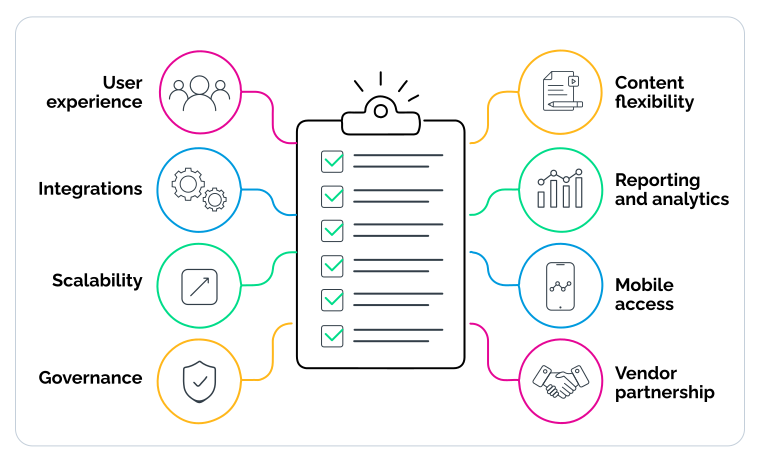
User Experience That Reduces Friction
A strong LMS should make learning easier to start, easier to complete, and easier to return to. That sounds obvious, but many platforms still create unnecessary effort by sending learners across tabs, downloads, redirects, external tools, and disconnected resources. Administrators are left managing rigid workflows, while managers struggle to get visibility without manual reporting.
Usability is not a cosmetic issue. It has a direct effect on adoption, completion, and the perceived value of learning. A platform may look impressive in a demo and still create friction once real users begin searching for content, registering for live sessions, managing assignments, or trying to track progress across multiple audiences.
Integrations That Fit the Flow of Work
An LMS should not operate separately from the rest of the business. Enterprise teams already rely on HR systems, CRM platforms, collaboration tools, content libraries, and reporting environments, so a learning platform that does not connect well to that broader ecosystem often creates extra switching, more manual work, and unnecessary friction.
The right platform should integrate cleanly with core business systems, support automation and smoother data flow, and make it easier for learning to happen within the tools people already use every day. Instead of forcing learners and administrators into a disconnected experience, it should help learning fit more naturally into existing workflows. ExpertusONE supports this with integration capabilities designed to connect learning with the wider enterprise stack, including API-based integrations, xAPI support, and embedded learning experiences in systems such as Salesforce.
Scalability, Governance, and Audience Complexity
Many LMS platforms look strong in a demo but are far harder to manage in a real enterprise environment. Scalability is not just about supporting more users. It is about whether the platform can handle different audiences, reporting requirements, compliance needs, regional differences, and learning models without creating more complexity for the teams running it.
That is why governance matters. Enterprise organizations often need to look beyond surface-level features and evaluate how well a platform supports permissions, role-based controls, delegated administration, compliance management, and audience segmentation. ExpertusONE is designed with that kind of complexity in mind, helping organizations manage learning across multiple audiences and operational requirements with more structure and control.
Content Flexibility and Learning Modalities
Enterprise learning rarely fits into one format. Most organizations need some combination of self-paced learning, live training, blended programs, assessments, certifications, documents, videos, knowledge resources, learning paths, and short-form content that can be accessed quickly.
A modern LMS should make it easy to organize and report on that mix without forcing teams into awkward workarounds. The question is not whether the platform can host content. The question is whether it can support the range of learning experiences the organization actually needs, from formal compliance to onboarding, skill building, and external enablement.
Reporting, Analytics, and Visibility
Leaders need clear insight into what is happening, managers need visibility into learner progress, and administrators need reporting that does not rely on constant manual effort. A strong LMS should make it easy to track compliance, completions, engagement, certifications, and performance across different audiences, while keeping that information accessible and useful in day-to-day operations.
This is where reporting capabilities can make a real difference in the evaluation process. ExpertusONE supports this with flexible analytics tools, including configurable dashboards, drag-and-drop reporting, and AI-assisted report creation, helping teams get answers more quickly without depending on specialist support for every request.
Mobile Access and Accessibility
Learning needs to fit the reality of work, whether that means desk-based employees, field workers, remote teams, frontline roles, frequent travel, or limited time during the day. A platform that works well in one environment but poorly in another will struggle to support learning consistently across the organization.
Mobile access should be treated as a core part of the learner experience, not an add-on. It affects whether people can actually reach, start, and complete training in the moments that make sense for their role. ExpertusONE supports learning on the go with offline access, downloadable content, and simplified class registration and launch, which are the kinds of practical details worth looking for when evaluating how well a platform will support learning in real working conditions.
Vendor Partnership and Long-Term Viability
An LMS purchase is not only a product choice. It is also a partnership decision. Support, implementation guidance, product direction, and long-term fit all matter, especially for enterprise organizations that need stability as their learning environment evolves.
That long-term view is an important part of buying an LMS for life rather than buying one that only solves the next short-term problem. Buyers should look closely at implementation support, roadmap alignment, responsiveness, and whether the vendor seems built to support complexity over time rather than simply present well in a sales cycle.
What Are the Essential Elements of an Enterprise LMS?
Selection criteria help buyers evaluate platforms, but essential elements help clarify what a strong platform should actually enable across the business.
Employee Development Beyond Compliance
Compliance matters, but it is not enough on its own. The strongest LMS platforms support required training while also making room for onboarding, leadership development, role readiness, career growth, and reskilling.
That matters even more in the current environment, where learning is increasingly tied to retention, workforce adaptability, and internal mobility rather than just mandatory completion. LinkedIn’s report reinforces that point by tying career development and learning opportunities to stronger talent retention and advancement outcomes.
Skills Visibility and Skills-Based Development
Many organizations are trying to move beyond course delivery and gain clearer visibility into workforce capabilities. That does not mean every buyer needs a fully developed skills strategy from day one, but it does mean the LMS decision should take into account how skills will be identified, developed, and connected to learning over time.
The key question is whether the platform can support a more skills-informed approach as needs evolve, or whether skills data will end up fragmented across separate systems. For organizations thinking about internal mobility, role readiness, or future capability gaps, that connection is becoming increasingly important.
In-Platform Video and Live Learning
Live learning still plays an important role in enterprise programs, especially for instructor-led sessions, cohort experiences, office hours, collaborative training, and certification events. A platform should make those experiences easier to run, not harder to coordinate.
That does not mean every buyer needs highly sophisticated live learning features, but it does mean the platform should support blended learning in a coherent way rather than pushing organizations into separate tools for every format.
Support for Customers, Partners, and Other External Audiences
For many organizations, learning is not only internal. It also supports customer education, partner enablement, franchise training, channel readiness, and external certification programs. A platform that can support external audiences alongside employee learning is often far more valuable than one designed only for internal use.
Enterprise learning management systems such as ExpertusONE are designed to support external training as a core use case, not just an extension of internal learning. That matters for organizations training customers, partners, franchisees, contractors, or other external audiences, especially when those programs affect revenue, brand consistency, customer success, or compliance.
The platform should be able to support different audiences with the right structure, permissions, and learning experiences for each group. That is often what determines whether external training can scale effectively without creating more administrative complexity.
How to Compare LMS Platforms Effectively?
A better buying process usually leads to a better decision. The key is to evaluate platforms in a way that reflects how they will actually be used.
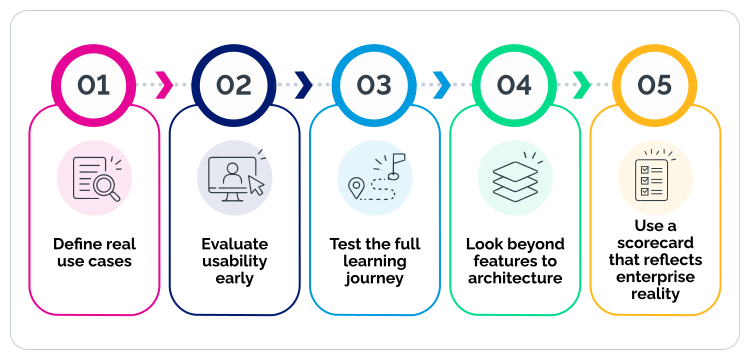
Start With Real Use Cases, Not Vendor Slides
Build the evaluation around scenarios your organization genuinely cares about rather than generic walkthroughs. Ask vendors to show how the platform handles onboarding across regions, compliance recertification, customer education, partner training, manager visibility, live learning, or content updates at scale.
A useful evaluation usually includes several real workflows, such as:
- How learners discover content
- How assignments are managed
- How managers see progress
- How certifications are tracked
- How content is updated
- How reporting works in practice
The more realistic the scenario, the more revealing the comparison becomes.
Evaluate Usability Early
Do not leave usability until late in the process. A platform can look strong on paper and still create unnecessary friction once learners, administrators, and managers start using it in real situations. Feature breadth can be impressive, but if the experience is difficult to navigate, adoption and efficiency usually suffer.
This is a good point in the evaluation process to look more closely at the mistakes that often derail LMS selection, especially around usability, architecture, and mobile assumptions. For a deeper look at those issues, see our white paper on the four common LMS buying traps.
Test the Full Learning Journey
A demo should not stop at course launch. The platform should be evaluated across the full learning journey so the team can see how well it supports actual operations.
That journey should usually include discovery, assignment, live learning, assessments, certifications, reminders, manager visibility, mobile access, reporting, and administrative changes. A platform is only as strong as the end-to-end experience it supports.
Look Beyond Features to Architecture
A long feature list is not the same as a strong platform. Some systems are assembled through add-ons or loosely connected tools, which can create inconsistency, complexity, and usability issues over time.
That is why enterprise buyers should ask how capabilities are delivered, how data moves across the system, how consistent the user experience remains across modules, and whether the platform stays coherent as use cases expand. In many cases, architecture turns out to matter as much as visible functionality.
Use a Scorecard That Reflects Enterprise Reality
An evaluation scorecard should include more than product features alone. A more balanced scorecard helps prevent the final decision from being driven by the most polished demo.
A practical scorecard often includes:
- Usability
- Governance
- External audience support
- Scalability
- Reporting
- Implementation fit
- Vendor support
- Integration fit
- Content flexibility
- Administrative efficiency
Building Your Business Case
Even a strong evaluation process can lose momentum if the business case is weak. The most effective business cases frame the LMS as a response to business pain and operational need, not just as a new technology purchase.
Start With the Cost of the Status Quo
Do not begin by talking about new software. Start by showing what the current environment is costing the organization today.
That may include manual administration, fragmented systems, poor learner adoption, inconsistent reporting, weak compliance visibility, duplicated effort, and limited ability to support new learning needs. Pain is often easier for stakeholders to recognize than possibility, which is why the status quo is such an important starting point.
Tie the Investment to Business Outcomes
The strongest business cases connect learning technology to business priorities. The goal is not to claim that the LMS solves everything, but to show that it removes barriers that are currently limiting performance.
Relevant outcomes may include:
- Faster onboarding
- Improved compliance readiness
- Stronger partner performance
- Reduced manual effort
- Better certification tracking
- More consistent customer education
- Stronger internal mobility
- Better visibility into learning impact
This mirrors the broader direction of current L&D research, which increasingly ties learning and career development to measurable business results rather than treating them as separate from performance.
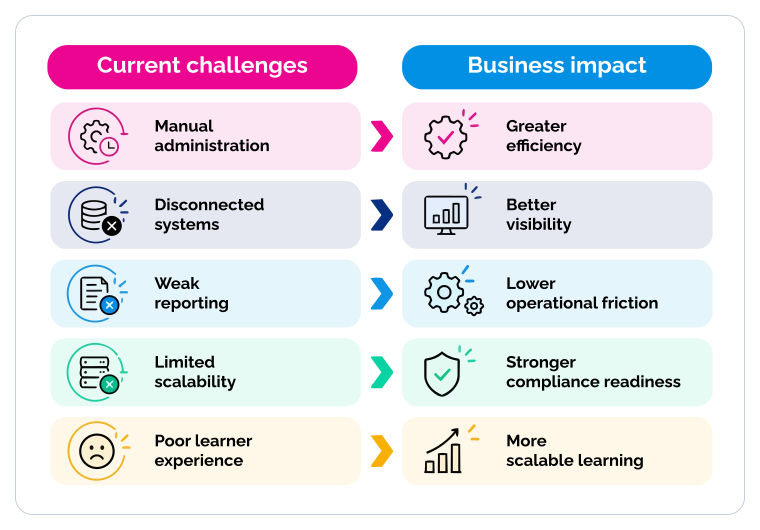
Speak in the Language of Executives
Executives rarely approve technology because it sounds modern. They respond to business value, operational efficiency, risk reduction, and measurable impact, so the case needs to be framed in those terms.
Instead of leading with features, explain where time is being lost, where visibility is weak, where learner friction is undermining outcomes, where risk is hard to manage, and how a stronger platform supports company priorities. In other words, do not sell features. Translate them into consequences.
Build a Cross-Functional Buying Team
Enterprise LMS decisions are rarely strongest when they sit in one function alone. The buying team should reflect the reality that the platform affects multiple parts of the business.
That usually means involving:
- Learning leaders
- System owners
- HR
- IT
- Finance
- Operations
- Enablement leaders
- Compliance stakeholders where relevant
- Procurement where relevant
Cross-functional input improves the evaluation itself and usually makes executive approval easier later in the process.
Plan for a Realistic Timeline
A good LMS decision takes time. Requirements gathering, internal alignment, vendor evaluation, demos, pilots, budget approval, procurement, and implementation planning all add up, so the process needs enough structure to maintain momentum without becoming rushed.
The point is not to slow the process down. It is to create enough discipline that the final decision holds up under scrutiny.
Questions to Ask Before You Make a Final Decision
Before making a final selection, pressure-test the decision with a short set of questions that bring the process back to fundamentals:
- Can this platform support the full mix of audiences we need today and may need later?
- Will it reduce friction for learners, administrators, and managers?
- Does it fit into the systems and workflows our teams already use?
- Can it support compliance, development, live learning, and external training in one environment?
- Will reporting give leaders the visibility they actually need?
- Is it built to handle complexity without creating more of it?
- Do we trust the vendor to support implementation well?
- Will this platform still make sense as our learning requirements expand?
Key Takeaways
Treat LMS buying as a strategic decision, not a box-checking exercise.
Define your audiences, operational problems, and success measures before comparing vendors.
Prioritize usability, integrations, governance, scalability, and reporting over feature volume alone.
Look for a platform that supports both compliance and growth, including employee, customer, and partner learning where needed.
Build the business case around pain, value, and measurable business outcomes.
Use an evaluation process that tests the full learning journey, not just the demo experience.
FAQs
The most important thing is fit. The right LMS should match your audience complexity, learning goals, operational requirements, and long-term growth plans. In practice, that usually means balancing usability, scalability, integrations, governance, and reporting rather than focusing too heavily on one feature alone.
Use real business scenarios, a shared scorecard, and a cross-functional evaluation team. Platforms should be compared on the full learning journey, not only on feature lists or polished demos.
It depends on the size and complexity of the organization, but enterprise decisions often involve multiple stakeholders, security and procurement review, and a more rigorous comparison process. The timeline should allow for alignment, evaluation, and due diligence without dragging on unnecessarily.
One of the most common mistakes is overvaluing feature breadth while underestimating usability, architecture, and operational fit. A platform can look impressive in a demo and still create friction once real teams start using it.
Future-proof platforms tend to support multiple audiences, fit into broader enterprise ecosystems, provide strong governance, and adapt as learning needs change. They make modernization easier without pushing the organization toward another replacement too soon.
Buying an LMS is no longer a narrow software decision. For enterprise organizations, it affects compliance, employee development, customer and partner training, reporting, operational efficiency, and the ability to scale learning across a complex business.
This guide is for learning leaders, HR and enablement teams, and enterprise buyers who need to evaluate platforms with more rigor. The core idea is simple: the right LMS should reduce friction, support multiple audiences, fit into the systems your teams already use, and continue to deliver value as the organization grows. A strong buying process is not about chasing the longest feature list. It is about choosing a platform that can support real business outcomes over time.
Key Terms:
- Enterprise LMS
- Learning Management System
- LMS Buying Guide
- LMS Selection Criteria
- LMS Comparison
- Extended Enterprise Learning
- Skills-based Learning
- Learning Analytics
Why is Buying an LMS a Strategic Decision?
Buying an LMS is no longer just about replacing an old training system or modernizing course delivery. For enterprise organizations, the platform now influences retention, onboarding, productivity, customer education, and the ability to scale learning across a more complex business. Research from Deloitte shows that workers who feel confident in their growth path are 3.3 times more likely to stay with their current employer over the next 12 months.
That makes the LMS decision broader than it first appears. When learning systems support development well, they help organizations do more than deliver required training. They create a better employee experience, strengthen role readiness, and support stronger early-tenure outcomes. BambooHR, for example, reports that employees who experience effective onboarding feel up to 18 times more committed to their workplace, which gives onboarding and training infrastructure far more strategic importance than a simple compliance lens would suggest.
The same logic applies beyond the workforce. Customer education and external training can have a direct effect on retention and revenue, which is one reason enterprise buyers increasingly need to think beyond employee learning alone. TSIA data cited by ChurnZero shows that customers who are trained and educated on how to get value from a product or service are 92% more likely to renew. For organizations that train customers, partners, franchises, or dealers, the LMS is not just an internal tool. It becomes part of the broader growth and retention engine.
At the same time, the cost of a disconnected learning environment is getting harder to ignore. Enterprise teams already work across HR systems, CRM platforms, collaboration tools, and reporting environments, so learning technology that sits outside that ecosystem tends to create more friction than value. Atlassian cites research showing that people who context-switch experience, on average, a 40% decrease in productivity, which helps explain why fragmented learning workflows are so difficult to justify at scale.
That is why LMS selection should be treated as a strategic business decision rather than a software refresh. The real question is not which platform has the longest feature list. It is which system can reduce friction, support multiple audiences, fit into the broader enterprise stack, and continue to deliver value as the organization grows.
What to Define Before You Compare Platforms?
Before reviewing vendors, demos, or pricing, define the job the platform actually needs to do. That foundation makes the rest of the buying process more disciplined and much more useful.
Who Are You Training?
Start with the audiences. Some organizations only need employee learning, while others also need to support customers, partners, franchisees, contractors, dealers, or other external groups. Many also need different experiences for different regions, business units, roles, or compliance requirements.
A few scope questions are worth answering early:
- Do you only need employee training, or do you also need customer and partner education?
- Will different audiences need different branding, permissions, portals, or reporting views?
- Are there regional, regulatory, or language requirements that change how learning should be delivered?
- Do managers, instructors, and administrators need different levels of control and visibility?
This is where enterprise complexity starts to matter. The systems that hold up best are usually the ones designed for multi-audience learning from the beginning, rather than products that were built for a simpler use case and later stretched to fit.
What Problems Do You Need to Solve?
Be specific about the operational issues behind the search. A buying process is much stronger when it starts with real business problems rather than a vague goal to modernize.
Typical pain points include too much manual administration, poor learner adoption, limited reporting, weak manager visibility, disconnected systems, inconsistent compliance tracking, or difficulty supporting external audiences without adding more tools. The clearer those problems are, the easier it becomes to evaluate platforms against actual needs instead of general impressions.
What Should Success Look Like?
Define success before the evaluation gets underway. That gives the team a shared way to compare options and later helps build the business case.
Success might mean:
- Reducing manual administration
- Improving completion or adoption rates
- Supporting more audiences without adding more systems
- Speeding onboarding
- Improving certification tracking
- Strengthening customer or partner education
- Giving leaders better visibility into learning performance
Those goals should be concrete enough to guide evaluation and simple enough to explain to executive stakeholders.
Selection Criteria for a Modern LMS
Once the fundamentals are clear, the next step is to evaluate platforms against the criteria that matter most in a real enterprise environment.
User Experience That Reduces Friction
A strong LMS should make learning easier to start, easier to complete, and easier to return to. That sounds obvious, but many platforms still create unnecessary effort by sending learners across tabs, downloads, redirects, external tools, and disconnected resources. Administrators are left managing rigid workflows, while managers struggle to get visibility without manual reporting.
Usability is not a cosmetic issue. It has a direct effect on adoption, completion, and the perceived value of learning. A platform may look impressive in a demo and still create friction once real users begin searching for content, registering for live sessions, managing assignments, or trying to track progress across multiple audiences.
Integrations That Fit the Flow of Work
An LMS should not operate separately from the rest of the business. Enterprise teams already rely on HR systems, CRM platforms, collaboration tools, content libraries, and reporting environments, so a learning platform that does not connect well to that broader ecosystem often creates extra switching, more manual work, and unnecessary friction.
The right platform should integrate cleanly with core business systems, support automation and smoother data flow, and make it easier for learning to happen within the tools people already use every day. Instead of forcing learners and administrators into a disconnected experience, it should help learning fit more naturally into existing workflows. ExpertusONE supports this with integration capabilities designed to connect learning with the wider enterprise stack, including API-based integrations, xAPI support, and embedded learning experiences in systems such as Salesforce.
Scalability, Governance, and Audience Complexity
Many LMS platforms look strong in a demo but are far harder to manage in a real enterprise environment. Scalability is not just about supporting more users. It is about whether the platform can handle different audiences, reporting requirements, compliance needs, regional differences, and learning models without creating more complexity for the teams running it.
That is why governance matters. Enterprise organizations often need to look beyond surface-level features and evaluate how well a platform supports permissions, role-based controls, delegated administration, compliance management, and audience segmentation. ExpertusONE is designed with that kind of complexity in mind, helping organizations manage learning across multiple audiences and operational requirements with more structure and control.
Content Flexibility and Learning Modalities
Enterprise learning rarely fits into one format. Most organizations need some combination of self-paced learning, live training, blended programs, assessments, certifications, documents, videos, knowledge resources, learning paths, and short-form content that can be accessed quickly.
A modern LMS should make it easy to organize and report on that mix without forcing teams into awkward workarounds. The question is not whether the platform can host content. The question is whether it can support the range of learning experiences the organization actually needs, from formal compliance to onboarding, skill building, and external enablement.
Reporting, Analytics, and Visibility
Leaders need clear insight into what is happening, managers need visibility into learner progress, and administrators need reporting that does not rely on constant manual effort. A strong LMS should make it easy to track compliance, completions, engagement, certifications, and performance across different audiences, while keeping that information accessible and useful in day-to-day operations.
This is where reporting capabilities can make a real difference in the evaluation process. ExpertusONE supports this with flexible analytics tools, including configurable dashboards, drag-and-drop reporting, and AI-assisted report creation, helping teams get answers more quickly without depending on specialist support for every request.
Mobile Access and Accessibility
Learning needs to fit the reality of work, whether that means desk-based employees, field workers, remote teams, frontline roles, frequent travel, or limited time during the day. A platform that works well in one environment but poorly in another will struggle to support learning consistently across the organization.
Mobile access should be treated as a core part of the learner experience, not an add-on. It affects whether people can actually reach, start, and complete training in the moments that make sense for their role. ExpertusONE supports learning on the go with offline access, downloadable content, and simplified class registration and launch, which are the kinds of practical details worth looking for when evaluating how well a platform will support learning in real working conditions.
Vendor Partnership and Long-Term Viability
An LMS purchase is not only a product choice. It is also a partnership decision. Support, implementation guidance, product direction, and long-term fit all matter, especially for enterprise organizations that need stability as their learning environment evolves.
That long-term view is an important part of buying an LMS for life rather than buying one that only solves the next short-term problem. Buyers should look closely at implementation support, roadmap alignment, responsiveness, and whether the vendor seems built to support complexity over time rather than simply present well in a sales cycle.
What Are the Essential Elements of an Enterprise LMS?
Selection criteria help buyers evaluate platforms, but essential elements help clarify what a strong platform should actually enable across the business.
Employee Development Beyond Compliance
Compliance matters, but it is not enough on its own. The strongest LMS platforms support required training while also making room for onboarding, leadership development, role readiness, career growth, and reskilling.
That matters even more in the current environment, where learning is increasingly tied to retention, workforce adaptability, and internal mobility rather than just mandatory completion. LinkedIn’s report reinforces that point by tying career development and learning opportunities to stronger talent retention and advancement outcomes.
Skills Visibility and Skills-Based Development
Many organizations are trying to move beyond course delivery and gain clearer visibility into workforce capabilities. That does not mean every buyer needs a fully developed skills strategy from day one, but it does mean the LMS decision should take into account how skills will be identified, developed, and connected to learning over time.
The key question is whether the platform can support a more skills-informed approach as needs evolve, or whether skills data will end up fragmented across separate systems. For organizations thinking about internal mobility, role readiness, or future capability gaps, that connection is becoming increasingly important.
In-Platform Video and Live Learning
Live learning still plays an important role in enterprise programs, especially for instructor-led sessions, cohort experiences, office hours, collaborative training, and certification events. A platform should make those experiences easier to run, not harder to coordinate.
That does not mean every buyer needs highly sophisticated live learning features, but it does mean the platform should support blended learning in a coherent way rather than pushing organizations into separate tools for every format.
Support for Customers, Partners, and Other External Audiences
For many organizations, learning is not only internal. It also supports customer education, partner enablement, franchise training, channel readiness, and external certification programs. A platform that can support external audiences alongside employee learning is often far more valuable than one designed only for internal use.
Enterprise learning management systems such as ExpertusONE are designed to support external training as a core use case, not just an extension of internal learning. That matters for organizations training customers, partners, franchisees, contractors, or other external audiences, especially when those programs affect revenue, brand consistency, customer success, or compliance.
The platform should be able to support different audiences with the right structure, permissions, and learning experiences for each group. That is often what determines whether external training can scale effectively without creating more administrative complexity.
How to Compare LMS Platforms Effectively?
A better buying process usually leads to a better decision. The key is to evaluate platforms in a way that reflects how they will actually be used.
Start With Real Use Cases, Not Vendor Slides
Build the evaluation around scenarios your organization genuinely cares about rather than generic walkthroughs. Ask vendors to show how the platform handles onboarding across regions, compliance recertification, customer education, partner training, manager visibility, live learning, or content updates at scale.
A useful evaluation usually includes several real workflows, such as:
- How learners discover content
- How assignments are managed
- How managers see progress
- How certifications are tracked
- How content is updated
- How reporting works in practice
The more realistic the scenario, the more revealing the comparison becomes.
Evaluate Usability Early
Do not leave usability until late in the process. A platform can look strong on paper and still create unnecessary friction once learners, administrators, and managers start using it in real situations. Feature breadth can be impressive, but if the experience is difficult to navigate, adoption and efficiency usually suffer.
This is a good point in the evaluation process to look more closely at the mistakes that often derail LMS selection, especially around usability, architecture, and mobile assumptions. For a deeper look at those issues, see our white paper on the four common LMS buying traps.
Test the Full Learning Journey
A demo should not stop at course launch. The platform should be evaluated across the full learning journey so the team can see how well it supports actual operations.
That journey should usually include discovery, assignment, live learning, assessments, certifications, reminders, manager visibility, mobile access, reporting, and administrative changes. A platform is only as strong as the end-to-end experience it supports.
Look Beyond Features to Architecture
A long feature list is not the same as a strong platform. Some systems are assembled through add-ons or loosely connected tools, which can create inconsistency, complexity, and usability issues over time.
That is why enterprise buyers should ask how capabilities are delivered, how data moves across the system, how consistent the user experience remains across modules, and whether the platform stays coherent as use cases expand. In many cases, architecture turns out to matter as much as visible functionality.
Use a Scorecard That Reflects Enterprise Reality
An evaluation scorecard should include more than product features alone. A more balanced scorecard helps prevent the final decision from being driven by the most polished demo.
A practical scorecard often includes:
- Usability
- Governance
- External audience support
- Scalability
- Reporting
- Implementation fit
- Vendor support
- Integration fit
- Content flexibility
- Administrative efficiency
Building Your Business Case
Even a strong evaluation process can lose momentum if the business case is weak. The most effective business cases frame the LMS as a response to business pain and operational need, not just as a new technology purchase.
Start With the Cost of the Status Quo
Do not begin by talking about new software. Start by showing what the current environment is costing the organization today.
That may include manual administration, fragmented systems, poor learner adoption, inconsistent reporting, weak compliance visibility, duplicated effort, and limited ability to support new learning needs. Pain is often easier for stakeholders to recognize than possibility, which is why the status quo is such an important starting point.
Tie the Investment to Business Outcomes
The strongest business cases connect learning technology to business priorities. The goal is not to claim that the LMS solves everything, but to show that it removes barriers that are currently limiting performance.
Relevant outcomes may include:
- Faster onboarding
- Improved compliance readiness
- Stronger partner performance
- Reduced manual effort
- Better certification tracking
- More consistent customer education
- Stronger internal mobility
- Better visibility into learning impact
This mirrors the broader direction of current L&D research, which increasingly ties learning and career development to measurable business results rather than treating them as separate from performance.
Speak in the Language of Executives
Executives rarely approve technology because it sounds modern. They respond to business value, operational efficiency, risk reduction, and measurable impact, so the case needs to be framed in those terms.
Instead of leading with features, explain where time is being lost, where visibility is weak, where learner friction is undermining outcomes, where risk is hard to manage, and how a stronger platform supports company priorities. In other words, do not sell features. Translate them into consequences.
Build a Cross-Functional Buying Team
Enterprise LMS decisions are rarely strongest when they sit in one function alone. The buying team should reflect the reality that the platform affects multiple parts of the business.
That usually means involving:
- Learning leaders
- System owners
- HR
- IT
- Finance
- Operations
- Enablement leaders
- Compliance stakeholders where relevant
- Procurement where relevant
Cross-functional input improves the evaluation itself and usually makes executive approval easier later in the process.
Plan for a Realistic Timeline
A good LMS decision takes time. Requirements gathering, internal alignment, vendor evaluation, demos, pilots, budget approval, procurement, and implementation planning all add up, so the process needs enough structure to maintain momentum without becoming rushed.
The point is not to slow the process down. It is to create enough discipline that the final decision holds up under scrutiny.
Questions to Ask Before You Make a Final Decision
Before making a final selection, pressure-test the decision with a short set of questions that bring the process back to fundamentals:
- Can this platform support the full mix of audiences we need today and may need later?
- Will it reduce friction for learners, administrators, and managers?
- Does it fit into the systems and workflows our teams already use?
- Can it support compliance, development, live learning, and external training in one environment?
- Will reporting give leaders the visibility they actually need?
- Is it built to handle complexity without creating more of it?
- Do we trust the vendor to support implementation well?
- Will this platform still make sense as our learning requirements expand?
Key Takeaways
Treat LMS buying as a strategic decision, not a box-checking exercise.
Define your audiences, operational problems, and success measures before comparing vendors.
Prioritize usability, integrations, governance, scalability, and reporting over feature volume alone.
Look for a platform that supports both compliance and growth, including employee, customer, and partner learning where needed.
Build the business case around pain, value, and measurable business outcomes.
Use an evaluation process that tests the full learning journey, not just the demo experience.
FAQs
The most important thing is fit. The right LMS should match your audience complexity, learning goals, operational requirements, and long-term growth plans. In practice, that usually means balancing usability, scalability, integrations, governance, and reporting rather than focusing too heavily on one feature alone.
Use real business scenarios, a shared scorecard, and a cross-functional evaluation team. Platforms should be compared on the full learning journey, not only on feature lists or polished demos.
It depends on the size and complexity of the organization, but enterprise decisions often involve multiple stakeholders, security and procurement review, and a more rigorous comparison process. The timeline should allow for alignment, evaluation, and due diligence without dragging on unnecessarily.
One of the most common mistakes is overvaluing feature breadth while underestimating usability, architecture, and operational fit. A platform can look impressive in a demo and still create friction once real teams start using it.
Future-proof platforms tend to support multiple audiences, fit into broader enterprise ecosystems, provide strong governance, and adapt as learning needs change. They make modernization easier without pushing the organization toward another replacement too soon.


