
BLOG
The Complete Guide to Extended Enterprise Training: Educating Customers, Partners, and Beyond
 Author: Gordon Johnson
BLOG
The Complete Guide to Extended Enterprise Training: Educating Customers, Partners, and Beyond
Author: Gordon Johnson
Table of Contents
What is Extended Enterprise Training?
Audiences of Extended Enterprise Training
Benefits of Extended Enterprise Training
Challenges of Extended Enterprise Training
What to Look for in an Extended Enterprise LMS?
Build an Extended Enterprise Training Strategy
Extended enterprise training helps organizations deliver learning to people outside their internal workforce, including customers, partners, resellers, franchisees, dealers, contractors, suppliers, and members.
For enterprise organizations, this is no longer a secondary training need. External audiences influence revenue, customer experience, compliance, product adoption, brand consistency, and support demand. When they are trained well, they can sell more effectively, use products more successfully, represent the brand more consistently, and follow the right operational standards.
This guide explains what extended enterprise training is, why it is growing, which audiences it supports, what benefits it can deliver, and what to look for in an extended enterprise LMS.
Key Terms:
- Extended Enterprise Training
- Extended Enterprise LMS
- Customer Training
- Partner Training
- Channel Training
- External Learner Training
- Franchise Training
- Dealer Training
- Customer Education
- Learning Analytics
What is Extended Enterprise Training?
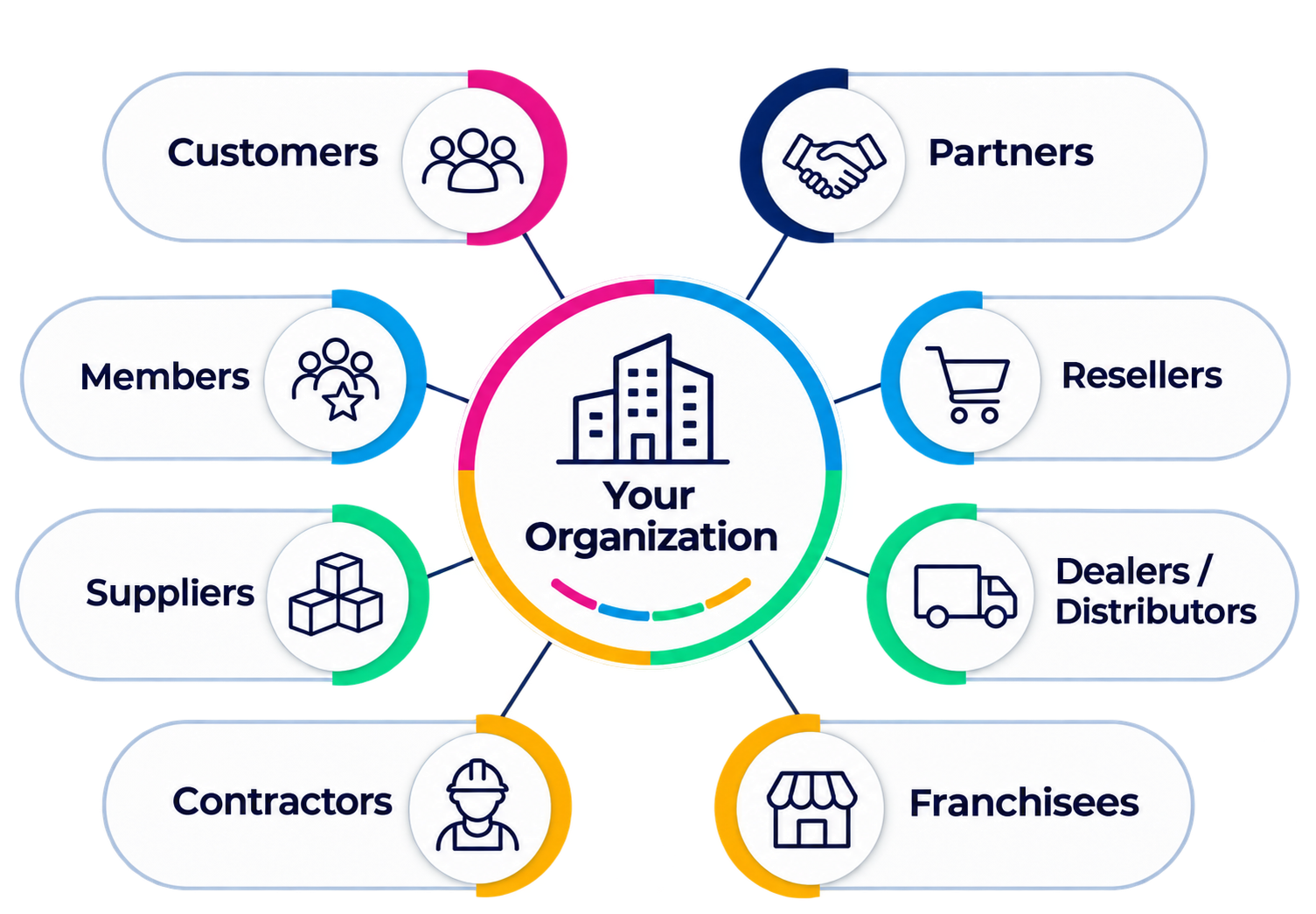
Extended enterprise training is the process of delivering learning to audiences outside your organization’s employee base. These audiences might include:
- Customers
- Channel partners
- Resellers
- Dealers and distributors
- Franchisees
- Contractors
- Suppliers
- Association members
- External sales or service networks
The goal is simple: give external stakeholders the knowledge, resources, and confidence they need to work successfully with your products, services, systems, standards, or brand. That can include product onboarding, certification, compliance training, sales enablement, brand training, customer education, service training, operational training, or partner enablement.
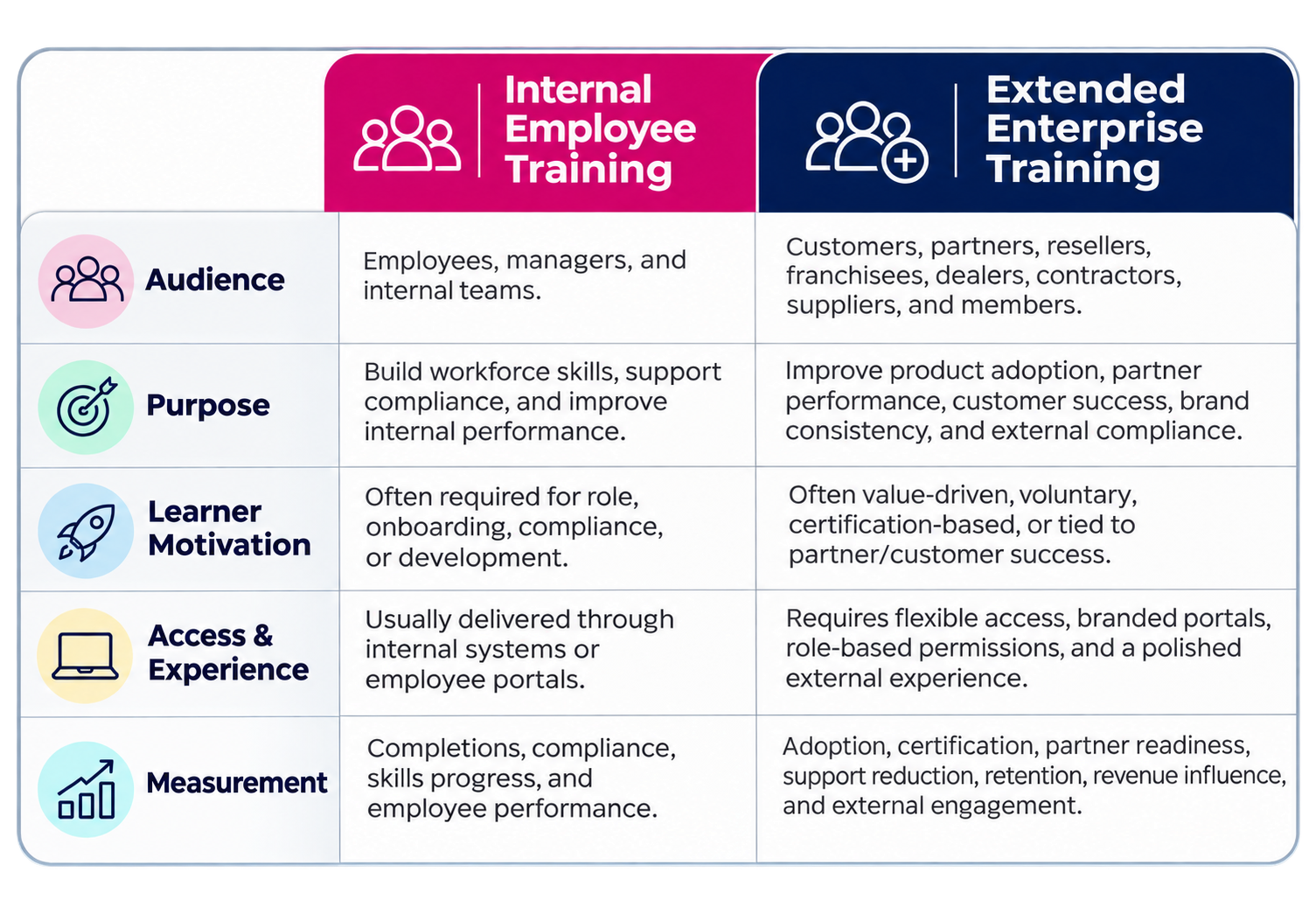
Extended enterprise training is different from employee training because the learner relationship is different. Employees usually have a direct obligation to complete training, while external learners often do not. They need training that is useful, easy to access, relevant to their role, and clearly worth their time.
A customer may need quick onboarding tutorials. A reseller may need product positioning and sales training. A franchisee may need operating standards and compliance certification. A distributor may need product update training across multiple regions. The same learning system may need to support all of them without creating confusion, duplicated administration, or fragmented reporting.
Why is Extended Enterprise Training Growing?
Extended enterprise training is growing because organizations increasingly depend on external audiences to deliver business outcomes.
In many industries, the customer experience does not end with the sale. Partners, resellers, franchisees, dealers, support teams, contractors, and customers all influence whether products are adopted successfully, whether standards are followed, and whether the brand is represented consistently.
ExpertusONE research found that 36% of training professionals now manage partner training, showing that external learning is becoming a larger part of the learning function’s remit. There are several reasons for this growth.
External Audiences Have a Bigger Impact on Revenue
Many organizations sell through partners, resellers, dealers, distributors, or franchise networks. These external audiences need to understand the product, the brand, the market, and the customer.
If they are poorly trained, revenue suffers. If they are well trained, they can explain products more clearly, handle objections more effectively, and create more consistent customer experiences.
Brandon Hall Group has emphasized that organizations need to provide high-quality learning not only to employees, but also to customers, resellers, and other external groups that can affect market performance.
Customers Expect Better Support and Faster Answers
Customers do not think in terms of “extended enterprise learning.” They simply want useful information, available when they need it.
PwC research found that nearly 80% of American consumers point to speed, convenience, knowledgeable help, and friendly service as the most important elements of a positive customer experience.
That matters for customer training. A training experience that is slow, hard to navigate, or too generic does not feel like support. It feels like friction.
Customer education can reduce that friction by giving users clear onboarding, practical product guidance, troubleshooting resources, and role-specific learning paths.
Training Needs Are Becoming More Complex
External learners are rarely one uniform group.
A global organization may need to train partners in different countries, franchisees in different regions, customers with different product configurations, and contractors with different compliance obligations.
That creates complexity around:
- Language and localization
- Branding
- Access permissions
- Certification requirements
- Reporting
- eCommerce
- Data visibility
- Mobile access
- Regional or business-unit differences
A one-size-fits-all training model cannot support that complexity well.
Organizations Are Consolidating Learning Systems
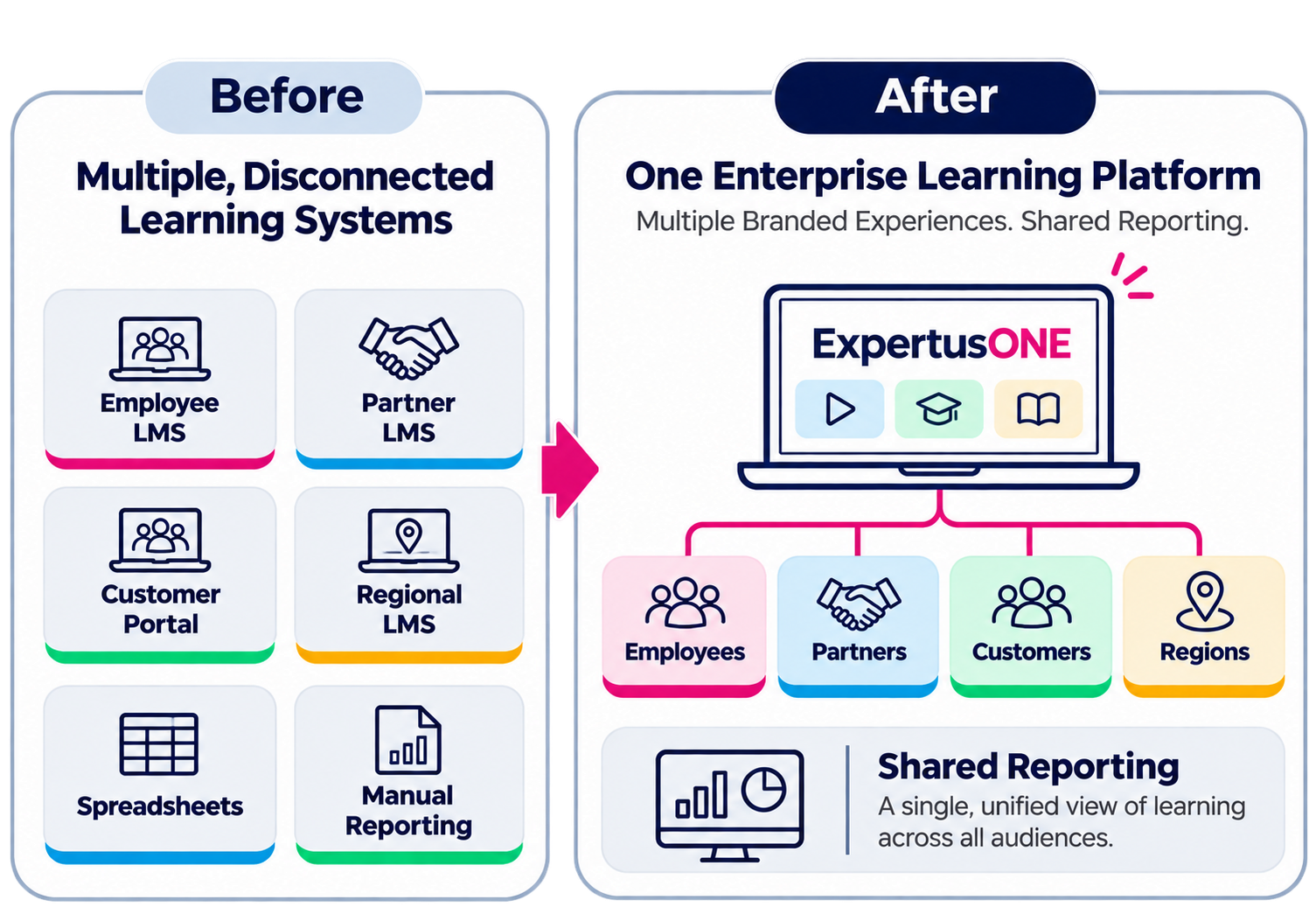
Many enterprises still manage separate learning systems for employees, partners, customers, regions, or business units. This may solve short-term problems, but it often creates long-term friction.
Multiple LMS platforms can increase licensing costs, duplicate administrative work, fragment reporting, and create more integration or security risk. Many enterprises still manage separate systems for employees, partners, business units, or geographies, creating challenges around cost, administration, reporting, and security.
This is one reason extended enterprise training is becoming part of broader learning technology modernization. Organizations want one learning environment that can serve multiple audiences while still giving each audience a relevant experience.
Common Extended Enterprise Training Audiences
Extended enterprise training can support many external audiences. The most common include customers, partners, franchisees, dealers, distributors, contractors, and members.
Customer Training
Customer training helps customers understand, adopt, and get more value from a product or service.
This might include onboarding, product tutorials, implementation guidance, certification, release updates, self-service support, or advanced user education.
Good customer training can improve adoption, reduce support tickets, strengthen retention, and help customers see more value from their investment.
Partner and Channel Training
Partner training supports resellers, referral partners, consultants, agents, and channel sales teams.
These audiences need to understand what they are selling, who it is for, how to position it, and how to represent the brand accurately.
Partner training often includes product education, sales enablement, competitive positioning, certification, compliance, messaging, and deal-support resources.
Franchise and Dealer Training
Franchise and dealer networks need consistency.
A franchisee may need training on brand standards, customer service, operational procedures, compliance, product updates, and local market requirements. A dealer may need product specifications, sales processes, service procedures, and warranty guidance.
The goal is to give every location or dealer a consistent foundation while still allowing for regional or role-based differences.
Distributor and Reseller Training
Distributors and resellers often operate at a distance from the parent organization. Training helps close that gap.
They may need product knowledge, pricing guidance, market positioning, compliance information, and updates on new products or campaigns. They also need easy access, because they may not work inside the organization’s everyday systems.
Contractor, Supplier, and External Workforce Training
Some organizations rely on contractors, suppliers, contingent workers, or external service providers to deliver work on their behalf.
These learners may need compliance training, safety training, process training, systems training, or certification before they can perform specific tasks. In regulated or operationally complex industries, this can be essential for reducing risk.
Member and Ecosystem Training
Associations, professional bodies, nonprofits, and membership organizations may use extended enterprise training to educate members, volunteers, chapters, or broader communities.
This training may focus on certification, continuing education, advocacy, standards, professional development, or community enablement.
Benefits of Extended Enterprise Training
Extended enterprise training helps organizations scale knowledge beyond their internal workforce. Done well, it can support measurable business outcomes across revenue, customer experience, compliance, brand consistency, and operational efficiency.
1. Stronger Product Knowledge and Adoption
External learners need to understand what your product or service does, how to use it, and how it solves real problems.
Customer training helps users get value faster. Partner training helps sellers communicate value more clearly. Dealer and distributor training helps external teams stay aligned with product updates and positioning.
This can be especially important for complex products, technical services, regulated offerings, or products that require behavior change after purchase.
2. Better Customer and Partner Relationships
Training is a way to continue the relationship after the sale.
When customers and partners have access to helpful learning, they are less dependent on one-off support interactions. They can answer common questions, build confidence, and solve problems faster.
That creates a better experience. It also shows external audiences that the organization is invested in their success, not just in the transaction.
3. More Consistent Brand and Operational Standards
External audiences often represent your brand in the market.
A franchisee, reseller, dealer, distributor, or implementation partner may be the person a customer interacts with most. If these audiences use different messaging, follow different standards, or explain products inconsistently, the customer experience becomes uneven.
Extended enterprise training helps create a shared foundation. It gives external audiences the same core information while allowing the experience to be tailored by role, location, product line, or region.
4. Improved Compliance and Certification Visibility
For many organizations, external training is not only about enablement. It is also about risk.
Franchisees, contractors, suppliers, service partners, and dealers may need to complete specific training before they can represent the brand, sell a product, operate equipment, handle customer data, or follow regulated processes.
An extended enterprise LMS can make this easier to manage by centralizing training, certification, completion data, renewal requirements, and reporting.
5. Revenue Growth and Reduced Support Burden
Extended enterprise learning can influence both top-line growth and operational efficiency.
A study commissioned by Intellum found that formalized extended enterprise and customer education programs were associated with a 38.3% increase in product adoption, a 26.2% improvement in customer satisfaction, a 35% increase in average lifetime value per trainee, a 7.6% increase in revenue for products targeted by training, and a 15.5% decrease in customer support costs.
The reason is straightforward. Better-trained customers adopt products more successfully. Better-trained partners sell and support more effectively. Better-trained external networks require less repeated support and create fewer avoidable errors.
Common Extended Enterprise Training Challenges
Extended enterprise training can deliver significant value, but it is also more complex than internal training.
External Learners Are Not Captive Audiences
Employees usually complete training because it is part of their role. External learners may not have the same obligation.
That means the learning experience has to earn attention. It needs to be useful, accessible, relevant, and easy to complete.
Long, generic courses rarely work well for customers, partners, or external networks. These audiences usually need focused training that helps them solve a problem or perform a task.
Different Audiences Need Different Experiences
A customer, partner, contractor, and franchisee may all need information about the same product, but not in the same way.
Each audience may need different:
- Content
- Branding
- Learning paths
- Permissions
- Certifications
- Languages
- Reporting views
- Support resources
If the learning platform cannot manage these differences, administrators often compensate manually. That increases workload and makes the program harder to scale.
Reporting Can Become Fragmented
Extended enterprise training is most valuable when organizations can see what is happening.
They need to know who has completed training, which partners are certified, where customers are getting stuck, which regions are engaged, and whether training is influencing business outcomes.
When data is split across multiple systems, it becomes harder to understand impact.
Access and User Experience Matter More
External learners may not tolerate a clunky experience.
They may be customers with limited time, partners working in the field, franchisees managing daily operations, or contractors who need to complete training before starting work.
Training should be easy to find, easy to launch, and available on the devices learners actually use.
Administration Can Become Difficult at Scale
As external training grows, administration can quickly become complicated.
Teams may need to manage multiple portals, audience rules, content versions, certification requirements, regional needs, and reporting structures.
Without the right platform, extended enterprise training can become a patchwork of manual processes.
What to Look for in an Extended Enterprise LMS?
An extended enterprise LMS should do more than host courses. It should help organizations manage multiple audiences, deliver tailored experiences, control access, and measure impact.
The most important capabilities include:
Multi-Audience Support
The platform should support different learner groups from one system.
That might include employees, customers, partners, franchisees, contractors, dealers, distributors, and members. Each audience should be able to access the right content, branding, permissions, and learning paths without requiring a separate LMS.
Branded Learning Portals
External training should feel like part of the brand experience.
A customer portal, partner academy, franchise training hub, or dealer certification center should feel polished, credible, and relevant to the audience. Branded portals help create that continuity.
Role-Based Access and Permissions
External learners should only see the content, data, and tools that are relevant to them.
Role-based access helps organizations manage different audiences securely and efficiently. It also reduces confusion for learners.
eCommerce and Paid Training Support
Some organizations sell training, certification, memberships, or continuing education.
An extended enterprise LMS should support eCommerce where needed, including course payments, certification purchases, refunds, tax handling, multiple payment types, or regional pricing models.
Mobile and Offline Learning
Many external learners are not sitting at a desk.
Field teams, contractors, franchise operators, service partners, and sales teams may need mobile access. Offline learning can also be valuable when learners are travelling, working in the field, or operating in low-connectivity environments.
Localization and Globalization
Global training programs need to support different languages, regions, currencies, cultural expectations, and compliance needs.
Localization is especially important for multinational partner networks, dealer networks, franchise systems, and customer communities.
Reporting and Analytics
Extended enterprise learning should be measurable.
Organizations need visibility into registrations, completions, engagement, assessment results, certification status, audience performance, and business impact.
Reporting should help teams answer practical questions, such as:
- Which customers completed onboarding?
- Which partners are certified?
- Which regions have low engagement?
- Which courses are reducing support demand?
- Which audiences need additional resources?
Integrations
Extended enterprise training often connects with other systems.
A partner training program may need CRM integration. A customer education program may need product usage or support data. A contractor program may need HR, identity, or compliance system integrations.
The goal is not to connect every tool for the sake of it. The goal is to reduce friction and make learning data useful.
Interactive Content and Authoring
External learners need practical, engaging content.
Quizzes, simulations, scenarios, videos, guided practice, and interactive product walkthroughs can help make training more useful. Built-in authoring tools can also help teams update content quickly as products, policies, or processes change.
How to Build an Extended Enterprise Training Strategy?
A strong extended enterprise training strategy starts with the learner, not the content library.
Before building courses, define who the audience is, what they need to do, and what business outcome the training should support.
1. Define Each Audience
Start by identifying the external groups you need to train.
For each group, define:
- Who they are
- What they need to know
- Why the training matters
- How they access training
- What success looks like
- Whether they need certification or compliance tracking
Avoid treating “external learners” as one group. A customer and a reseller may both need product training, but the purpose of that training is different.
2. Map Training to Business Goals
Extended enterprise training should support clear business outcomes.
That might include:
- Faster customer onboarding
- Higher product adoption
- More partner-sourced revenue
- Better franchise compliance
- Fewer support tickets
- Improved certification rates
- More consistent brand representation
- Lower administrative burden
This keeps the strategy focused and helps prove value later.
3. Create Audience-Specific Learning Paths
Once the audience and outcome are clear, design learning paths that match the learner’s role.
A partner learning path might include product positioning, sales certification, objection handling, and renewal training.
A customer learning path might include onboarding, feature walkthroughs, troubleshooting resources, and advanced usage.
A franchisee learning path might include operations, service standards, compliance, and brand training.
4. Make Training Easy to Access
External learners should not have to search through irrelevant content.
Use clear portals, simple navigation, role-based assignments, mobile access, and well-structured content libraries. The easier the experience is, the more likely learners are to engage.
5. Measure Engagement and Outcomes
Track more than completions.
Completion data matters, but extended enterprise training should also be measured by engagement, certification status, learner progress, assessment performance, support trends, customer outcomes, partner performance, and revenue influence where possible.
The right metrics depend on the audience and the business goal.
6. Improve the Program Over Time
External training should evolve.
Products change. Markets change. Partners change. Customer expectations change.
Use learning data, learner feedback, support trends, and stakeholder input to improve content, update learning paths, and remove friction from the experience.
How Does ExpertusONE Support Extended Enterprise Training?
ExpertusONE helps enterprise organizations manage complex learning environments across internal and external audiences. For extended enterprise training,
ExpertusONE supports the needs of customers, partners, franchisees, dealers, distributors, contractors, and other external learner groups through a scalable learning platform built for multi-audience delivery.
Organizations can use ExpertusONE to deliver branded learning experiences, manage different learner audiences, support role-based access, provide mobile and offline learning, enable eCommerce, localize training, track progress, and report on learning activity across external networks.
ExpertusONE also supports interactive content creation through Interaction Studio, learning analytics through Insights, and integrations that help connect learning to the systems organizations already use.
For enterprise teams, the value is not just course delivery. It is the ability to scale external training without creating separate systems, inconsistent learner experiences, or unnecessary administrative work.
Key Takeaways
Extended enterprise training supports learners outside the employee base.
- Common audiences include customers, partners, franchisees, dealers, contractors, suppliers, and members.
- External training is growing because external audiences influence revenue, adoption, compliance, and customer experience.
- Strong programs tailor training by audience, role, region, and business need.
- An extended enterprise LMS should support multiple audiences, branded portals, permissions, reporting, eCommerce, mobile access, localization, and integrations.
- Success should be measured through engagement, completion, certification, adoption, support reduction, revenue influence, and operational consistency.
ExpertusONE helps enterprises scale external training from one platform while supporting distinct learner experiences.
FAQs
Employee training is designed for internal workers. Extended enterprise training is designed for external audiences who may not use the same systems, share the same obligations, or need the same content. It usually requires more audience segmentation, branding, access control, localization, and flexibility.
Success can be measured through course completions, learner engagement, certification rates, assessment results, customer onboarding progress, partner performance, support ticket reduction, product adoption, compliance status, and revenue influence.
Extended enterprise training helps organizations deliver learning to people outside their internal workforce, including customers, partners, resellers, franchisees, dealers, contractors, suppliers, and members.
For enterprise organizations, this is no longer a secondary training need. External audiences influence revenue, customer experience, compliance, product adoption, brand consistency, and support demand. When they are trained well, they can sell more effectively, use products more successfully, represent the brand more consistently, and follow the right operational standards.
This guide explains what extended enterprise training is, why it is growing, which audiences it supports, what benefits it can deliver, and what to look for in an extended enterprise LMS.
Key Terms:
- Extended Enterprise Training
- Extended Enterprise LMS
- Customer Training
- Partner Training
- Channel Training
- External Learner Training
- Franchise Training
- Dealer Training
- Customer Education
- Learning Analytics
What is Extended Enterprise Training?
Extended enterprise training is the process of delivering learning to audiences outside your organization’s employee base. These audiences might include:
- Customers
- Channel partners
- Resellers
- Dealers and distributors
- Franchisees
- Contractors
- Suppliers
- Association members
- External sales or service networks
The goal is simple: give external stakeholders the knowledge, resources, and confidence they need to work successfully with your products, services, systems, standards, or brand. That can include product onboarding, certification, compliance training, sales enablement, brand training, customer education, service training, operational training, or partner enablement.
Extended enterprise training is different from employee training because the learner relationship is different. Employees usually have a direct obligation to complete training, while external learners often do not. They need training that is useful, easy to access, relevant to their role, and clearly worth their time.
A customer may need quick onboarding tutorials. A reseller may need product positioning and sales training. A franchisee may need operating standards and compliance certification. A distributor may need product update training across multiple regions. The same learning system may need to support all of them without creating confusion, duplicated administration, or fragmented reporting.
Why is Extended Enterprise Training Growing?
Extended enterprise training is growing because organizations increasingly depend on external audiences to deliver business outcomes.
In many industries, the customer experience does not end with the sale. Partners, resellers, franchisees, dealers, support teams, contractors, and customers all influence whether products are adopted successfully, whether standards are followed, and whether the brand is represented consistently.
ExpertusONE research found that 36% of training professionals now manage partner training, showing that external learning is becoming a larger part of the learning function’s remit. There are several reasons for this growth.
External Audiences Have a Bigger Impact on Revenue
Many organizations sell through partners, resellers, dealers, distributors, or franchise networks. These external audiences need to understand the product, the brand, the market, and the customer.
If they are poorly trained, revenue suffers. If they are well trained, they can explain products more clearly, handle objections more effectively, and create more consistent customer experiences.
Brandon Hall Group has emphasized that organizations need to provide high-quality learning not only to employees, but also to customers, resellers, and other external groups that can affect market performance.
Customers Expect Better Support and Faster Answers
Customers do not think in terms of “extended enterprise learning.” They simply want useful information, available when they need it.
PwC research found that nearly 80% of American consumers point to speed, convenience, knowledgeable help, and friendly service as the most important elements of a positive customer experience.
That matters for customer training. A training experience that is slow, hard to navigate, or too generic does not feel like support. It feels like friction.
Customer education can reduce that friction by giving users clear onboarding, practical product guidance, troubleshooting resources, and role-specific learning paths.
Training Needs Are Becoming More Complex
External learners are rarely one uniform group.
A global organization may need to train partners in different countries, franchisees in different regions, customers with different product configurations, and contractors with different compliance obligations.
That creates complexity around:
- Language and localization
- Branding
- Access permissions
- Certification requirements
- Reporting
- eCommerce
- Data visibility
- Mobile access
- Regional or business-unit differences
A one-size-fits-all training model cannot support that complexity well.
Organizations Are Consolidating Learning Systems
Many enterprises still manage separate learning systems for employees, partners, customers, regions, or business units. This may solve short-term problems, but it often creates long-term friction.
Multiple LMS platforms can increase licensing costs, duplicate administrative work, fragment reporting, and create more integration or security risk. Many enterprises still manage separate systems for employees, partners, business units, or geographies, creating challenges around cost, administration, reporting, and security.
This is one reason extended enterprise training is becoming part of broader learning technology modernization. Organizations want one learning environment that can serve multiple audiences while still giving each audience a relevant experience.
Common Extended Enterprise Training Audiences
Extended enterprise training can support many external audiences. The most common include customers, partners, franchisees, dealers, distributors, contractors, and members.
Customer Training
Customer training helps customers understand, adopt, and get more value from a product or service.
This might include onboarding, product tutorials, implementation guidance, certification, release updates, self-service support, or advanced user education.
Good customer training can improve adoption, reduce support tickets, strengthen retention, and help customers see more value from their investment.
Partner and Channel Training
Partner training supports resellers, referral partners, consultants, agents, and channel sales teams.
These audiences need to understand what they are selling, who it is for, how to position it, and how to represent the brand accurately.
Partner training often includes product education, sales enablement, competitive positioning, certification, compliance, messaging, and deal-support resources.
Franchise and Dealer Training
Franchise and dealer networks need consistency.
A franchisee may need training on brand standards, customer service, operational procedures, compliance, product updates, and local market requirements. A dealer may need product specifications, sales processes, service procedures, and warranty guidance.
The goal is to give every location or dealer a consistent foundation while still allowing for regional or role-based differences.
Distributor and Reseller Training
Distributors and resellers often operate at a distance from the parent organization. Training helps close that gap.
They may need product knowledge, pricing guidance, market positioning, compliance information, and updates on new products or campaigns. They also need easy access, because they may not work inside the organization’s everyday systems.
Contractor, Supplier, and External Workforce Training
Some organizations rely on contractors, suppliers, contingent workers, or external service providers to deliver work on their behalf.
These learners may need compliance training, safety training, process training, systems training, or certification before they can perform specific tasks. In regulated or operationally complex industries, this can be essential for reducing risk.
Member and Ecosystem Training
Associations, professional bodies, nonprofits, and membership organizations may use extended enterprise training to educate members, volunteers, chapters, or broader communities.
This training may focus on certification, continuing education, advocacy, standards, professional development, or community enablement.
Benefits of Extended Enterprise Training
Extended enterprise training helps organizations scale knowledge beyond their internal workforce. Done well, it can support measurable business outcomes across revenue, customer experience, compliance, brand consistency, and operational efficiency.
1. Stronger Product Knowledge and Adoption
External learners need to understand what your product or service does, how to use it, and how it solves real problems.
Customer training helps users get value faster. Partner training helps sellers communicate value more clearly. Dealer and distributor training helps external teams stay aligned with product updates and positioning.
This can be especially important for complex products, technical services, regulated offerings, or products that require behavior change after purchase.
2. Better Customer and Partner Relationships
Training is a way to continue the relationship after the sale.
When customers and partners have access to helpful learning, they are less dependent on one-off support interactions. They can answer common questions, build confidence, and solve problems faster.
That creates a better experience. It also shows external audiences that the organization is invested in their success, not just in the transaction.
3. More Consistent Brand and Operational Standards
External audiences often represent your brand in the market.
A franchisee, reseller, dealer, distributor, or implementation partner may be the person a customer interacts with most. If these audiences use different messaging, follow different standards, or explain products inconsistently, the customer experience becomes uneven.
Extended enterprise training helps create a shared foundation. It gives external audiences the same core information while allowing the experience to be tailored by role, location, product line, or region.
4. Improved Compliance and Certification Visibility
For many organizations, external training is not only about enablement. It is also about risk.
Franchisees, contractors, suppliers, service partners, and dealers may need to complete specific training before they can represent the brand, sell a product, operate equipment, handle customer data, or follow regulated processes.
An extended enterprise LMS can make this easier to manage by centralizing training, certification, completion data, renewal requirements, and reporting.
5. Revenue Growth and Reduced Support Burden
Extended enterprise learning can influence both top-line growth and operational efficiency.
A study commissioned by Intellum found that formalized extended enterprise and customer education programs were associated with a 38.3% increase in product adoption, a 26.2% improvement in customer satisfaction, a 35% increase in average lifetime value per trainee, a 7.6% increase in revenue for products targeted by training, and a 15.5% decrease in customer support costs.
The reason is straightforward. Better-trained customers adopt products more successfully. Better-trained partners sell and support more effectively. Better-trained external networks require less repeated support and create fewer avoidable errors.
Common Extended Enterprise Training Challenges
Extended enterprise training can deliver significant value, but it is also more complex than internal training.
External Learners Are Not Captive Audiences
Employees usually complete training because it is part of their role. External learners may not have the same obligation.
That means the learning experience has to earn attention. It needs to be useful, accessible, relevant, and easy to complete.
Long, generic courses rarely work well for customers, partners, or external networks. These audiences usually need focused training that helps them solve a problem or perform a task.
Different Audiences Need Different Experiences
A customer, partner, contractor, and franchisee may all need information about the same product, but not in the same way.
Each audience may need different:
- Content
- Branding
- Learning paths
- Permissions
- Certifications
- Languages
- Reporting views
- Support resources
If the learning platform cannot manage these differences, administrators often compensate manually. That increases workload and makes the program harder to scale.
Reporting Can Become Fragmented
Extended enterprise training is most valuable when organizations can see what is happening.
They need to know who has completed training, which partners are certified, where customers are getting stuck, which regions are engaged, and whether training is influencing business outcomes.
When data is split across multiple systems, it becomes harder to understand impact.
Access and User Experience Matter More
External learners may not tolerate a clunky experience.
They may be customers with limited time, partners working in the field, franchisees managing daily operations, or contractors who need to complete training before starting work.
Training should be easy to find, easy to launch, and available on the devices learners actually use.
Administration Can Become Difficult at Scale
As external training grows, administration can quickly become complicated.
Teams may need to manage multiple portals, audience rules, content versions, certification requirements, regional needs, and reporting structures.
Without the right platform, extended enterprise training can become a patchwork of manual processes.
What to Look for in an Extended Enterprise LMS?
An extended enterprise LMS should do more than host courses. It should help organizations manage multiple audiences, deliver tailored experiences, control access, and measure impact.
The most important capabilities include:
Multi-Audience Support
The platform should support different learner groups from one system.
That might include employees, customers, partners, franchisees, contractors, dealers, distributors, and members. Each audience should be able to access the right content, branding, permissions, and learning paths without requiring a separate LMS.
Branded Learning Portals
External training should feel like part of the brand experience.
A customer portal, partner academy, franchise training hub, or dealer certification center should feel polished, credible, and relevant to the audience. Branded portals help create that continuity.
Role-Based Access and Permissions
External learners should only see the content, data, and tools that are relevant to them.
Role-based access helps organizations manage different audiences securely and efficiently. It also reduces confusion for learners.
eCommerce and Paid Training Support
Some organizations sell training, certification, memberships, or continuing education.
An extended enterprise LMS should support eCommerce where needed, including course payments, certification purchases, refunds, tax handling, multiple payment types, or regional pricing models.
Mobile and Offline Learning
Many external learners are not sitting at a desk.
Field teams, contractors, franchise operators, service partners, and sales teams may need mobile access. Offline learning can also be valuable when learners are travelling, working in the field, or operating in low-connectivity environments.
Localization and Globalization
Global training programs need to support different languages, regions, currencies, cultural expectations, and compliance needs.
Localization is especially important for multinational partner networks, dealer networks, franchise systems, and customer communities.
Reporting and Analytics
Extended enterprise learning should be measurable.
Organizations need visibility into registrations, completions, engagement, assessment results, certification status, audience performance, and business impact.
Reporting should help teams answer practical questions, such as:
- Which customers completed onboarding?
- Which partners are certified?
- Which regions have low engagement?
- Which courses are reducing support demand?
- Which audiences need additional resources?
Integrations
Extended enterprise training often connects with other systems.
A partner training program may need CRM integration. A customer education program may need product usage or support data. A contractor program may need HR, identity, or compliance system integrations.
The goal is not to connect every tool for the sake of it. The goal is to reduce friction and make learning data useful.
Interactive Content and Authoring
External learners need practical, engaging content.
Quizzes, simulations, scenarios, videos, guided practice, and interactive product walkthroughs can help make training more useful. Built-in authoring tools can also help teams update content quickly as products, policies, or processes change.
How to Build an Extended Enterprise Training Strategy?
A strong extended enterprise training strategy starts with the learner, not the content library.
Before building courses, define who the audience is, what they need to do, and what business outcome the training should support.
1. Define Each Audience
Start by identifying the external groups you need to train.
For each group, define:
- Who they are
- What they need to know
- Why the training matters
- How they access training
- What success looks like
- Whether they need certification or compliance tracking
Avoid treating “external learners” as one group. A customer and a reseller may both need product training, but the purpose of that training is different.
2. Map Training to Business Goals
Extended enterprise training should support clear business outcomes.
That might include:
- Faster customer onboarding
- Higher product adoption
- More partner-sourced revenue
- Better franchise compliance
- Fewer support tickets
- Improved certification rates
- More consistent brand representation
- Lower administrative burden
This keeps the strategy focused and helps prove value later.
3. Create Audience-Specific Learning Paths
Once the audience and outcome are clear, design learning paths that match the learner’s role.
A partner learning path might include product positioning, sales certification, objection handling, and renewal training.
A customer learning path might include onboarding, feature walkthroughs, troubleshooting resources, and advanced usage.
A franchisee learning path might include operations, service standards, compliance, and brand training.
4. Make Training Easy to Access
External learners should not have to search through irrelevant content.
Use clear portals, simple navigation, role-based assignments, mobile access, and well-structured content libraries. The easier the experience is, the more likely learners are to engage.
5. Measure Engagement and Outcomes
Track more than completions.
Completion data matters, but extended enterprise training should also be measured by engagement, certification status, learner progress, assessment performance, support trends, customer outcomes, partner performance, and revenue influence where possible.
The right metrics depend on the audience and the business goal.
6. Improve the Program Over Time
External training should evolve.
Products change. Markets change. Partners change. Customer expectations change.
Use learning data, learner feedback, support trends, and stakeholder input to improve content, update learning paths, and remove friction from the experience.
How Does ExpertusONE Support Extended Enterprise Training?
ExpertusONE helps enterprise organizations manage complex learning environments across internal and external audiences. For extended enterprise training,
ExpertusONE supports the needs of customers, partners, franchisees, dealers, distributors, contractors, and other external learner groups through a scalable learning platform built for multi-audience delivery.
Organizations can use ExpertusONE to deliver branded learning experiences, manage different learner audiences, support role-based access, provide mobile and offline learning, enable eCommerce, localize training, track progress, and report on learning activity across external networks.
ExpertusONE also supports interactive content creation through Interaction Studio, learning analytics through Insights, and integrations that help connect learning to the systems organizations already use.
For enterprise teams, the value is not just course delivery. It is the ability to scale external training without creating separate systems, inconsistent learner experiences, or unnecessary administrative work.
Key Takeaways
Extended enterprise training supports learners outside the employee base.
- Common audiences include customers, partners, franchisees, dealers, contractors, suppliers, and members.
- External training is growing because external audiences influence revenue, adoption, compliance, and customer experience.
- Strong programs tailor training by audience, role, region, and business need.
- An extended enterprise LMS should support multiple audiences, branded portals, permissions, reporting, eCommerce, mobile access, localization, and integrations.
- Success should be measured through engagement, completion, certification, adoption, support reduction, revenue influence, and operational consistency.
ExpertusONE helps enterprises scale external training from one platform while supporting distinct learner experiences.
FAQs
Employee training is designed for internal workers. Extended enterprise training is designed for external audiences who may not use the same systems, share the same obligations, or need the same content. It usually requires more audience segmentation, branding, access control, localization, and flexibility.
Success can be measured through course completions, learner engagement, certification rates, assessment results, customer onboarding progress, partner performance, support ticket reduction, product adoption, compliance status, and revenue influence.


