
BLOG
Training Strategy: A Practical Guide to Effectiveness, ROI, and Scale
 Author: Trestin Miller
BLOG
Training Strategy: A Practical Guide to Effectiveness, ROI, and Scale
Author: Trestin Miller
Table of Contents
Why Does Training Strategy Matter?
What Does Training Effectiveness Look Like?
How to Assess Your Current Training Strategy?
Why Do Training Strategies Underperform?
Improve Training Effectiveness
Measure Training Effectiveness
Scaling Training Across Complex Organizations
Modern Training Strategy in Hybrid Work
A training strategy is only effective if it helps people perform better, supports business goals, and can scale across the realities of a modern organization. Many training programs fall short not because they lack content, but because strategy, delivery, measurement, and learner experience are not working together.
This guide explains how enterprise organizations can assess their current approach, improve training effectiveness, increase ROI, and scale learning in a way that is practical, measurable, and sustainable.
Key Terms:
- Training Strategy
- Training Effectiveness
- Learning and Development Strategy
- Corporate Training
- Employee Training
- Training ROI
- Learning Analytics
- Enterprise Learning Platform
Why Does Training Strategy Matter?
Training Now Carries More Business Weight
Training is no longer judged only by completions, attendance, or catalog size. It affects how quickly people become productive, how consistently teams follow process, how prepared managers are to lead, and how well organizations respond to change. That pressure is increasing as skill requirements keep shifting. The World Economic Forum says employers expect 39% of workers’ core skills to change by 2030, while Deloitte reports that 66% of managers and executives say most recent hires are not fully prepared, and identifies learning and development as the talent process most in need of reinvention because of AI-related disruption in work.
Learning Is Tied More Closely to Retention and Adaptability
Training now sits much closer to engagement and career momentum than many organizations once assumed. LinkedIn’s Workplace Learning Report found that 84% of employees say learning adds purpose to their work and 68% say learning helps them adapt during times of change. Gallup’s global workplace research makes the business impact clearer, reporting that engagement fell to 20% in 2025 and that low engagement cost the world economy an estimated $10 trillion in lost productivity.
Skills Gaps Are No Longer a Side Issue
CIPD research shows that skills shortages have become one of the top organizational development priorities and that addressing skills gaps is a leading priority for L&D practitioners. That matters because it shifts training strategy out of a narrow support role. It becomes part of how organizations protect capability, resilience, and future readiness.
What Does Training Effectiveness Actually Look Like?
Effective Strategy Goes Beyond Course Delivery
Training effectiveness is often defined too narrowly. It is not just about whether a course is well written. It is not just about whether people finished what they were assigned. And it is not just about whether a platform has enough features.
A strong training strategy helps the organization move from learning activity to business value. In practice, that usually means it does five things well:
- Aligns learning to clear business priorities
- Makes training accessible in real working conditions
- Keeps the experience relevant to different learners
- Gives managers and administrators useful visibility
- Scales without creating operational drag
Relevance Matters More Than Volume
Many organizations already have enough content. The larger issue is often that the learning is too broad, too static, or too disconnected from what different audiences actually need. A stronger strategy helps the right people find the right learning at the right time, instead of pushing everyone through the same generic experience.
This is where platform design starts to matter in a practical way. ExpertusONE supports more targeted delivery through personalized learner views, AI-driven recommendations, and audience-based learning experiences, which can reduce manual assignment while keeping training more relevant to the individual.
Accessibility Is Part of Effectiveness
Usability is not a secondary concern. If training is hard to reach, hard to navigate, or hard to complete in the flow of work, the strategy weakens quickly. ExpertusONE supports this with mobile access, centralized content delivery, and learning experiences that fit more naturally into the tools and environments people already use.
How to Assess Your Current Training Strategy?
Start With the Right Questions
A good assessment should tell you more than whether training exists. It should tell you whether your model fits how work happens now.
Start with questions like these:
- Do you have a single, reliable learning environment or too many disconnected systems?
- Can learners access training easily at work, at home, in the field, and on mobile devices?
- Is the experience personalized enough to reflect role, context, and need?
- Can managers and administrators gather useful data without excessive manual work?
- Are credentials, certifications, and training records easy to demonstrate when needed?
These questions are useful because they reveal whether your strategy is built for real usage or still shaped by older assumptions about where people work, how they learn, and what administrators can realistically support.
Look for Friction, Not Just Gaps
When training underperforms, teams often look first at the content. Sometimes that is the right place to look. But just as often, the bigger issue is friction around the content. Learners may be moving across too many systems. Supporting materials may be hard to find. Managers may have limited visibility. Reporting may be too shallow to guide action. Growth may create more manual work than the current model can absorb.
That kind of friction is usually a strategy problem, not just a course problem.
Check Whether the Model Fits Hybrid Work
CIPD’s flexible and hybrid working research found that 91% of organizations offer some form of flexible working arrangement. Employers most often associate hybrid working with stronger attraction and retention, a wider recruitment geography, improved wellbeing, and greater business flexibility, while also reporting challenges around manager effectiveness and organizational connection. Training strategy has to reflect that reality. It needs to be accessible enough for distributed work and structured enough to maintain consistency and visibility.
Why Training Strategies Underperform?
Fragmentation Makes Learning Harder to Use
One of the most common reasons strategies underperform is fragmentation. Learning lives across too many systems. Content is spread across too many formats. Reporting sits in too many places. Learners are expected to navigate all of it while already trying to keep up with real work.
That weakens the learner experience and increases the burden on administrators and managers. It also makes measurement less reliable because the organization loses a clear view of what people are doing, where they are struggling, and which interventions are working.
Generic Learning Weakens Relevance
Another recurring problem is one-size-fits-all delivery. Consistency matters, but too much standardization usually reduces relevance. Employees, managers, customers, partners, and regulated roles rarely need the same learning experience in the same way.
When training feels generic, people are more likely to treat it as something to finish rather than something to use.
Learning Often Stops Too Early
Many training strategies still lose momentum after onboarding or after required learning is complete. That is a poor fit for an environment where roles, products, technologies, and compliance expectations continue to evolve. The World Economic Forum’s findings on ongoing skills disruption make the case for a more continuous model, while McKinsey’s upskilling research shows that workers are interested in building skills but often face barriers of time and money.
How to Improve Training Effectiveness?
Personalize the Experience Without Adding Admin Drag
Personalization is one of the clearest ways to improve training effectiveness because it helps learners focus on what matters instead of sorting through what does not. The goal is not personalization for its own sake. The goal is relevance.
That may include:
- Role-based learning paths
- Personalized course recommendations
- Audience-specific learning experiences
Targeted content for different skill levels
ExpertusONE supports this kind of model through AI-based recommendations and personalized learner experiences, helping training teams keep the experience more targeted without relying on constant manual assignment.
Reduce Context Switching
Training is easier to use when it fits into the tools people already rely on. If learners have to leave their normal environment, search across systems, or piece together content from multiple places, attention drops quickly.
That is why integrations matter. ExpertusONE’s support for integrations with Slack, Salesforce, Microsoft Teams, and more, along with its Digital Content Player, helps reduce switching between tools and makes it easier for learning to sit inside daily workflows.
Make Learning More Interactive and Multimodal
Static delivery still has a place, but it is rarely enough on its own. Many learners retain more when information is presented in multiple ways or when they are asked to participate rather than only consume.
In practice, that can include video, quizzes, surveys, virtual sessions, discussion, scenario-based learning, digital observation, and gamified elements where appropriate. ExpertusONE supports richer experiences through capabilities such as its Digital Content Player, Interaction Studio, Observation Checklist, built-in meetings, and gamification tools.
Build Around Continuous Development
The most effective strategies do not stop at onboarding or annual compliance. They create room for ongoing development, skill growth, and role readiness over time. McKinsey’s research is useful here because it shows that time and cost remain the biggest barriers to upskilling, which helps explain why flexible and employer-supported learning models matter so much. LinkedIn’s report complements that by showing that employees increasingly associate learning with adaptability and purpose.
Give Managers Better Visibility
Managers matter more to training outcomes than many organizations acknowledge. LinkedIn’s report found that only 15% of employees said their manager helped them build a career plan in the previous six months, while Gallup’s data shows a sharp decline in manager engagement and makes clear how important manager capability is to broader organizational performance.
That makes reporting and visibility more important, not less. ExpertusONE supports this through analytics, compliance reporting, digital observation, automated reminders, and Learning Record Store support using xAPI standards. Those capabilities help managers and administrators move faster from activity to actionable insight.
How to Measure Training Effectiveness More Clearly?
Match Metrics to the Goal
Not every program should be measured the same way. A compliance initiative, a leadership program, an onboarding sequence, and a customer education path all exist for different reasons. The right question is not just what can be tracked. It is what would show that this specific effort is working.
Look Beyond Completion Rates
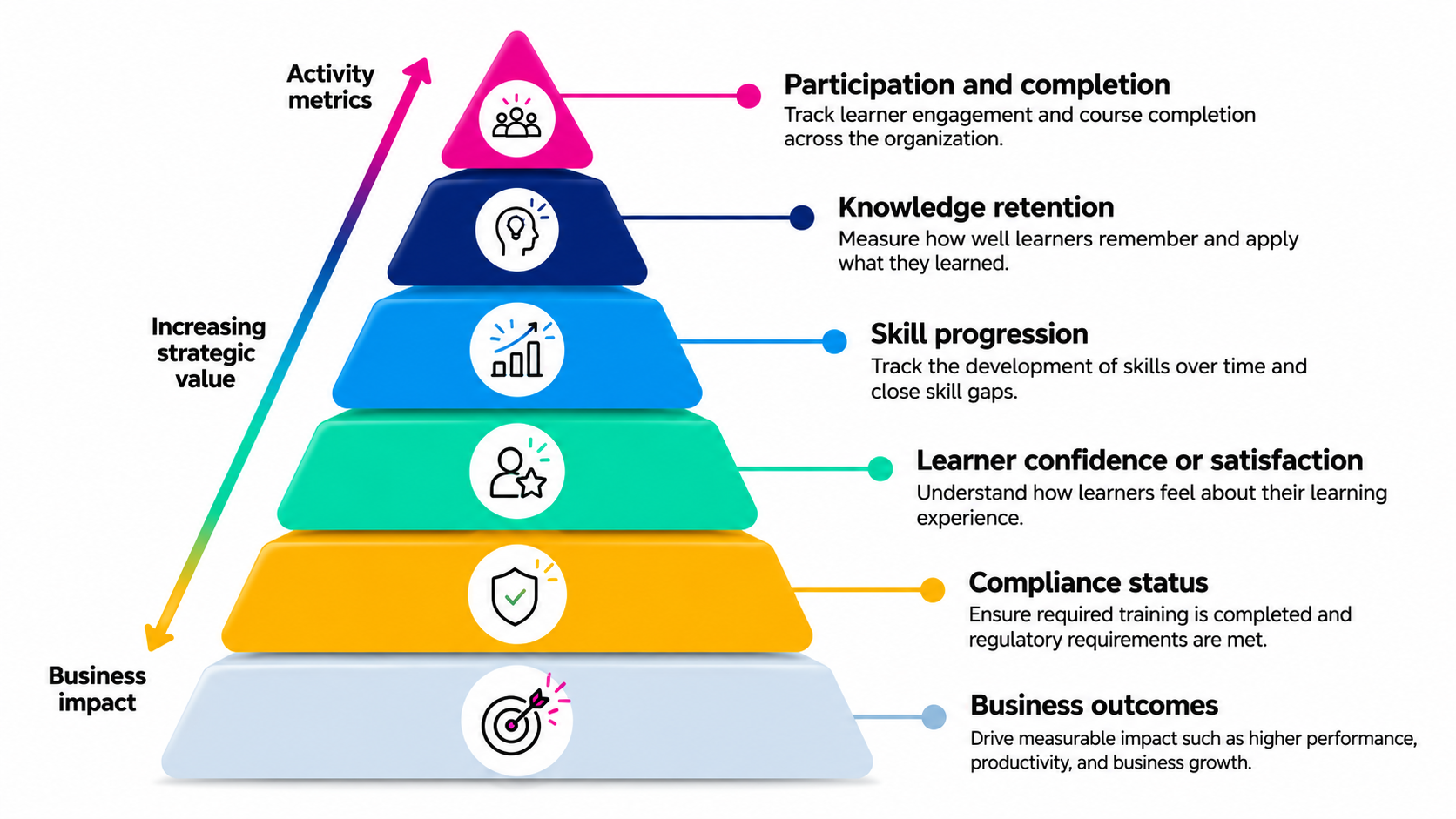
Completion still matters, but it should not be the only lens. A stronger measurement model usually looks across several layers:
- Participation and completion
- Knowledge retention
- Skill progression
- Learner confidence or satisfaction
- Compliance status
- Business outcomes tied to the program goal
LinkedIn’s data supports that broader view, showing that career development leaders most often measure business impact through engagement, retention, promotions, skills development, and internal mobility rather than participation alone.
Use Data to Improve, Not Just Document
Reporting becomes far more valuable when it helps teams decide what to change. Strong measurement should help identify where learners drop off, which content is underperforming, where compliance risk is building, and where managers may need support.
ExpertusONE’s reporting, insights, credential visibility, and centralized learner data can support that kind of visibility across multiple audiences, making it easier to move from documentation to improvement.
Maximizing Training ROI
Think Beyond Software ROI
Training ROI is often framed as a software question, but it starts with strategy. A platform cannot create return on its own if the experience is too fragmented, too generic, or too difficult to manage.
A stronger approach connects ROI to outcomes leaders already care about, such as time to productivity, consistency, compliance readiness, customer outcomes, retention, and the ability to scale without adding more administrative overhead.
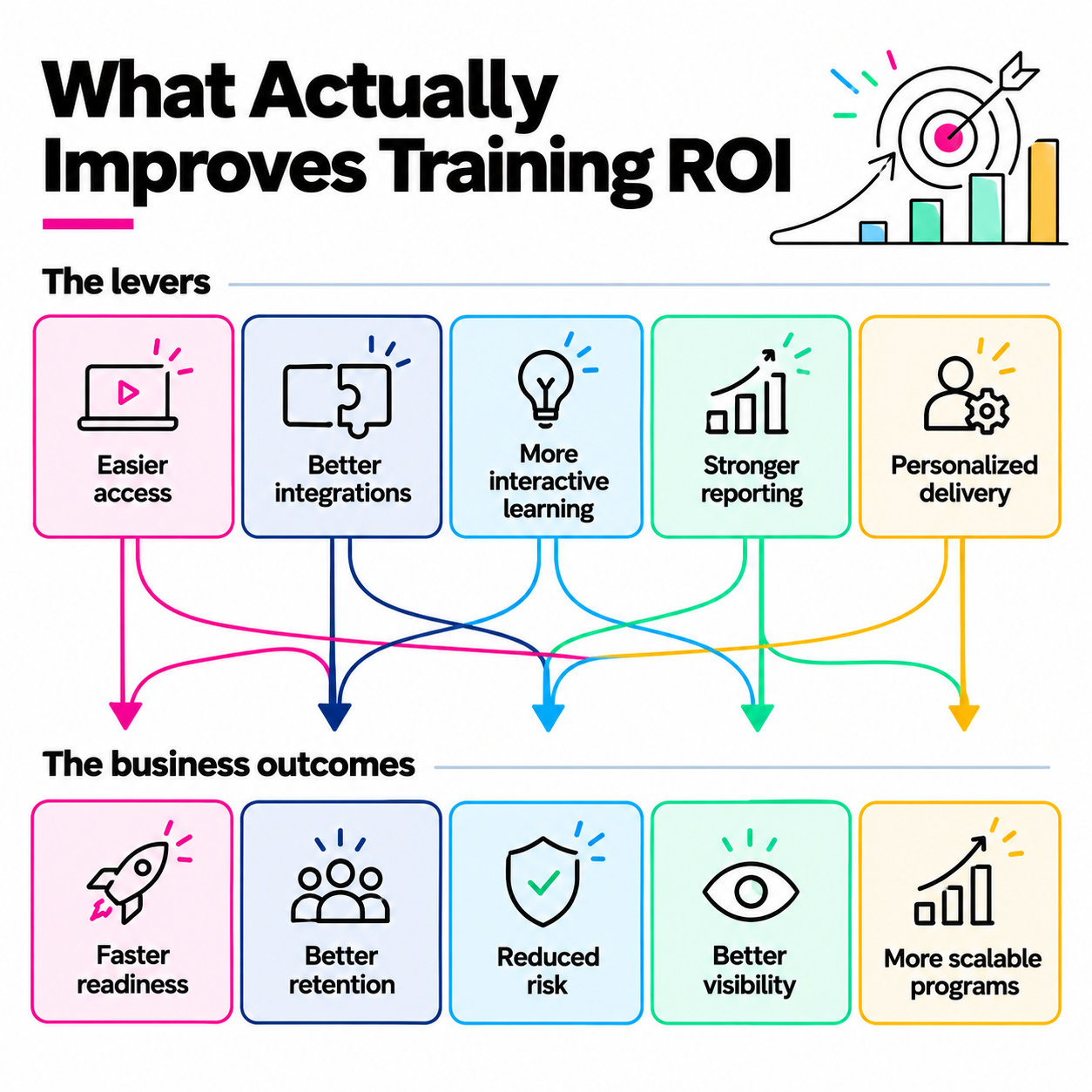
Focus on a Few Practical Levers
Some of the clearest ways to improve return are straightforward:
- Make learning easier to access
- Reduce confusion through better integrations
- Improve retention with more interactive experiences
- Use reporting to spot risk and prioritize action
Personalize delivery across different audiences
This broader view of ROI aligns with LinkedIn’s guidance that learning leaders increasingly need to show whether an initiative helps the organization make money, save money, or mitigate risk.
Use Functionality That Supports Scale
For organizations that need multi-audience delivery, mobile access, stronger reporting, personalized recommendations, and integrated workflows in one environment, the value is not just feature depth. It is the ability to improve learning outcomes without multiplying fragmentation.
Scaling Training Across Complex Organizations
Scale Changes the Problem
A strategy may work reasonably well in one team or one business unit and begin to strain once it expands. Growth, acquisitions, new products, added compliance requirements, and more external audiences all increase complexity quickly.
At that point, the weak spots become more visible. Manual assignment no longer keeps up. Reporting becomes too thin. Generic pathways feel less useful. Administrative effort rises faster than program value.
Support Multiple Audiences Without Losing Control
Scaling often means supporting more than employees. Customers, partners, distributors, and other external audiences may all need different access rules, different pathways, and different measures of success.
ExpertusONE is built to support multiple audiences and use cases in one environment rather than forcing organizations to manage each group in a separate learning stack. That matters for relevance, governance, and reporting alike.
Keep Compliance and Credentialing Visible
Scale also increases the importance of compliance visibility and portable credentials. In many roles, it is not enough for training records to exist in a system. They need to be visible when needed, easy to verify, and tied to real operational requirements.
ExpertusONE supports this through compliance tracking, automated reminders, digital credential visibility, and portable proof of completion that can travel with the learner rather than staying buried in the back-end process.
Modern Training Strategy in Hybrid Work
Training Must Stay Consistent Across Distributed Teams
Hybrid work did not just change where people work. It changed what training needs to support. Learning now has to work across different locations, schedules, and working patterns while still feeling consistent and easy to access.
That has direct implications for training strategy. It needs to give learners flexibility without losing structure. People should be able to access training wherever they work, while managers and administrators still have clear visibility into progress, participation, and readiness.
Learning Has to Travel With the Learner
This is where mobile access, on-demand content, and portable credentialing matter more than they once did. Training now needs to work across office, home, field, and mobile settings without losing continuity.
ExpertusONE supports that need through mobile learning access, centralized content delivery, and digital credential visibility, which helps keep learning usable even when work happens across multiple environments.
Turning Strategy Into Execution
Start With Business Outcomes
A training strategy only becomes useful when it can be put into operation. That starts with clarity on what the organization is actually trying to improve. The goal might be faster onboarding, better compliance readiness, stronger manager capability, improved customer consistency, or something more specific to the business.
When the outcome is clear, decisions about audience design, delivery, reporting, and governance get much easier.
Build the Operating Model, Not Just the Course Catalog
Execution depends on more than content. It depends on audience structures, data, configuration, integrations, business processes, and the people responsible for running the system well.
A practical rollout often follows a sequence like this:
- Define the business outcome
- Identify the audiences involved
- Design the learning experience around their needs
- Configure data, governance, and reporting
- Align integrations and business processes
Launch, measure, and refine
The broader point is that implementation should be treated as an operational process, not just a technical setup. Strong execution usually requires thoughtful configuration, clear ownership, solid data foundations, integrated workflows, and proper administrator support so the strategy can work in practice, not just in theory.
Plan for Long-Term Use, Not Just Launch
Implementation should make the strategy more durable, not just more immediate. If reporting is poorly structured, if ownership is unclear, or if learners have to work around the system rather than through it, the strategy will weaken over time.
That is why the operating model matters so much. A good strategy is not just launched. It is built to keep improving.
Key Takeaways
- Training is most effective when learning is relevant, accessible, and clearly connected to business goals and day-to-day performance.
Strong training strategies usually combine flexible access, personalization, better reporting, and ongoing development rather than one-time course delivery.
Hybrid and distributed teams need training experiences that create consistency, visibility, and connection across office, home, field, and mobile environments.
A modern learning platform should support more than course delivery. It should improve access, streamline administration, reduce fragmentation, and give managers better visibility into progress.
The most important strategy enablers often include personalization, integrations, multimodal learning, mobile access, compliance visibility, credential portability, and scalable reporting.
- Success should be measured through more than completions, including learner engagement, skill progression, compliance readiness, accessibility, and business outcomes tied to the purpose of the program.
FAQs
A training strategy is the plan and operating model an organization uses to build knowledge, skills, and readiness in support of business goals. It includes audiences, delivery methods, systems, measurement, governance, and how learning is improved over time.
A stronger approach goes beyond completions. It looks at accessibility, relevance, skill progression, compliance visibility, learner confidence, and business outcomes tied to the purpose of the program. LinkedIn’s data shows that many career development leaders already use engagement, retention, promotions, new skills development, and internal mobility to understand impact.
The most common issues are fragmented systems, poor accessibility, generic learning experiences, weak reporting, one-time training models, and strategies that become harder to manage as the organization grows.
A training strategy is only effective if it helps people perform better, supports business goals, and can scale across the realities of a modern organization. Many training programs fall short not because they lack content, but because strategy, delivery, measurement, and learner experience are not working together.
This guide explains how enterprise organizations can assess their current approach, improve training effectiveness, increase ROI, and scale learning in a way that is practical, measurable, and sustainable.
Key Terms:
- Training Strategy
- Training Effectiveness
- Learning and Development Strategy
- Corporate Training
- Employee Training
- Training ROI
- Learning Analytics
- Enterprise Learning Platform
Why Does Training Strategy Matter?
Training Now Carries More Business Weight
Training is no longer judged only by completions, attendance, or catalog size. It affects how quickly people become productive, how consistently teams follow process, how prepared managers are to lead, and how well organizations respond to change. That pressure is increasing as skill requirements keep shifting. The World Economic Forum says employers expect 39% of workers’ core skills to change by 2030, while Deloitte reports that 66% of managers and executives say most recent hires are not fully prepared, and identifies learning and development as the talent process most in need of reinvention because of AI-related disruption in work.
Learning Is Tied More Closely to Retention and Adaptability
Training now sits much closer to engagement and career momentum than many organizations once assumed. LinkedIn’s Workplace Learning Report found that 84% of employees say learning adds purpose to their work and 68% say learning helps them adapt during times of change. Gallup’s global workplace research makes the business impact clearer, reporting that engagement fell to 20% in 2025 and that low engagement cost the world economy an estimated $10 trillion in lost productivity.
Skills Gaps Are No Longer a Side Issue
CIPD research shows that skills shortages have become one of the top organizational development priorities and that addressing skills gaps is a leading priority for L&D practitioners. That matters because it shifts training strategy out of a narrow support role. It becomes part of how organizations protect capability, resilience, and future readiness.
What Does Training Effectiveness Actually Look Like?
Effective Strategy Goes Beyond Course Delivery
Training effectiveness is often defined too narrowly. It is not just about whether a course is well written. It is not just about whether people finished what they were assigned. And it is not just about whether a platform has enough features.
A strong training strategy helps the organization move from learning activity to business value. In practice, that usually means it does five things well:
- Aligns learning to clear business priorities
- Makes training accessible in real working conditions
- Keeps the experience relevant to different learners
- Gives managers and administrators useful visibility
- Scales without creating operational drag
Relevance Matters More Than Volume
Many organizations already have enough content. The larger issue is often that the learning is too broad, too static, or too disconnected from what different audiences actually need. A stronger strategy helps the right people find the right learning at the right time, instead of pushing everyone through the same generic experience.
This is where platform design starts to matter in a practical way. ExpertusONE supports more targeted delivery through personalized learner views, AI-driven recommendations, and audience-based learning experiences, which can reduce manual assignment while keeping training more relevant to the individual.
Accessibility Is Part of Effectiveness
Usability is not a secondary concern. If training is hard to reach, hard to navigate, or hard to complete in the flow of work, the strategy weakens quickly. ExpertusONE supports this with mobile access, centralized content delivery, and learning experiences that fit more naturally into the tools and environments people already use.
How to Assess Your Current Training Strategy?
Start With the Right Questions
A good assessment should tell you more than whether training exists. It should tell you whether your model fits how work happens now.
Start with questions like these:
- Do you have a single, reliable learning environment or too many disconnected systems?
- Can learners access training easily at work, at home, in the field, and on mobile devices?
- Is the experience personalized enough to reflect role, context, and need?
- Can managers and administrators gather useful data without excessive manual work?
- Are credentials, certifications, and training records easy to demonstrate when needed?
These questions are useful because they reveal whether your strategy is built for real usage or still shaped by older assumptions about where people work, how they learn, and what administrators can realistically support.
Look for Friction, Not Just Gaps
When training underperforms, teams often look first at the content. Sometimes that is the right place to look. But just as often, the bigger issue is friction around the content. Learners may be moving across too many systems. Supporting materials may be hard to find. Managers may have limited visibility. Reporting may be too shallow to guide action. Growth may create more manual work than the current model can absorb.
That kind of friction is usually a strategy problem, not just a course problem.
Check Whether the Model Fits Hybrid Work
CIPD’s flexible and hybrid working research found that 91% of organizations offer some form of flexible working arrangement. Employers most often associate hybrid working with stronger attraction and retention, a wider recruitment geography, improved wellbeing, and greater business flexibility, while also reporting challenges around manager effectiveness and organizational connection. Training strategy has to reflect that reality. It needs to be accessible enough for distributed work and structured enough to maintain consistency and visibility.
Why Training Strategies Underperform?
Fragmentation Makes Learning Harder to Use
One of the most common reasons strategies underperform is fragmentation. Learning lives across too many systems. Content is spread across too many formats. Reporting sits in too many places. Learners are expected to navigate all of it while already trying to keep up with real work.
That weakens the learner experience and increases the burden on administrators and managers. It also makes measurement less reliable because the organization loses a clear view of what people are doing, where they are struggling, and which interventions are working.
Generic Learning Weakens Relevance
Another recurring problem is one-size-fits-all delivery. Consistency matters, but too much standardization usually reduces relevance. Employees, managers, customers, partners, and regulated roles rarely need the same learning experience in the same way.
When training feels generic, people are more likely to treat it as something to finish rather than something to use.
Learning Often Stops Too Early
Many training strategies still lose momentum after onboarding or after required learning is complete. That is a poor fit for an environment where roles, products, technologies, and compliance expectations continue to evolve. The World Economic Forum’s findings on ongoing skills disruption make the case for a more continuous model, while McKinsey’s upskilling research shows that workers are interested in building skills but often face barriers of time and money.
How to Improve Training Effectiveness?
Personalize the Experience Without Adding Admin Drag
Personalization is one of the clearest ways to improve training effectiveness because it helps learners focus on what matters instead of sorting through what does not. The goal is not personalization for its own sake. The goal is relevance.
That may include:
- Role-based learning paths
- Personalized course recommendations
- Audience-specific learning experiences
Targeted content for different skill levels
ExpertusONE supports this kind of model through AI-based recommendations and personalized learner experiences, helping training teams keep the experience more targeted without relying on constant manual assignment.
Reduce Context Switching
Training is easier to use when it fits into the tools people already rely on. If learners have to leave their normal environment, search across systems, or piece together content from multiple places, attention drops quickly.
That is why integrations matter. ExpertusONE’s support for integrations with Slack, Salesforce, Microsoft Teams, and more, along with its Digital Content Player, helps reduce switching between tools and makes it easier for learning to sit inside daily workflows.
Make Learning More Interactive and Multimodal
Static delivery still has a place, but it is rarely enough on its own. Many learners retain more when information is presented in multiple ways or when they are asked to participate rather than only consume.
In practice, that can include video, quizzes, surveys, virtual sessions, discussion, scenario-based learning, digital observation, and gamified elements where appropriate. ExpertusONE supports richer experiences through capabilities such as its Digital Content Player, Interaction Studio, Observation Checklist, built-in meetings, and gamification tools.
Build Around Continuous Development
The most effective strategies do not stop at onboarding or annual compliance. They create room for ongoing development, skill growth, and role readiness over time. McKinsey’s research is useful here because it shows that time and cost remain the biggest barriers to upskilling, which helps explain why flexible and employer-supported learning models matter so much. LinkedIn’s report complements that by showing that employees increasingly associate learning with adaptability and purpose.
Give Managers Better Visibility
Managers matter more to training outcomes than many organizations acknowledge. LinkedIn’s report found that only 15% of employees said their manager helped them build a career plan in the previous six months, while Gallup’s data shows a sharp decline in manager engagement and makes clear how important manager capability is to broader organizational performance.
That makes reporting and visibility more important, not less. ExpertusONE supports this through analytics, compliance reporting, digital observation, automated reminders, and Learning Record Store support using xAPI standards. Those capabilities help managers and administrators move faster from activity to actionable insight.
How to Measure Training Effectiveness More Clearly?
Match Metrics to the Goal
Not every program should be measured the same way. A compliance initiative, a leadership program, an onboarding sequence, and a customer education path all exist for different reasons. The right question is not just what can be tracked. It is what would show that this specific effort is working.
Look Beyond Completion Rates
Completion still matters, but it should not be the only lens. A stronger measurement model usually looks across several layers:
- Participation and completion
- Knowledge retention
- Skill progression
- Learner confidence or satisfaction
- Compliance status
- Business outcomes tied to the program goal
LinkedIn’s data supports that broader view, showing that career development leaders most often measure business impact through engagement, retention, promotions, skills development, and internal mobility rather than participation alone.
Use Data to Improve, Not Just Document
Reporting becomes far more valuable when it helps teams decide what to change. Strong measurement should help identify where learners drop off, which content is underperforming, where compliance risk is building, and where managers may need support.
ExpertusONE’s reporting, insights, credential visibility, and centralized learner data can support that kind of visibility across multiple audiences, making it easier to move from documentation to improvement.
Maximizing Training ROI
Think Beyond Software ROI
Training ROI is often framed as a software question, but it starts with strategy. A platform cannot create return on its own if the experience is too fragmented, too generic, or too difficult to manage.
A stronger approach connects ROI to outcomes leaders already care about, such as time to productivity, consistency, compliance readiness, customer outcomes, retention, and the ability to scale without adding more administrative overhead.
Focus on a Few Practical Levers
Some of the clearest ways to improve return are straightforward:
- Make learning easier to access
- Reduce confusion through better integrations
- Improve retention with more interactive experiences
- Use reporting to spot risk and prioritize action
Personalize delivery across different audiences
This broader view of ROI aligns with LinkedIn’s guidance that learning leaders increasingly need to show whether an initiative helps the organization make money, save money, or mitigate risk.
Use Functionality That Supports Scale
For organizations that need multi-audience delivery, mobile access, stronger reporting, personalized recommendations, and integrated workflows in one environment, the value is not just feature depth. It is the ability to improve learning outcomes without multiplying fragmentation.
Scaling Training Across Complex Organizations
Scale Changes the Problem
A strategy may work reasonably well in one team or one business unit and begin to strain once it expands. Growth, acquisitions, new products, added compliance requirements, and more external audiences all increase complexity quickly.
At that point, the weak spots become more visible. Manual assignment no longer keeps up. Reporting becomes too thin. Generic pathways feel less useful. Administrative effort rises faster than program value.
Support Multiple Audiences Without Losing Control
Scaling often means supporting more than employees. Customers, partners, distributors, and other external audiences may all need different access rules, different pathways, and different measures of success.
ExpertusONE is built to support multiple audiences and use cases in one environment rather than forcing organizations to manage each group in a separate learning stack. That matters for relevance, governance, and reporting alike.
Keep Compliance and Credentialing Visible
Scale also increases the importance of compliance visibility and portable credentials. In many roles, it is not enough for training records to exist in a system. They need to be visible when needed, easy to verify, and tied to real operational requirements.
ExpertusONE supports this through compliance tracking, automated reminders, digital credential visibility, and portable proof of completion that can travel with the learner rather than staying buried in the back-end process.
Modern Training Strategy in Hybrid Work
Training Must Stay Consistent Across Distributed Teams
Hybrid work did not just change where people work. It changed what training needs to support. Learning now has to work across different locations, schedules, and working patterns while still feeling consistent and easy to access.
That has direct implications for training strategy. It needs to give learners flexibility without losing structure. People should be able to access training wherever they work, while managers and administrators still have clear visibility into progress, participation, and readiness.
Learning Has to Travel With the Learner
This is where mobile access, on-demand content, and portable credentialing matter more than they once did. Training now needs to work across office, home, field, and mobile settings without losing continuity.
ExpertusONE supports that need through mobile learning access, centralized content delivery, and digital credential visibility, which helps keep learning usable even when work happens across multiple environments.
Turning Strategy Into Execution
Start With Business Outcomes
A training strategy only becomes useful when it can be put into operation. That starts with clarity on what the organization is actually trying to improve. The goal might be faster onboarding, better compliance readiness, stronger manager capability, improved customer consistency, or something more specific to the business.
When the outcome is clear, decisions about audience design, delivery, reporting, and governance get much easier.
Build the Operating Model, Not Just the Course Catalog
Execution depends on more than content. It depends on audience structures, data, configuration, integrations, business processes, and the people responsible for running the system well.
A practical rollout often follows a sequence like this:
- Define the business outcome
- Identify the audiences involved
- Design the learning experience around their needs
- Configure data, governance, and reporting
- Align integrations and business processes
Launch, measure, and refine
The broader point is that implementation should be treated as an operational process, not just a technical setup. Strong execution usually requires thoughtful configuration, clear ownership, solid data foundations, integrated workflows, and proper administrator support so the strategy can work in practice, not just in theory.
Plan for Long-Term Use, Not Just Launch
Implementation should make the strategy more durable, not just more immediate. If reporting is poorly structured, if ownership is unclear, or if learners have to work around the system rather than through it, the strategy will weaken over time.
That is why the operating model matters so much. A good strategy is not just launched. It is built to keep improving.
Key Takeaways
- Training is most effective when learning is relevant, accessible, and clearly connected to business goals and day-to-day performance.
Strong training strategies usually combine flexible access, personalization, better reporting, and ongoing development rather than one-time course delivery.
Hybrid and distributed teams need training experiences that create consistency, visibility, and connection across office, home, field, and mobile environments.
A modern learning platform should support more than course delivery. It should improve access, streamline administration, reduce fragmentation, and give managers better visibility into progress.
The most important strategy enablers often include personalization, integrations, multimodal learning, mobile access, compliance visibility, credential portability, and scalable reporting.
- Success should be measured through more than completions, including learner engagement, skill progression, compliance readiness, accessibility, and business outcomes tied to the purpose of the program.
FAQs
A training strategy is the plan and operating model an organization uses to build knowledge, skills, and readiness in support of business goals. It includes audiences, delivery methods, systems, measurement, governance, and how learning is improved over time.
A stronger approach goes beyond completions. It looks at accessibility, relevance, skill progression, compliance visibility, learner confidence, and business outcomes tied to the purpose of the program. LinkedIn’s data shows that many career development leaders already use engagement, retention, promotions, new skills development, and internal mobility to understand impact.
The most common issues are fragmented systems, poor accessibility, generic learning experiences, weak reporting, one-time training models, and strategies that become harder to manage as the organization grows.


