

Case Study
How a Large Convenience Store Chain Keeps 5,000 Employees Ready, Certified, and in Compliance
Case Study
How a Large Convenience Store Chain Keeps 5,000 Employees Ready, Certified, and in Compliance
Nine states. Six regulated product categories. About 45 new people walk through the door every day. Here’s how a fast-growing convenience store chain automated 95% of its compliance program and gave its training team its time back.

At a glance
- The Company: A fast-growing convenience store chain with 450 stores and 5,000 employees across nine U.S. states.
- The Challenge: Every store employee needs several state-issued certifications before working a single shift. The rules change by state, by store, and by role. Keeping track by hand took up almost all of the training leader’s time.
- The Solution: ExpertusONE, set up to connect HR data, state rules, outside certificate vendors, and weekly reporting into one automated system.
- The Results: 95% of the compliance process automated. 90% less manual effort assigning training. Same-day training for every new hire. Compliance reports in 55 leaders’ inboxes every Monday, without anyone building them.
Part 1: Caught in the web
The question that matters most
Picture a c onvenience store on an ordinary Tuesday afternoon. A state inspector walks in. No appointment. No warning.
The inspector asks one question: Can you prove that every person behind this counter is certified to sell alcohol?
It sounds like a question about training. It isn’t. Everyone took the class. The real question is whether you can prove it, right now, for this store, under this state’s rules.
For one fast-growing convenience store chain, that question could come up at any of its 450 stores, in any of nine states, on any day of the week.
The compliance web
Most people think of compliance as a checklist. Take the course, pass the test, done.
But a convenience store isn’t one checklist. It’s a spider web of training, testing, and proof of compliance.
Each store sells products the state regulates: alcohol, tobacco, e-cigarettes, fuel, propane, and food. Each of the nine states writes its own rules for each one.
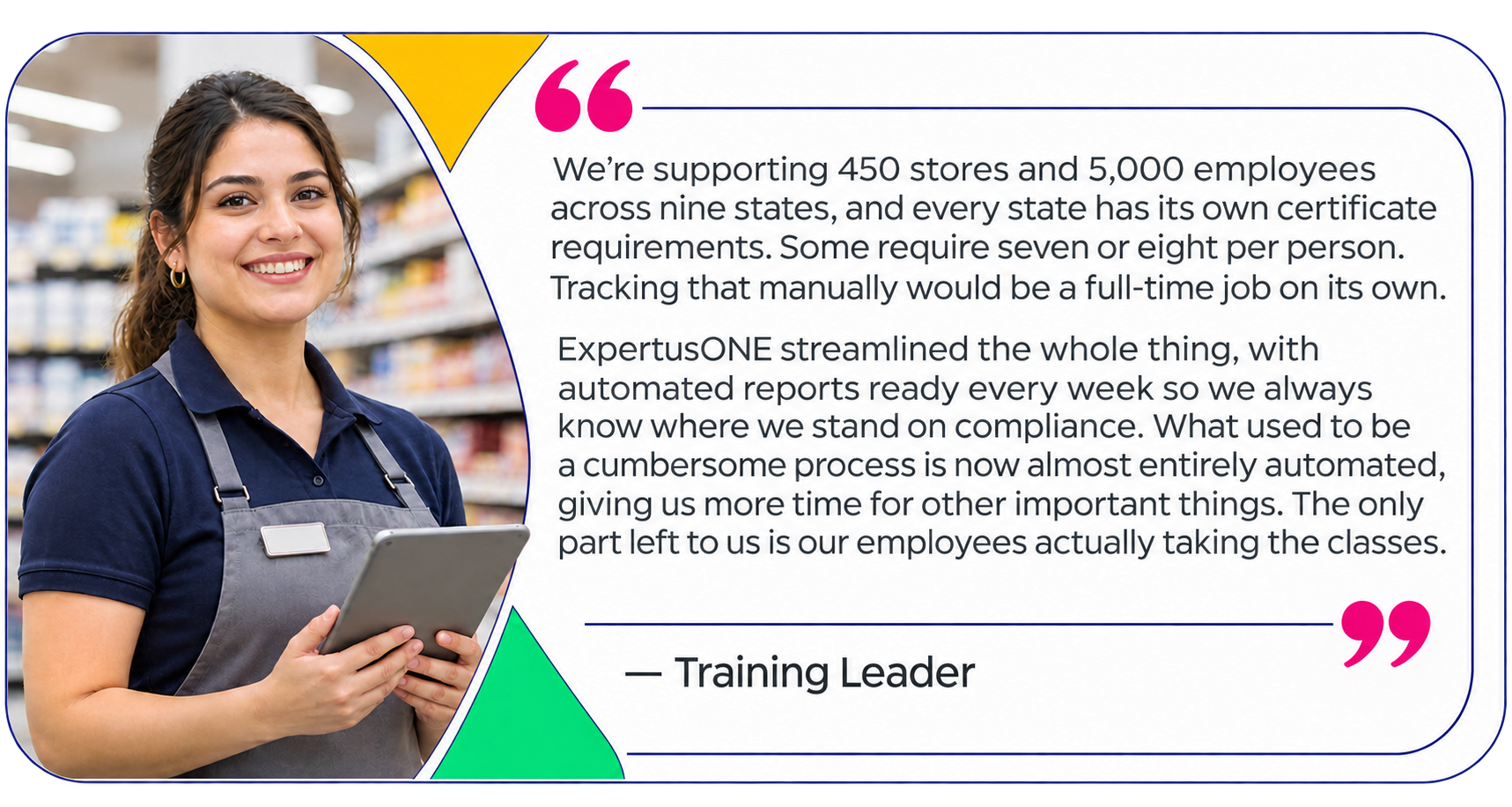
That’s 54 different rule sets in play at the same time. Most employees need six or seven certifications, depending on where they work.
And the web keeps moving: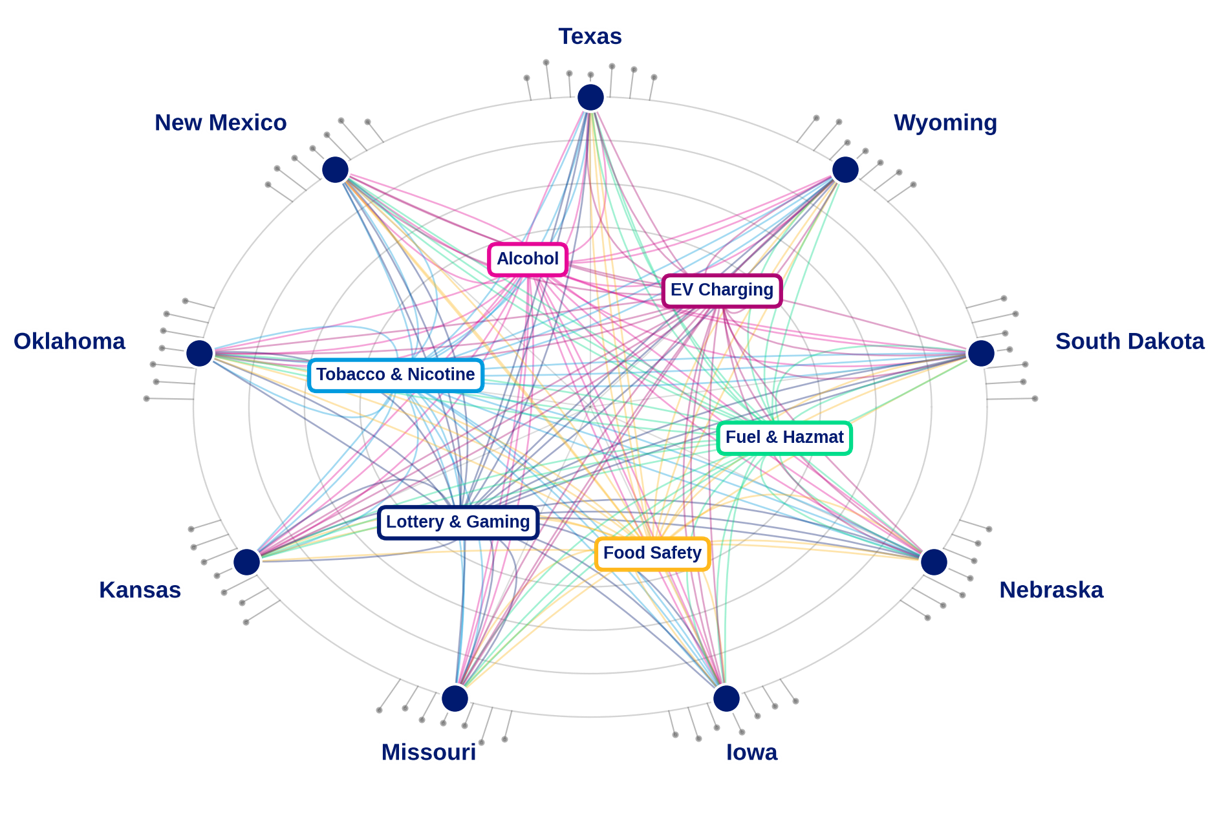
- The rules differ. Some states require five or six certifications. Others require seven or eight.
- The rules change. When a state revises a test, everyone enrolled has to move to the new version.
- The people change. About 45 people join every day: 35 new hires and 10 rehires. Others get promoted, switch stores or change roles. Employees under 18 need different training.
- The proof lives somewhere else. Many state courses run on outside vendor websites. The certificate sits there, not in the company’s learning system.
- The clocks don’t match. Some certifications last 90 days. Others last one, two, three, or five years. Some states issue a temporary permit first, then a permanent one.
- Leaders want proof every week. 55 regional, district, and HR leaders expect a compliance report every Monday.
Every thread has to be verified before an employee can work a single shift.
- Compliance Web graphic, EV Charging. Swap the six categories to the ones the customer named: alcohol, tobacco, e-cigarettes, fuel, propane, and food safety. That removes EV Charging and Lottery & Gaming but keeps the “6” and “54” accurate. If you’d rather just delete EV Charging, change 6 to 5 and 54 to 45.
- Compliance Web graphic, blind edits. Remove the Yesway logo. Replace the nine state names with unlabeled markers. Named states plus 450 stores would let readers identify the company.
The training takes an hour. The tracking never ends.
Here’s the surprising part. The hard part was never the training. It was everything that happened after it.
Take a single state work permit. Under the old process, each one took six manual steps:
- The employee completes the state’s course on an outside vendor’s website.
- The employee downloads the certificate.
- The employee uploads it to the learning system.
- The employee tells their manager it’s there.
- The manager reviews it and gives credit.
- The completion gets logged for reports and audits.
Six steps don’t sound like much. Now do the math. Forty-five new people a day, six steps each, is 270 manual steps a day. And that’s for just one permit per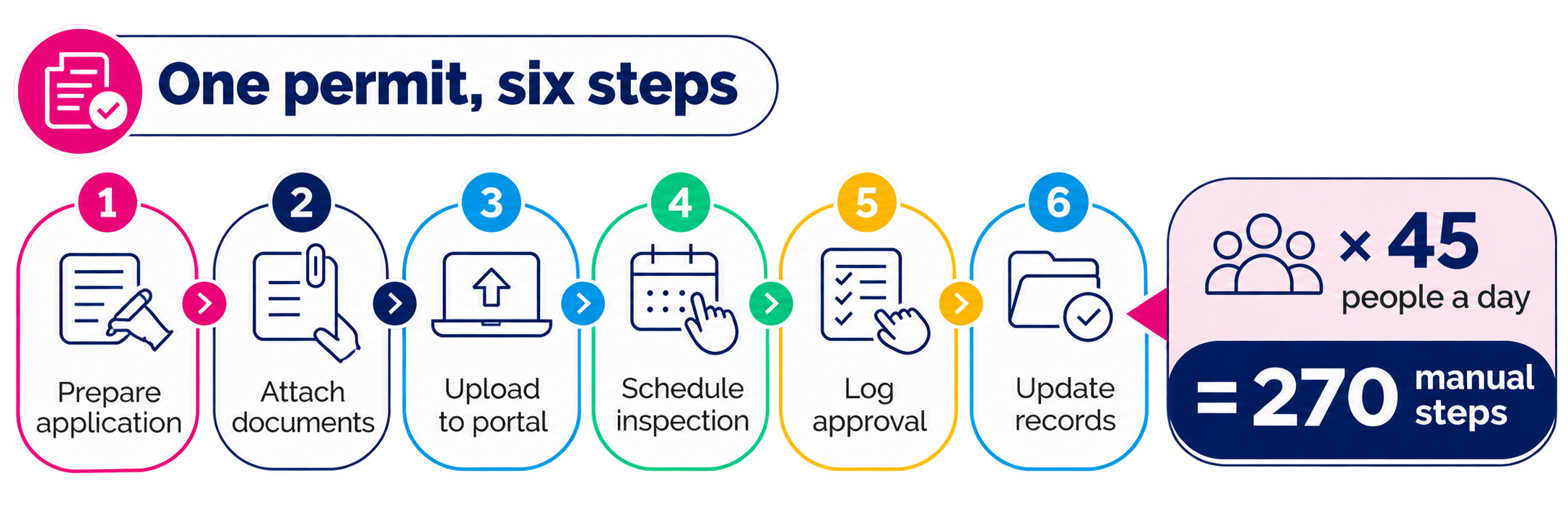 person. Most people need six or seven.
Every step is a place where something can slip. A certificate never gets uploaded. A manager misses an email. A renewal date quietly passes. When that happens, someone ends up working without a valid permit. That’s how companies end up facing fines, disrupted operations, and hard conversations with regulators.
The company’s training leader spent almost all of her time just keeping track. Not building courses. Not improving onboarding. Tracking.
“Tracking all this manually is a full-time job on its own.”
– Training leader
The company didn’t have a training problem. It had a tracking problem.
Part 2: Untangling the web
The company looked at 13 learning platforms before choosing ExpertusONE.
The idea behind the new system was this: let people do only what they have to do. Employees take the training and pass the test. Managers give a quick approval. ExpertusONE handles everything else.
It came together in six moves. Each one holds a lesson for any company with a complex compliance program.
1. Let the HR system do the enrolling
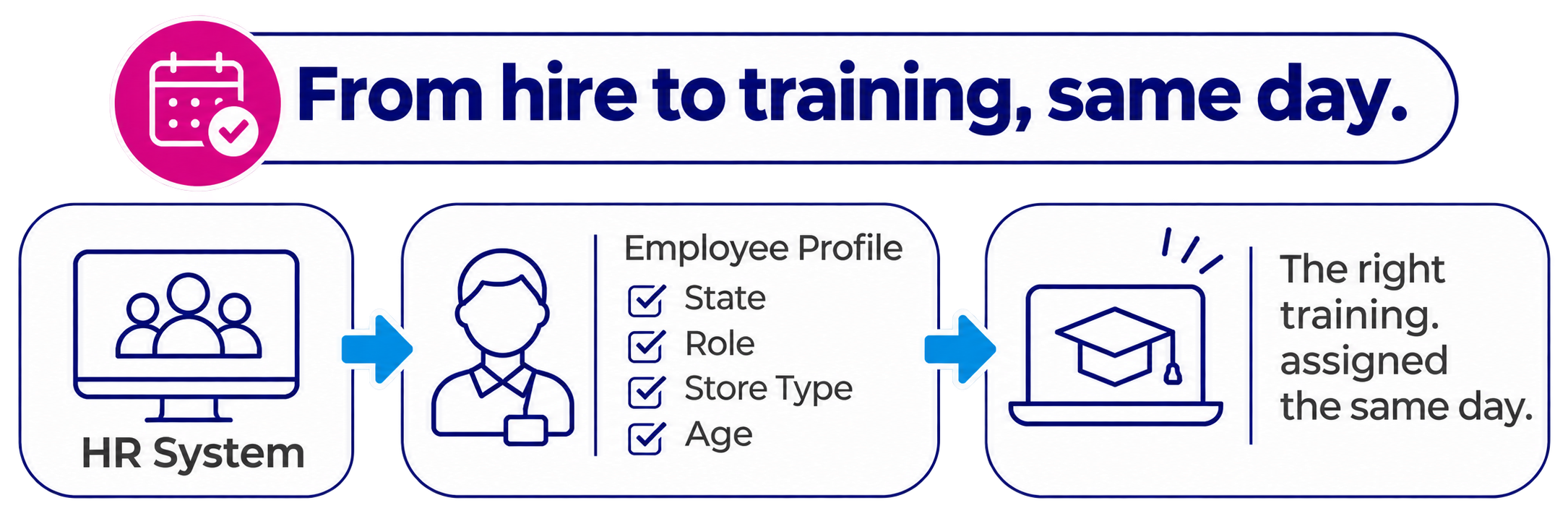
ExpertusONE connects to the company’s HR system (UKG) and syncs every day. New hires, rehires, promotions, and store transfers flow in on their own. Details like state, role, store type, and age decide which training each person gets. New hires and rehires get their training the same day they start. Rehires get credit for valid certifications they already hold.
The lesson: The best person to enroll someone in compliance training is no one at all.
2. Write each rule once
The company’s rules now live inside the system, not in anyone’s head. Training is assigned by state, role, and store type. When an employee finishes a temporary permit, the permanent permit training is assigned automatically. Employees under 18 get the extra training their states require. When a state revises a course, the new version takes over, and every enrolled employee moves to it.
The lesson: If a rule has to be remembered, eventually it will be forgotten.
3. Bring outside certificates in automatically
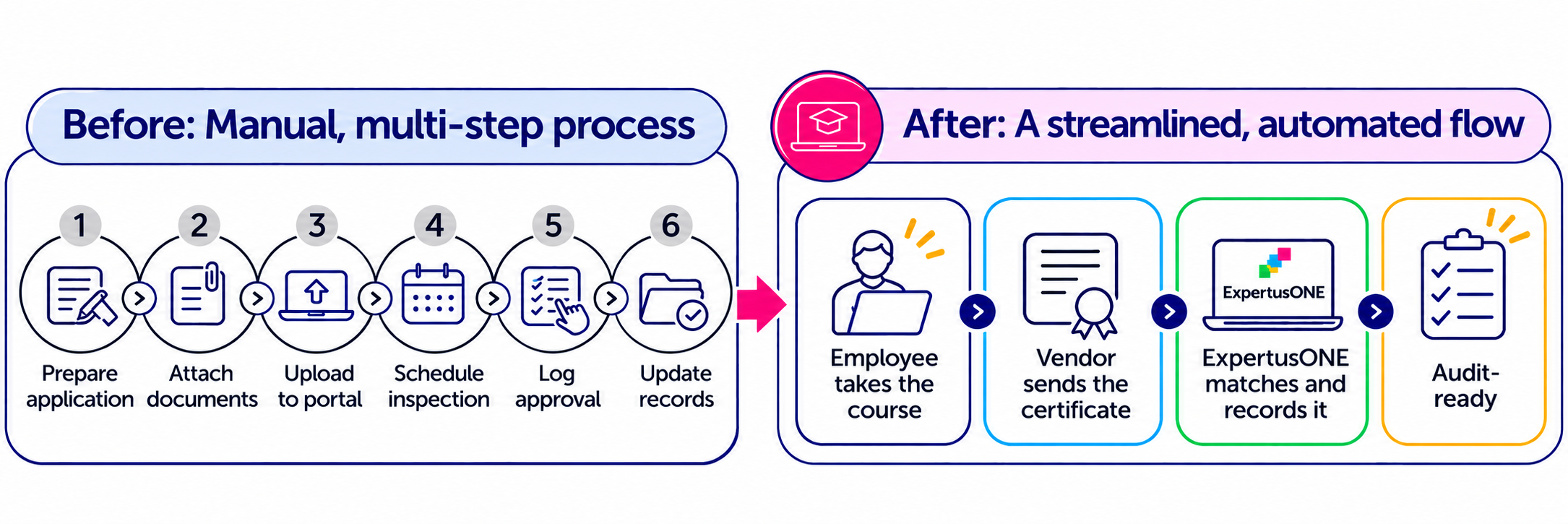
This was the most tangled thread in the web.
Many state courses run on outside vendor websites. Now those vendors send certificates straight to ExpertusONE. The system finds the right employee, matches the certificate to the right course, and records the completion. The employee never downloads, uploads, or emails anything. Their only job is to take the course.
It works even when a vendor doesn’t offer a modern software connection (an API). ExpertusONE can pick up files through secure file transfer, shared folders, and scheduled data feeds, so it isn’t limited to the vendors that offer one.
The lesson: Treat a certificate as data, not as an attachment someone has to chase.
 4. Renew before anything expires
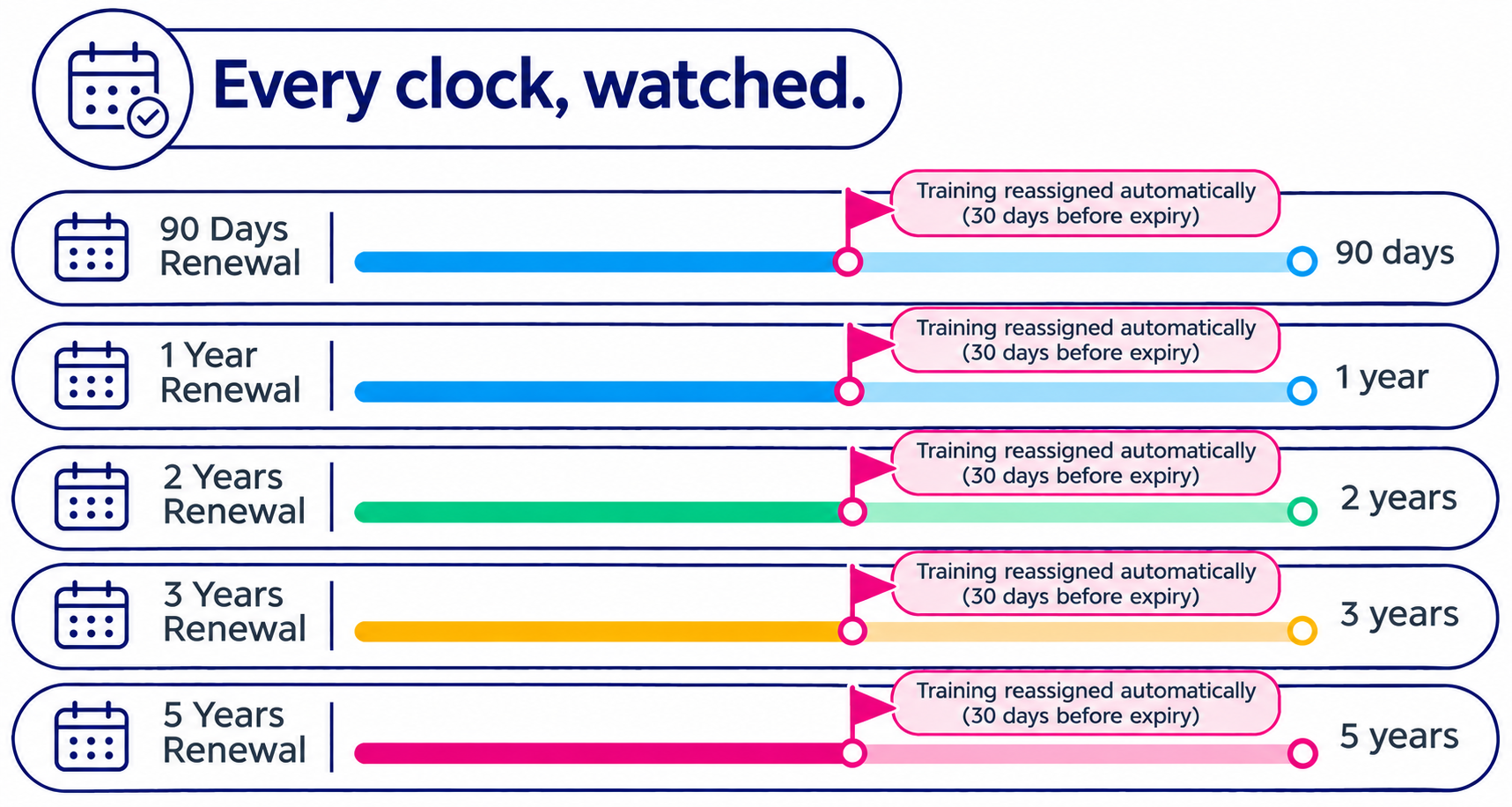
Every certification has its own expiration date. ExpertusONE watches all of them. It reassigns training 30 days before a certification expires and sends reminders until it’s done.
The lesson: Renewals should start before anyone has to remember them.
5. Make the proof automatic
Every Monday morning, compliance reports with charts land in the inboxes of 55 regional, district, and HR leaders. Nobody builds them. And when an inspector walks in, the certification records are already in place.
The lesson: If leaders have to ask for a compliance report, you’re already behind.
6. Keep it to a few clicks for managers
Store managers are busy. They don’t have time to sit at the computer in the back. In ExpertusONE, nothing they do takes more than two or three clicks. Approving a certificate is quick and easy. They can check their team’s progress in one place, the Collaboration Hub, from a computer, tablet, or phone.
“To me, that’s a big deal because it’s simple. You’re not going to get lost in the process of it.”
– Training leader
The lesson: The less a manager has to learn, the more likely the work gets done.
A partner through every change
No compliance program stands still. States revise their rules. Vendors change how they send files. The company keeps opening new stores. Through every change, the ExpertusONE team has worked side by side with the company’s training team to keep the system in step.
“They’ve worked through it with me, which I really appreciate. They’ve stuck by my side through all of it.”
– Training leader
Part 3: Getting the time back
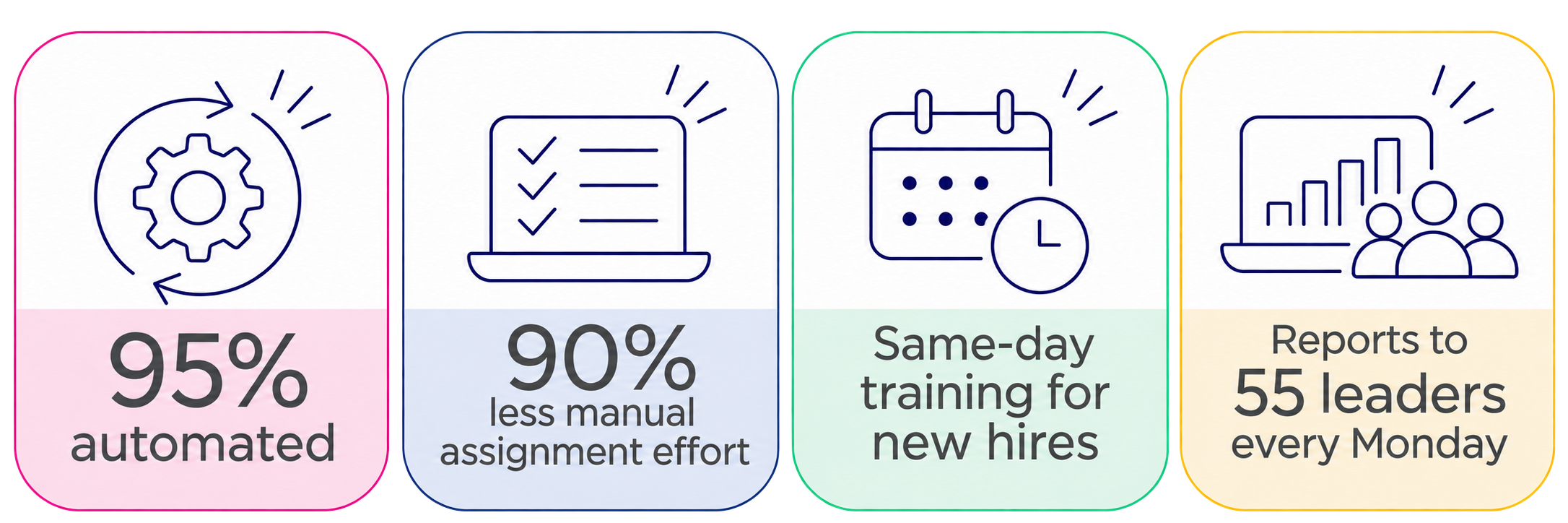
Today, 95% of the company’s compliance process runs on its own. What’s left for people is taking the training and a quick manager approval.
- 95% of the compliance process is automated.
- 90% less manual effort assigning training.
- Same-day training for the roughly 45 people who join every day.
- No more chasing certificates. Certificates from outside vendors flow in without employees downloading or uploading anything.
- Weekly compliance reports reach 55 leaders without anyone building them.
- Ready for inspection. Records are in place whenever an inspector walks in.
What happens when the tracking disappears
The most important result doesn’t fit on a stat tile.
Before, keeping track of compliance took up almost all of one person’s time. Now that time goes to the work that makes a training program better: creating new content and building stronger programs for 5,000 employees.
There’s a lesson here for any company with a complex compliance program. We tend to judge compliance by whether people are trained. But training is only a part. The hard part is proving it, every day, for every person, under every rule. Solve that, and you get back the time to do the work that matters.
Has your compliance web outgrown manual tracking?
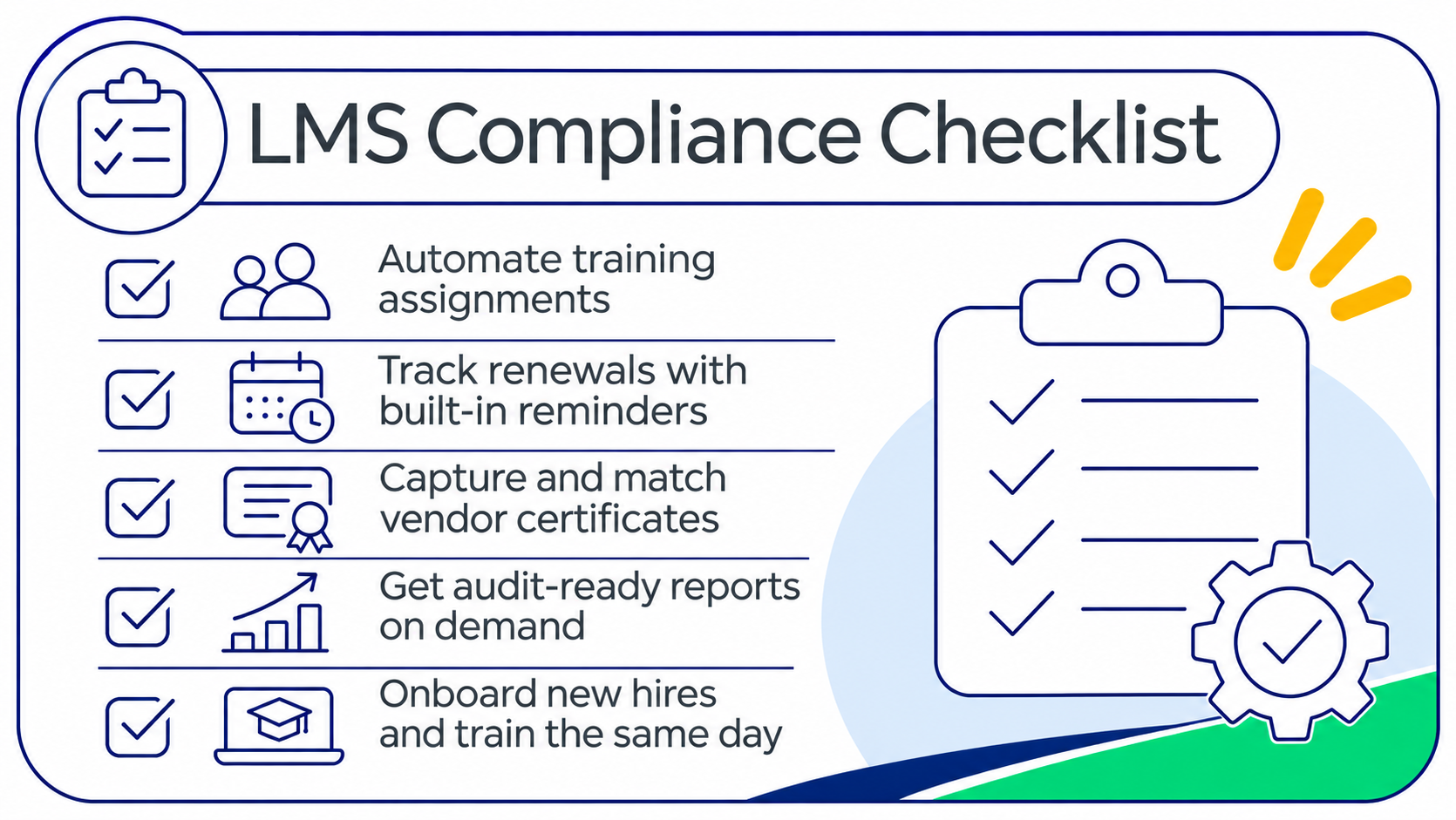
If two or more of these sound familiar, your team is probably spending more time tracking compliance than improving it.


